
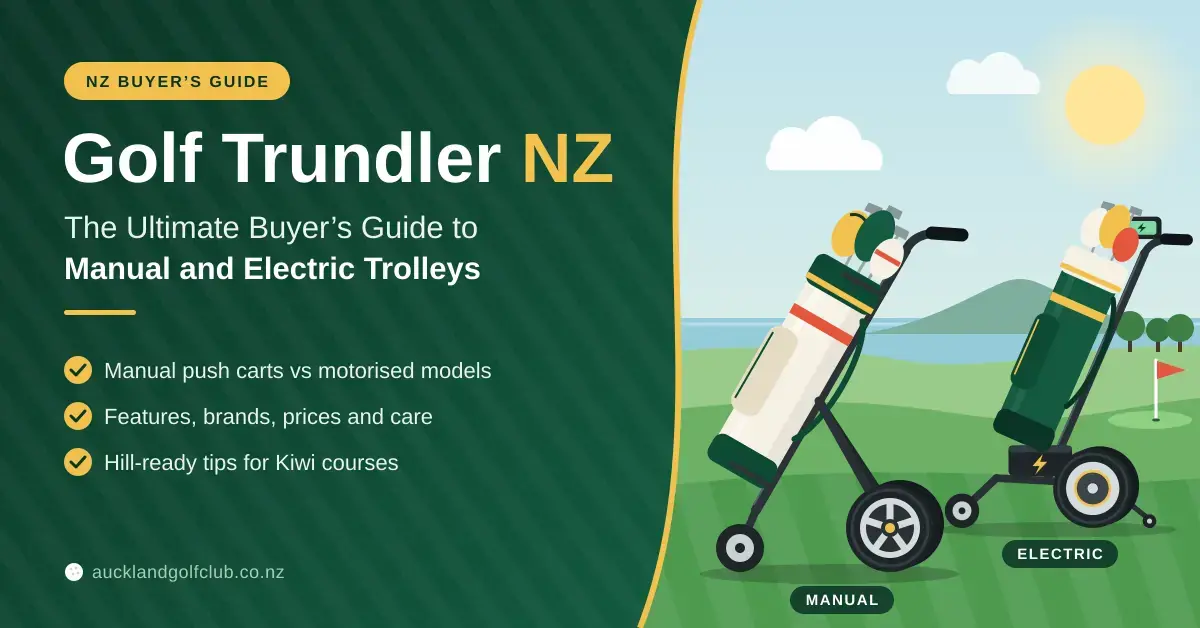
A golf trundler is the wheeled trolley you push, pull or drive alongside you to carry your clubs while you walk the course, and choosing the right one is one of the most practical upgrades a walking golfer can make. In New Zealand the word “trundler” simply means what other countries call a golf trolley or push cart. This guide explains the main types — manual push carts and electric (motorised) models — and walks through the features, brands, prices and maintenance that matter, so you can match a trolley to your budget, your fitness and the terrain of your home course.
Many Auckland and wider New Zealand courses are built on rolling or hilly ground, so features such as stable frames, all-terrain wheels and, on electric models, downhill speed control genuinely change how a round feels on the legs. Below, each question a buyer typically asks is answered under its own heading.
Key Points
- Two main types: lightweight manual push carts and motor-driven electric trundlers (including hands-free remote-control models).
- Power: electric models use cable-free 28V lithium batteries with rapid charging and enough capacity for 18–36 holes.
- Hilly courses: look for Downhill Control (DHC) or electronic braking plus an electronic parking brake.
- Storage: inverting wheels and one-step folding shrink the packed size to fit a car boot.
- NZ pricing: manual carts about $300–$650; electric models about $1,300–$4,300 depending on features.
What is a golf trundler and how does it work?
A golf trundler is a lightweight frame on wheels that carries your golf bag so you do not have to shoulder it for 18 holes. Manual models are moved by human effort — you push a three- or four-wheel cart in front of you using a height-adjustable handle. Electric models add a battery and motor that propel the trolley, so you either steer it by hand at walking pace or, on remote-control units, let it travel unaided while you walk separately.
The appeal is simple: carrying a loaded stand bag can mean lifting 8–12 kg on your back for several hours, which tires the shoulders, lower back and legs and can affect swing consistency late in a round. A trundler transfers that load to the wheels. It is a different product from the ride-on golf carts some clubs hire out — a trundler is for walkers who still want the exercise without the strain of carrying.
Manual push versus electric: which trundler style suits you?
The first decision is the propulsion method, and it comes down to fitness, how often you play and budget. Manual push carts are lighter, cheaper and need no charging; electric trundlers remove almost all the effort but cost more and add weight to lift into the car. There is no single “best” answer — the table below compares the three common formats on the factors that decide most purchases.
| Attribute | 3-wheel manual push | Standard electric | Remote-control electric |
|---|---|---|---|
| Effort required | Moderate — you push it yourself | Low — the motor carries the load; you steer the handle | Minimal — hands-free steering by wireless remote |
| Frame weight (no bag) | Roughly 6.5–9.5 kg | Roughly 9–12 kg | Roughly 11–15 kg with anti-tip bar |
| Power | Purely mechanical (sealed bearings) | Lithium battery and a single motor | Lithium battery with twin motors and tracking sensors |
| Best terrain | Flat to gently rolling parkland | All terrain, especially with downhill control | Hilly, undulating courses |
| Typical NZ price | $300–$650 | $1,300–$2,600 | $2,600–$4,300 |
What does an electric trundler change on a hilly round?
An electric trundler removes the physical work of moving your bag over four hours of walking. Pushing a heavy cart up repeated inclines loads the lower back, shoulders and hamstrings, and that accumulated fatigue is often felt over the closing holes. Because the motor does the pushing, you walk with a more upright posture and keep your effort steady, which many players find helps their concentration and rhythm on the back nine. If you already do cross-training that supports your golf, a trundler simply keeps the walking benefits while removing the carrying strain.
Popular golf trundler brands in New Zealand
Several international brands are well supported by New Zealand retailers, which matters for warranty cover and spare parts. When comparing models, look past colour and styling and focus on frame stability, folded size and the ease of the folding mechanism. The main brands stocked locally include Motocaddy, MGI, PowaKaddy, Clicgear, Big Max, Axglo and Sun Mountain.
- Motocaddy (M-Series and S-Series): British brand known for compact folding electric trolleys with 28V power, cable-free “Click ’n’ Connect” lithium batteries and, on GPS models, a touchscreen with pre-loaded course maps. Motocaddy, based in the United Kingdom, also popularised the EASILOCK bag connection.
- MGI (Zip and Ai Navigator): Australian brand strong in remote-control electric buggies, using a directional remote, Gyroscope Straight Tracker technology and downhill speed control, with twin-motor drive on all-terrain models.
- Clicgear (Model 4 and 3.5+): a benchmark for manual three-wheel push carts, built from aircraft-grade aluminium tubing with maintenance-free airless tyres and a compact fold.
- PowaKaddy (CT and DLX): compact-folding electric trolleys; the CT8 GPS pairs a colour touchscreen with an Electronic Braking System (EBS) that slows the trolley on descents.
- Big Max, Axglo and Sun Mountain: popular manual push-cart makers offering light, affordable three- and four-wheel frames with easy one- or two-step folding.
Trundler Comparison
| Model | Type | Standout feature | Approx. NZ price |
|---|---|---|---|
| Axglo Tri-360 | Manual 3-wheel | Light, quick fold, good value | From ~$349 |
| Big Max Blade Quattro | Manual 4-wheel | Very flat flat-fold for tight boots | ~$399–$519 |
| Clicgear Model 4 | Manual 3-wheel | Aircraft-grade aluminium, airless tyres | ~$500–$600 |
| Motocaddy M5 GPS DHC | Electric | 28V, Downhill Control, touchscreen GPS, EASILOCK | ~$3,099 |
| PowaKaddy CT8 GPS | Electric | Compact fold, colour touchscreen, Electronic Braking | ~$2,800–$3,300 |
| MGI Zip Navigator | Remote-control electric | Directional remote, gyroscope tracking, twin motors | ~$3,499–$3,899 |
Downhill Control and electronic braking: do you need them?
Downhill Control (DHC) is worth having on any course with real slopes, which describes a lot of New Zealand golf. A standard electric motor cannot slow itself on a descent, so on a steep hole a heavy trolley can run away and you end up hanging on to the handle. DHC uses sensors to regulate speed on downward slopes, applying gentle electronic braking so the trolley holds a steady walking pace on its own.
- Automatic speed regulation: whether you are climbing, on the flat or descending, a DHC trolley tries to hold the speed you selected rather than accelerating downhill.
- Electronic parking brake: DHC models add a digital parking brake that locks the drive wheels at the press of the dial, so you can step away to play a shot on a slope without the trolley rolling off.
- All-terrain tyres: these models usually run deeper-grooved rubber tyres that grip wet turf better than slick plastic wheels.
PowaKaddy calls its version an Electronic Braking System (EBS) and MGI uses downhill speed control; the principle is the same. If your home course is flat parkland, a basic electric or a good manual cart may serve you just as well and cost far less.
Key features to check before you buy
A trundler is functional sporting equipment that has to hold up under load for years, so a short checklist beats being swayed by screens and colour kits. Focus on the frame, the folding action and the components that wear.
- Aluminium frame: anodised aluminium tubing is rigid enough for heavy tour bags while staying light and corrosion-resistant — important in coastal, salt-air conditions.
- Cable-free battery connection: on electric models, slot-in or “Click ’n’ Connect” battery trays avoid external plugs and wires that collect dirt or snap during folding.
- Compact fold and inverting wheels: quick-release wheels that pop off or fold inward shrink the packed size so the trolley fits a small car boot alongside your bag.
- USB charging port: many electric models add a USB port under the handle to keep a phone, GPS watch or rangefinder charged during the round.
- Bag-locking system: Motocaddy’s EASILOCK and similar systems pin a matching cart bag to the base plate so it does not twist, removing the need for a lower strap.
- Folded dimensions and weight: check the actual folded size and lifting weight, especially for electric models you will hoist in and out of the car regularly.
Accessories for New Zealand’s changing seasons
Weatherproofing accessories make a trundler far more usable across a New Zealand year, where a dry summer round and a wet, windy winter round need different setups. Most modern frames take a range of add-ons.
- Umbrella holder: a clamp on the handle console anchors a large golf umbrella over the bag to keep clubs and hands dry — pair it with a sturdy golf umbrella built for wind.
- Drink and scorecard holders: insulated bottle holders and a waterproof console for scorecard, pencil, tees and markers keep essentials to hand.
- Anti-tip bar: on remote-control electric models, a rear wheel bar stops the buggy tipping backward when climbing steep hills.
- Winter “Hedgehog” wheels: studded sleeves that reduce turf contact and mud pick-up on soft winter fairways, and some clubs require them in the wettest months. Note the compatibility trap: Motocaddy’s Hedgehog winter wheels are not compatible with DHC models, and they cannot be used on a remote trolley while it is in Remote mode. Check your specific model before buying them.
For more items worth carrying, see the guide to essential golf accessories.
How much does a golf trundler cost in New Zealand?
Prices scale with mechanical complexity, frame material and electronics. As a current guide from New Zealand retailers: quality manual three- and four-wheel push carts run roughly $300 to $650 (for example an Axglo Tri-360 around $349, a Big Max Blade Quattro around $399–$519, a Clicgear around $500–$600). Entry-level electric models start near $1,300, mid-range GPS electric models such as the Motocaddy M5 GPS DHC sit around $3,000, and flagship remote-control units like the MGI Zip Navigator and Ai Navigator range up to about $3,500–$4,300. Prices change with model years and sales, so treat these as bands rather than fixed figures, and shopping seasonal clearances can lower them. If you are buying other gear at the same time, an Auckland stockist such as the Golf Warehouse in Ellerslie lets you compare frames in person.
Looking after your trundler
A short, regular maintenance routine noticeably extends the life of the frame, bearings and — on electric models — the battery. Trundlers are exposed to grass, sand, mud and course fertilisers that grind into moving parts if left uncleaned. The table below covers the essentials.
| Task | How often | What to do | Why it helps |
|---|---|---|---|
| Wipe frame and wheel hubs | After any damp or muddy round | Use a soft cloth and warm water; avoid high-pressure hosing | Stops grit and fertiliser grinding into the bearings |
| Check wheel alignment | Every few months, or if it drifts | Adjust the tracking dial near the front wheel fork | Keeps it rolling straight and, on electric models, saves battery |
| Manage the lithium battery | After each round | Recharge promptly; do not store it fully flat | Protects cell health and maximises lifespan |
| Lubricate hinges | A couple of times a season | A light dry silicone spray on folding points | Stops squeaks and keeps the fold smooth |
Common mistakes when buying a golf trundler
Most buyer regret comes from a handful of avoidable errors rather than picking the “wrong” brand.
- Ignoring your course terrain: buying a basic electric model for a hilly course, then wishing you had downhill control and better tyres.
- Overlooking folded size and lift weight: a trolley that will not fit your boot, or is too heavy to lift comfortably, gets left at home.
- Assuming any bag fits perfectly: a bag that does not match the frame can twist; check strap points or a bag-lock system.
- Buying winter wheels that do not fit your model: as noted, Hedgehog wheels are incompatible with several DHC and remote setups.
- Skipping battery care: leaving a lithium battery flat for long periods shortens its life and is a common reason electric trolleys underperform after a season or two.
- Paying for features you will not use: touchscreen GPS and remote control are excellent, but a walker on flat parkland may be just as happy with a good manual cart.
Sources
- Golf Warehouse NZ — Motocaddy M5 GPS DHC ’26 (28V Lithium Ultra)
- Motocaddy NZ — M5 GPS DHC electric trolley
- Motocaddy NZ — Hedgehog Winter Wheels (compatibility notes)
- MGI Golf — Zip Navigator electric trundler
- Golf HQ NZ — Clicgear Model 4 push cart
- Golf Warehouse NZ — PowaKaddy CT8 GPS EBS
- Today’s Golfer — PowaKaddy trolley range
Frequently Asked Questions (FAQ)
What is a golf trundler?
A golf trundler is a wheeled trolley that carries your golf bag while you walk the course, so you are not lifting the weight on your back for 18 holes. “Trundler” is the common New Zealand and Australian term for what is elsewhere called a golf trolley or push cart. They come in manual push versions and electric, motor-driven versions.
Should I choose a manual or an electric trundler?
Choose a manual push cart if you want the lightest, cheapest option, you play on flat to gently rolling ground and you do not mind pushing. Choose an electric trundler if you play often, want to save energy for your swing, or your course is hilly — the motor carries the load and, with downhill control, manages descents for you. Electric models cost more and are heavier to lift into the car.
Do I need Downhill Control on New Zealand courses?
Downhill Control (DHC) is worth it if your course has real slopes, which many New Zealand courses do. It uses sensors to hold a steady speed on descents and adds an electronic parking brake so the trolley will not roll away on a hill. On flat parkland it is less essential, and a manual cart or a basic electric model can be a better-value choice.
How much does a golf trundler cost in NZ?
Quality manual push carts generally run about $300 to $650. Entry-level electric trundlers start near $1,300, mid-range GPS electric models sit around $3,000, and flagship remote-control buggies reach roughly $3,500 to $4,300. Prices vary by model year and seasonal sales, so treat these as guide ranges.
Can I use any golf bag on an electric trundler, and what about winter wheels?
Most standard bags fit an electric trundler using the supplied straps, but a matching cart bag — ideally one that clips into a bag-lock system such as Motocaddy’s EASILOCK — sits most securely. For soft winter turf, studded “Hedgehog” wheels reduce mud pick-up, but check compatibility first: Motocaddy’s Hedgehog wheels do not fit DHC models and cannot be used on remote trolleys in Remote mode.