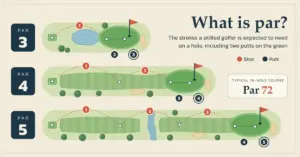
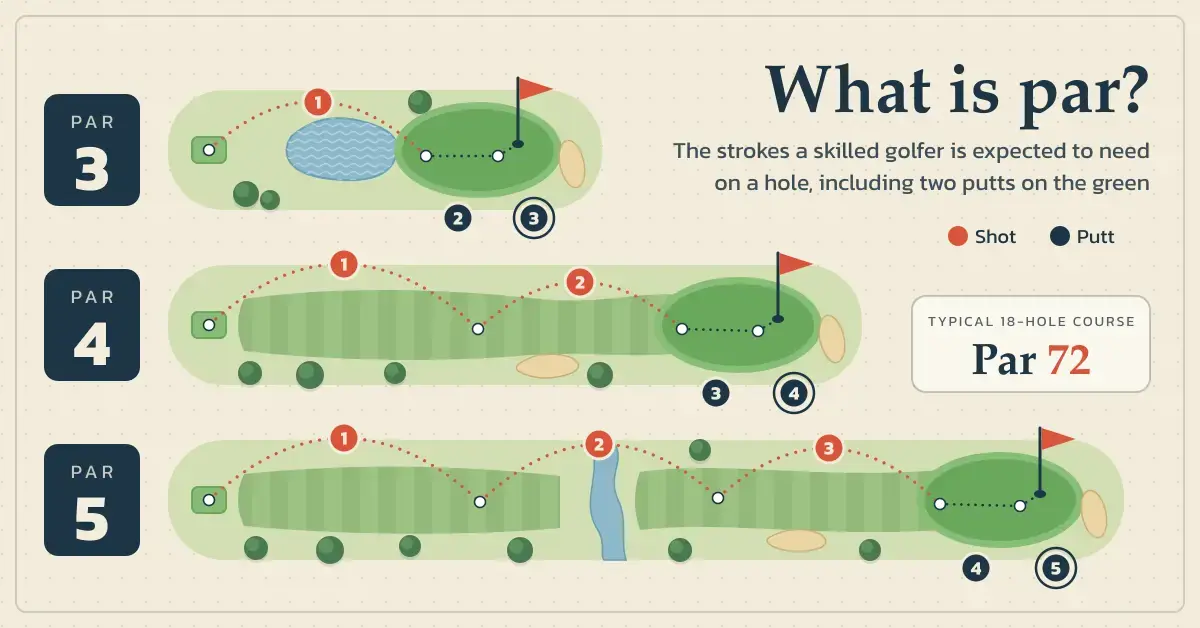
Par is the number of strokes a skilled golfer is expected to need to complete a hole, or a full round, under normal conditions. It is golf’s baseline score: every hole on a course is given a par, and your result is measured by how many strokes you take above or below it. On a par 4, for example, par is a score of four. Take three and you are one under; take five and you are one over. Understanding par is the first step to reading a scorecard, keeping score and following coverage of professional events.
Key Points
- Par is the number of strokes a skilled (scratch) golfer is expected to need on a hole, including two putts on the green.
- Par 3, 4 and 5 are set mainly by hole length, using the USGA’s yardage guidelines (which differ for men and women).
- A full 18-hole course is usually between par 69 and 73, most often par 72.
- Your score is measured against par: a birdie is 1 under, a bogey is 1 over, and level par means matching it exactly.
- Par is a benchmark for expert play, not the average golfer’s score, and a higher par does not mean a harder course.
What does “par” actually mean in golf?
Par is the score that an expert, or “scratch”, golfer is expected to make on a hole under ordinary conditions. A scratch golfer is a player good enough to have a handicap of zero – in other words, someone who, on average, plays to the standard par represents. A “stroke” is simply one swing at the ball that you intend to hit it; every stroke counts towards your score.
The key detail that trips up many beginners is that par always assumes two putts once the ball reaches the putting green (the closely mown area around the hole). So par is built from two parts: the strokes needed to reach the green, plus two putts to hole out. On a par 4, that is two shots to reach the green and two putts. On a par 3, one shot to the green and two putts. This two-putt allowance is why par is a fair, consistent benchmark rather than a perfect score.
The term dates back to 1911, when the United States Golf Association (USGA) formally adopted par as a scoring standard. It has been the reference point for measuring performance ever since, from a Saturday club round to the final group at a major. If you are completely new to the game, it helps to read par alongside a broader beginner’s overview of how to play golf, because par only makes full sense once you know how a hole is played from tee to green.
What do par 3, par 4 and par 5 mean?
Par 3, par 4 and par 5 tell you how many strokes a hole is expected to take. The number is the hole’s par, and in practice it also signals roughly how long the hole is and how many shots you should need to reach the green.
- Par 3: A short hole. A skilled player is expected to reach the green with their first shot from the tee, then take two putts – three strokes in total. These are the holes where a hole-in-one is realistically possible.
- Par 4: A medium-length hole. The expectation is a tee shot and a second shot (an approach) to reach the green, followed by two putts – four strokes in total. Most holes on a typical course are par 4s.
- Par 5: A long hole. A skilled player is expected to need three shots to reach the green and two putts to finish – five strokes in total. Longer hitters sometimes reach a par 5 in two, setting up a chance to score well under par.
Reaching the green within the expected number of shots – one on a par 3, two on a par 4, three on a par 5 – is called hitting the “green in regulation”. A player who reaches the green in regulation and then takes their two putts has made par.
How is a hole’s par decided?
A hole’s par is decided mainly by its length, measured from the tee to the hole. The USGA publishes yardage guidelines that course designers and rating teams use to assign par, and the ranges differ for men and women because expected hitting distances differ. The figures below are the long-standing USGA guideline ranges, with approximate metric equivalents for New Zealand readers (one yard is about 0.91 metres).
- Par 3: up to about 250 yards (around 230 m) for men; up to about 210 yards (around 190 m) for women.
- Par 4: roughly 251–470 yards (around 230–430 m) for men; roughly 211–400 yards (around 195–365 m) for women.
- Par 5: roughly 471–690 yards (around 430–630 m) for men; roughly 401–575 yards (around 365–525 m) for women.
- Par 6: about 691 yards and above (around 630 m-plus) for men; about 576 yards and above (around 525 m-plus) for women.
Length is the starting point, not the whole story. Par is based on the hole’s “effective playing length” rather than its raw measured distance. A hole that plays steeply downhill or downwind effectively plays shorter, so a measured 500-yard hole might be treated as a par 4 rather than a par 5. Elevation, prevailing wind and forced lay-ups can all nudge the figure.
These are guidelines, not rigid rules, and there are exceptions – particularly at major and near-major championships, where officials sometimes set a hole longer than the guideline for its par because they judge that distance alone does not capture its difficulty and strategy. That is how a demanding hole of around 300 yards can be played as a par 3 at an elite event.
What is par for a full 18-hole round?
The total par for a course is the sum of the par for all 18 holes. On most full-size courses it will usually be between 69 and 73, with par 72 the most common.
An 18-hole course is split into two halves: the front nine (holes 1–9) and the back nine (holes 10–18). If you only have time for nine holes, your target score is simply the par printed on the scorecard for whichever nine you play, which is not necessarily half of the 18-hole total.
Par is listed hole by hole on the scorecard, along with each hole’s length and its stroke index (a difficulty ranking used for handicapping). Courses around the country vary, so it is always worth checking the card before you tee off – our guide to golf courses around Auckland is a good starting point if you are choosing where to play.
How does scoring work relative to par?
Your score on each hole is described by how it compares with par, and golf uses a set of named terms for the common outcomes. Scoring the exact par figure is called “level par” (or “even par” in North America). Anything fewer is “under par”; anything more is “over par”. Over a full round, scores are often written as a plus or minus relative to total par, such as +3 or −2.
Golf Scoring Terms Compared
| Term | Strokes vs par | Example on a par 4 |
|---|---|---|
| Albatross (double eagle) | 3 under (−3) | 1 (hole-in-one) |
| Eagle | 2 under (−2) | 2 |
| Birdie | 1 under (−1) | 3 |
| Par | Level (E) | 4 |
| Bogey | 1 over (+1) | 5 |
| Double bogey | 2 over (+2) | 6 |
| Triple bogey | 3 over (+3) | 7 |
Scores under par
Scoring fewer strokes than par is the goal, and the better the result, the rarer it is.
- A birdie is one stroke under par – for example, a 3 on a par 4.
- An eagle is two strokes under par, most often made by reaching a par 5 in two shots and holing a putt for a 3.
- An albatross (also called a double eagle) is three strokes under par, such as a 2 on a par 5. It is rarer than a hole-in-one.
- A condor is four strokes under par – a hole-in-one on a par 5. It is astonishingly rare, recorded only a handful of times.
A hole-in-one, or “ace”, means holing your tee shot in a single stroke. On a par 3 that is an eagle; on the rare occasions it happens on a par 4 it is an albatross.
Scores over par
Taking more strokes than par is far more common, especially for everyday golfers, and the terms simply count how many over you went.
- A bogey is one stroke over par – a 5 on a par 4.
- A double bogey is two strokes over par – a 6 on a par 4.
- A triple bogey is three strokes over par – a 7 on a par 4.
- A quadruple bogey is four over – an 8 on a par 4, sometimes nicknamed a “snowman” after the shape of the numeral.
What is the difference between gross par and net par?
Gross par is the standard par described so far: it ignores your ability and treats every player the same. Net par takes your handicap into account. A handicap is a number that reflects your playing standard and lets golfers of different abilities compete fairly by adjusting their scores.
Under the World Handicap System used in New Zealand, you receive a set number of handicap strokes spread across the holes according to their stroke index. On a hole where you get a stroke, your “net” score is your actual (gross) score minus that one shot, so a gross 5 becomes a net 4. Net par is simply the par of the hole adjusted for the handicap strokes you are allowed there. If you are new to the idea, our explainer on how a golf handicap works sets out how the strokes are calculated and applied.
Net scoring is the basis of Stableford, a popular format that awards points per hole instead of counting total strokes: broadly, a net par scores two points, a net birdie three, a net bogey one, and a double bogey or worse zero. A total of around 36 points represents a solid round for a player at their handicap. Because a blow-out hole simply scores zero rather than wrecking the card, Stableford is friendly to beginners and keeps casual rounds moving.
Does a higher par mean a harder course?
No – a higher par does not automatically mean a harder course, and this is one of the most common misunderstandings about par. Par measures expected length and shot count, not difficulty. A par-72 course with wide fairways, few hazards and large greens can be far easier to score on than a tight, well-defended par-70.
Difficulty is captured by two separate numbers that sit alongside par on most rated courses: the Course Rating and the Slope Rating. Course Rating estimates the score a scratch golfer would be expected to shoot, and can be above or below the stated par; Slope Rating reflects how much harder the course plays for a higher-handicap golfer than for a scratch player. So when you compare two courses, par tells you the target, but the ratings tell you how tough reaching it really is.
Do par 6 and par 7 holes exist?
Yes, par 6 holes exist, though they are rare and never a standard part of a normal 18-hole layout. Under the length guidelines, a hole long enough for men to need five shots plus two putts – roughly 691 yards (around 630 m) and up – can be rated a par 6. You will occasionally come across one on courses around the world, usually as a novelty or because the terrain allows an unusually long hole.
Par 7 holes are rarer still and are not recognised in the USGA’s standard guidelines. The vast majority of golf you will ever play – recreational or professional – is made up of par 3s, par 4s and par 5s, so par 6s and 7s are curiosities rather than something you need to plan for.
Common mistakes and misconceptions about par
Two points about par are worth clearing up, because they are easy to get wrong even once the basics have clicked.
- Par can differ from tee to tee. The men’s and women’s yardage guidelines differ, and the same hole can be set to a different par from different tees – so always read the par printed on the card for the tees you are playing.
- Aim at your net par, not gross par. Your realistic target depends on your handicap. Using net par or a Stableford target, rather than the hole’s gross par, keeps your expectations sensible and the round enjoyable.
Sources
- The Golf News Net – Minimum and maximum yardage for par 3, par 4, par 5 and par 6 holes
- Golfbit – Golf Scoring Terms (Par, Bogey, Birdie, Eagle, Albatross and more)
- Kentucky Golf Association – Course Rating and Slope Rating explained
- Golf 360 (NZ) – How to Work Out Stableford Points in Golf
- Golf 360 (NZ) – Golf Handicaps in New Zealand: A Simple Guide
- Golf Compendium – What Is the Golf Score Called a Dolly Parton?
Frequently Asked Questions
What does it mean to “make par” on a hole?
It means you completed the hole in exactly the number of strokes set as its par – for example, a score of 4 on a par 4. You are neither under nor over par on that hole; you are level par.
Is par always 72 for a golf course?
No. Par 72 is the most common total for a full 18-hole course, but many courses are par 70, 71 or 73, and shorter or executive courses can be lower. Always check the scorecard for the course you are playing.
What is par for 9 holes?
Use the figure printed on the scorecard for whichever nine you play – a nine-hole round is not simply half of the 18-hole total. See the 18-hole section above for how the two nines are split.
Why are most holes on a golf course par 4s?
Par 4s cover the broad middle band of hole lengths, between the short par 3s and the long par 5s, so on a typical layout more holes fall naturally into that range than into either extreme. That is why a round is dominated by two-shot holes.
What is a “Dolly Parton” in golf?
It is light-hearted slang. Most often it refers to a score of 8 on a hole – a reference to the figure-eight shape – making it another name for the “snowman”. It is also used for a putt that circles the rim of the cup before dropping in. Neither is an official scoring term.