A slice is the shot that ruins more rounds than any other: the ball starts roughly on line, then curves hard to the right for a right-handed golfer (to the left for a left-hander) and finishes in the trees, the rough or out of bounds. The good news is that a slice is not bad luck or a lack of talent — it is a predictable piece of physics, and once you know what causes it you can fix it with a few grip and swing changes. This guide explains exactly why the ball curves, how to diagnose your own slice, and the step-by-step fixes and drills that straighten it out.
What is a slice in golf?
A slice is a shot that curves sharply away from a right-handed player, finishing well right of the target. It is the opposite of a hook (which curves left) and more severe than a fade, which drifts gently right on purpose. The curve itself is caused by sidespin: the ball is spinning in a way that makes the air push it sideways as it flies.
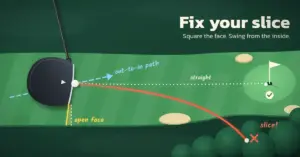
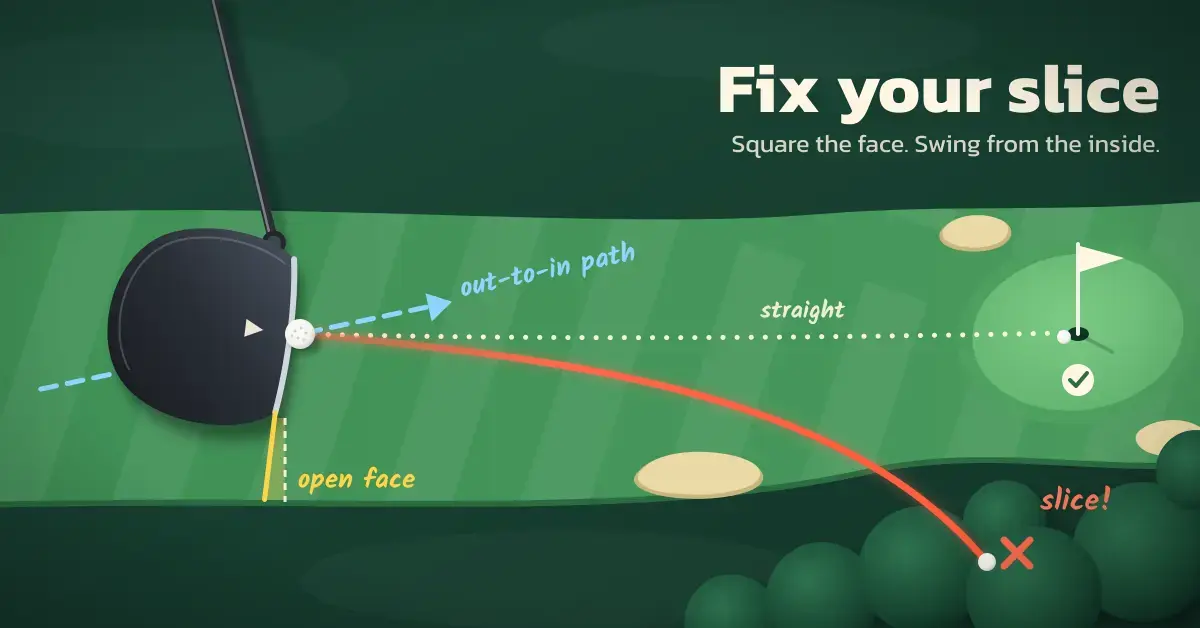
Two things at impact decide where the ball goes. The direction the clubface points decides where the ball starts, and the difference between the face and the swing path decides how much it curves. Modern launch-monitor data suggests the clubface is responsible for the large majority of the start direction — figures of around 75 to 85 percent are commonly quoted — while the gap between where the face points and where the club is travelling controls the curve. In plain terms: a slice happens when the clubface is open relative to the path the club is swinging on as it strikes the ball.
What causes a slice?
A slice is almost always a combination of an open clubface and an out-to-in swing path. Diagnosing which of these is your bigger problem is the first step, because the fix is different for each. Here are the four root causes, from most to least common.
An open clubface at impact
An open face is the single biggest cause of a slice. If the face is pointing right of your swing path when it meets the ball, you get clockwise sidespin and the ball curves right. Most amateurs open the face without realising it, usually because of their grip or because the hands and wrists do not release through impact.
An out-to-in (“over-the-top”) swing path
An out-to-in path means the club approaches the ball from outside the target line and cuts across it to the inside through impact. This is often called coming “over the top”, and it usually starts when the shoulders and upper body spin out toward the target too early in the downswing, throwing the club out and across the ball. Even with a reasonably square face, this cutting action adds slice spin.
A weak grip
A “weak” grip — where the hands are rotated too far toward the target so you can barely see the knuckles of your lead hand — makes it very hard to square the face in time. The hands naturally return toward a neutral position through impact, leaving the face open. Grip is the first thing a coach checks on a slicer for exactly this reason.
Poor setup and alignment
Many slicers make the problem worse by aiming further left to allow for the curve. Open shoulders and an aim well left of target actually encourage the over-the-top path and feed the slice. Ball position that is too far forward, and standing too far from the ball, can tilt the shoulders open as well. Fixing the slice often begins before the club ever moves.
Key Points
- A slice is caused by the clubface being open relative to the swing path at impact, producing left-to-right sidespin for a right-handed golfer.
- The clubface decides most of where the ball starts; the gap between face and path decides how much it curves.
- The three root causes are an open face, an out-to-in (over-the-top) path and a weak grip, often made worse by aiming left.
- Fix it in order: strengthen the grip, square your alignment, shallow the swing path, then release the face.
- Equipment such as a draw-bias driver reduces a slice but does not replace the swing changes.
- Grip and setup fixes can work the same day; retraining the swing path usually takes three to four weeks.
Slice, push, pull or hook: know your miss
Before you change anything, make sure you are actually fixing a slice and not a different miss, because the cures are opposite. The shape of the flight tells you exactly what the face and path did at impact.
- Slice: starts near the line (or slightly left) and curves hard to the right — face open to the path.
- Push: starts right and stays dead straight — face and path both aimed right, matching each other.
- Pull: starts left and stays straight — face and path both aimed left.
- Pull-slice: starts left of target then curves back to the right — the classic over-the-top pattern, and the most common amateur miss.
- Hook: curves sharply left — the opposite problem, caused by a face closed to the path.
If your ball starts left and bends right, you have a pull-slice and the swing path is your priority. If it starts right and curves further right, the clubface is the bigger culprit. Spending ten minutes identifying your shape saves weeks of chasing the wrong fix.
How to fix a slice, step by step
Work through these fixes in order — grip first, then setup, then path, then release. Changing everything at once usually produces chaos, so groove one change at a time, ideally at a range where you can watch the ball flight. A good understanding of how to hold a golf club underpins every other fix here.
Step 1 — Strengthen your grip
Rotate both hands slightly away from the target so you can see two or three knuckles on your lead hand at address. The “V” shapes formed by your thumbs and forefingers should point toward your trail shoulder rather than up at your chin. This is a “stronger” grip, and it lets the clubface rotate back to square through impact instead of hanging open. Keep grip pressure moderate — around four or five out of ten — because a death grip stops the wrists releasing.
Step 2 — Fix your setup and alignment
Set your feet, hips and shoulders parallel to the target line, not aimed left. Resist the urge to aim even further left to “allow” for the slice; that only steepens the over-the-top move. Check that the ball is not jammed too far forward and that your trail shoulder sits slightly lower than your lead shoulder at address, which pre-sets a shallower, more in-to-out delivery.
Step 3 — Change your swing path
Train the club to approach from the inside. The feeling most slicers need is to swing out toward “right field” — for a right-hander, as if hitting the ball out to the right of the target — while letting the trail elbow drop in front of the body in the downswing rather than the shoulders spinning out first. Path changes are the hardest part to retrain and can take several weeks of consistent practice, so be patient. Learning the fundamentals of how to swing a golf club correctly makes this far easier.
Step 4 — Square the clubface
With a stronger grip and a better path, the last piece is releasing the clubhead so the face turns over through impact. Let your forearms rotate so the toe of the club passes the heel after the ball — think of the back of your lead hand turning down toward the ground. If you have a severe slice where both the face and path are off, start closing the face slightly earlier in the transition rather than trying to flip it at the last moment.
The best drills to fix a slice
Drills turn these ideas into feelings you can repeat. You do not need all four — pick the one that targets your biggest fault and rehearse it until the new move feels normal. Most of these need nothing more than an alignment rod and a bucket of balls.
The alignment-rod gate drill
Push an alignment rod into the ground pointing at your target with its tip raised slightly off the turf, and tee a ball directly under the tip. Hit a 7-iron: if the clubhead hits the rod you are still coming over the top and will slice; if the club passes under and misses the rod, your path is shallower and the ball should draw. It gives instant, honest feedback on whether your path has actually changed.
The “swing to right field” drill
Lay one alignment stick on your target line and a second angled about 45 degrees to the right of it. Make slow practice swings sending the clubhead out along the angled stick, then hit small half shots trying to start the ball out to the right. Expect pulls and pull-draws at first — that is the over-the-top pattern being replaced by an in-to-out path. Build up to full speed only once the feel holds.
The headcover drill
Place a headcover or a rolled towel just outside the ball, a few centimetres beyond it on the target side. If you swing over the top, the club will strike the headcover on the way down. To miss it, you are forced to drop the club to the inside and approach from a shallower angle — the exact move a slicer needs.
The split-hand release drill
Grip a short iron with your hands separated by a few centimetres and make slow half swings, feeling your trail hand roll over your lead hand through impact. The gap exaggerates the forearm rotation that squares the face. After a dozen reps, return to your normal grip and keep the same releasing sensation.
Slice Fixes Compared
| Cause | What you’ll notice | How to fix it |
|---|---|---|
| Weak grip | Less than two knuckles visible on the lead hand; face hangs open | Rotate both hands away from the target until 2–3 knuckles show |
| Open clubface | Ball starts right of target and curves further right | Release the forearms so the toe passes the heel through impact |
| Over-the-top path | Ball starts left then slices back right; steep divots | Swing out to “right field”; drop the trail elbow in the downswing |
| Poor alignment | Shoulders aimed left; slice gets worse the more you aim left | Set feet, hips and shoulders parallel to the target line |
| Equipment | Slice persists even with reasonable technique | Try a draw-bias driver, correct grip size and an upright/draw lie |
Can equipment help fix a slice?
Yes — the right gear can reduce a slice, but it manages the symptom rather than curing the cause. Think of equipment as a helpful crutch while you retrain your swing, not a substitute for it. Three changes make the biggest difference.
Draw-bias and anti-slice drivers
Draw-bias (sometimes marketed as anti-slice) drivers move the centre of gravity toward the heel of the clubhead, which helps the toe release and the face square up through impact. Some models use fixed heel weighting; others have a movable weight you can set to a draw position. These clubs genuinely reduce slice spin for many golfers, but they do not stop you hitting a slice if your face is badly open — the swing fixes above still matter most.
Grip size, shaft and lie
Grips that are too thick for your hands can restrain wrist action and keep the face open; getting the right size as part of a re-grip can free up your release, so it is worth checking your golf grips and sizing. A shaft with a softer tip section allows the head to release more, though a fitter should confirm it suits your swing. On an adjustable driver, selecting the “D” or “Draw” hosel setting and a more upright lie adds draw bias — just note your original setting so you can revert it. For any of these, a session with a club fitter beats guesswork.
How long does it take to fix a slice?
A grip or setup change can take effect in a single range session, while rebuilding a swing path usually takes three to four weeks of consistent practice. The timeline depends on how ingrained the fault is and how often you practise. Quick wins — a stronger grip, better alignment, or a draw-bias driver — can straighten the ball noticeably the same day. The deeper path change is slower because you are overwriting a movement your body has repeated thousands of times. Short, frequent practice sessions beat occasional marathon ones, and working these drills into your routine at one of the driving ranges in Auckland gives you the reps and the instant ball-flight feedback you need.
Common mistakes when fixing a slice
Most golfers slow their own progress by making the same avoidable errors. Watch for these:
- Aiming further left to allow for the curve. Open shoulders only reinforce the over-the-top path, so the slice gets worse, not better.
- Trying to fix everything at once. Changing grip, path and release in the same session usually produces a two-way miss. Groove one change before adding the next.
- Swinging at full speed too soon. New movements fall apart under speed. Rehearse at half pace until the feel is reliable.
- Buying a new driver and nothing else. Equipment reduces a slice but will not cure an open face or a steep path on its own.
- Gripping too tightly. A tense grip freezes the wrists and keeps the face open through impact.
- Giving up after one range trip. A path change takes weeks; expect ugly pulls before you see a draw.
When to see a coach and where to practise in Auckland
If your slice keeps coming back under pressure no matter how much you practise, a lesson is the fastest route to a fix — a coach can spot a mechanical fault that drills alone will not reveal. Many Auckland practice facilities offer coaching alongside their bays, and a launch monitor or simulator lets you see exactly what your face and path are doing on every strike. Pair focused practice with a wider plan for improving your overall game, and treat the slice as one fault to groove out rather than a verdict on your golf.
Sources
Frequently Asked Questions (FAQ)
What is the quickest way to fix a slice?
Strengthen your grip so you can see two or three knuckles on your lead hand, and make sure your shoulders are square to the target rather than aimed left. These two changes address the most common cause — an open clubface — and can straighten your ball flight in a single range session.
Does a stronger grip really stop a slice?
For most golfers, yes. A weak grip leaves the clubface open at impact, and rotating the hands away from the target until two or three knuckles show lets the face return to square. It will not fix a severe over-the-top swing path on its own, but it removes the biggest single cause of slice spin.
How long does it take to fix a slice?
Grip and setup changes can work immediately, while retraining an out-to-in swing path typically takes three to four weeks of consistent practice. The deeper the fault and the less often you practise, the longer it takes. Short, frequent sessions produce faster results than occasional long ones.
Can a new driver fix my slice?
A draw-bias or adjustable driver can reduce a slice by moving weight toward the heel and helping the face square up, but it manages the symptom rather than curing it. If your clubface is badly open or your path is steep, you will still slice. Use equipment as support while you retrain the swing.
Why do I slice my driver but not my irons?
The driver has the least loft and the longest shaft, so it exposes an open face and an out-to-in path far more than a lofted iron does. Lower loft means more sidespin for the same face-to-path gap, and the longer club is harder to square. The same fault often exists with irons but produces a smaller, less visible curve.