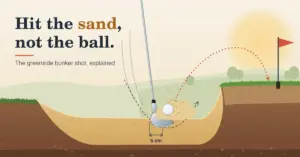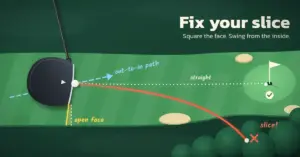
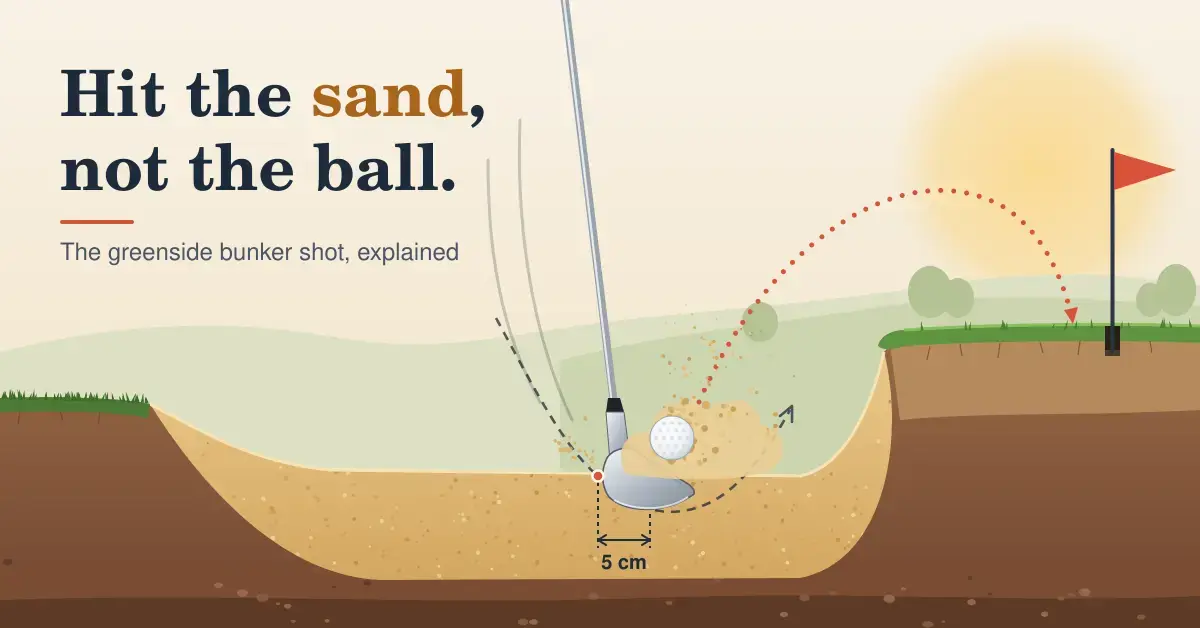
Getting out of a bunker comes down to one idea that feels backwards at first: in a greenside bunker you hit the sand, not the ball. You open the face of a sand wedge, aim your body left of the flag, and splash the clubhead through the sand a few centimetres behind the ball, so a cushion of sand lifts it up and onto the green. Do that with commitment and the escape becomes routine rather than a round-wrecker. This guide explains the greenside sand shot step by step, then covers fairway bunkers (where the technique is the opposite), the rules that catch players out, course etiquette, the most common mistakes, and how to practise so sand stops being scary.
Key Points
- Use a sand wedge (around 56 degrees) with 10 to 12 degrees of bounce, and open the face to expose that bounce.
- Aim your body about 20 to 30 degrees left of the target and play the ball forward in your stance.
- Hit the sand roughly 5 cm (two inches) behind the ball — never try to strike the ball first.
- Accelerate to a full finish; the sand, not the clubface, lifts the ball out.
- In a fairway bunker do the opposite: catch the ball first, choke down and take one extra club.
- Before the shot you must not ground the club or test the sand, or you take a two-stroke penalty.
What a bunker is, and why sand feels so intimidating
A bunker is a prepared area of sand, usually a shallow hollow where turf and soil have been removed and replaced with sand. Under the Rules of Golf, your ball is “in the bunker” when any part of it touches sand inside the edge of the bunker. If it rests on soil, grass or a growing plant inside the edge without touching any sand, it is not technically in the bunker — a distinction that matters, because the special bunker rules only apply when the ball is genuinely in the sand.
Two things make bunkers feel harder than they are. First, the method is the opposite of almost every other shot in golf: everywhere else you try to strike the ball cleanly, but in a greenside bunker you deliberately hit the sand behind it. Second, the rules restrict what you can do before the swing, so you cannot rehearse the feel by grounding the club. Once you accept that the sand — not the clubface — does the lifting, most of the fear disappears. If you are brand new to the game, it also helps to understand where the sand shot fits into the wider round, which our complete beginner’s guide on how to play golf lays out.
How to play a greenside bunker shot, step by step
A greenside bunker shot — often called a splash or explosion shot — is the escape you need when the ball sits close to the green in soft sand. The goal is modest: get the ball out and onto the putting surface in one shot, every time. Follow these five steps.
Step 1: Reach for a wedge with plenty of bounce
A sand wedge is the standard club for greenside bunkers. It typically carries 54 to 56 degrees of loft and, crucially, 10 to 12 degrees of bounce — the angle built into the sole so the trailing edge sits lower than the sharp leading edge. Bounce is what lets the club skid through the sand instead of digging in and stopping dead. A lob wedge of 58 to 60 degrees produces an even higher, softer shot for short-sided lies, while a wedge with very little bounce suits firm sand. If you want to understand how loft, bounce and grind combine, our guide to golf wedges explains how to match a wedge to your game and the sand you usually play.
Step 2: Open the clubface before you take your grip
Open the face first, then grip the club — never grip it and twist afterwards, or it will close again at impact. Rotate the clubface open so it points slightly right of your target and the sole’s bounce is exposed to the sand. Opening the face adds loft, which both raises the shot and brings the bounce into play so the club glides. On fine, soft sand you can open the face more; on packed, firm sand keep it squarer so the bounce does not skid off the surface and lead to a thinned shot.
Step 3: Set up open, and dig your feet in
Aim your feet, hips and shoulders left of the target — roughly 20 to 30 degrees — to compensate for the open face, so the shot starts left and the face points it back toward the flag. Play the ball forward in your stance, around off your front heel, and shuffle your feet down into the sand for a stable base. Digging in is allowed and it also lowers you slightly, encouraging the shallow, sweeping entry you want. Lean a touch of weight onto your front foot and keep it there.
Step 4: Aim at a spot in the sand, not at the ball
Pick a point in the sand about 5 centimetres (two inches) behind the ball and make that your target — this is the single biggest mental shift in bunker play. You are trying to slide the clubhead under the ball and throw out a slab of sand with the ball riding on top of it. The more sand you take, the shorter and softer the shot; the thinner the cut of sand, the further it flies. Never look at the ball itself as the thing to strike.
Step 5: Make a long, committed swing and finish
Accelerate through the sand and finish your swing — deceleration is where most bunker shots die. Because you are moving sand rather than hitting the ball directly, a greenside splash needs a noticeably bigger, faster swing than a normal chip of the same distance. Keep the clubface open through impact, let the bounce slap the sand, and swing all the way to a full follow-through. Commit completely: a timid half-swing leaves the ball in the sand far more often than an aggressive one sends it over the green. If your overall motion feels unreliable, rebuilding the fundamentals in our guide to how to swing a golf club will carry straight over to sand play.
Once the ball is safely on the putting surface, the job switches from escape to scoring — and reading the slope well is what turns a good sand shot into a saved par. Our guide to green reading and putting covers what happens next.
How to adjust for different lies, distances and sand
The five steps above cover the standard lie, but bunkers rarely give you the same shot twice. These adjustments keep the same core method while matching the conditions in front of you.
Longer greenside bunker shots
For a bunker shot that has to travel 15 metres or more, take a less open face and hit slightly closer to the ball — around 2.5 centimetres (one inch) behind it — so you move less sand and the ball carries further. You can also step down to a gap wedge or pitching wedge for the same swing length. Keep accelerating; distance in a bunker comes from a longer, faster swing and a thinner cut of sand, not from a stabbing hit.
Buried or “fried-egg” lies
When the ball sits down in its own crater — the “fried egg” — square or slightly close the clubface so the sharp leading edge can dig down and under the ball, which an open, bouncing sole cannot reach. Play the ball back a fraction, keep your weight forward, and expect the shot to come out lower and run on landing with little or no spin, so allow for the extra roll.
Wet, firm or very soft sand
Firm or wet sand needs less bounce and a slightly squarer face, because an open sole will skid off a hard surface and thin the ball across the green. Very soft, fluffy sand does the opposite: open the face fully and take plenty of sand, or the club will dig too deep and the ball will barely move. Reading the sand before you step in — and adjusting the face accordingly — is a skill that separates reliable bunker players from the rest.
Uphill and downhill lies
On a sloping bunker floor, set your shoulders to match the slope so your swing follows the ground. On an upslope, the shot flies higher and shorter, so take a little more swing. On a downslope, it comes out lower and runs more, so aim to land it earlier and allow for roll. In both cases, keeping your balance through a committed swing matters more than any clever adjustment.
How to play a fairway bunker shot (the opposite technique)
A fairway bunker shot reverses the greenside method: here you want to strike the ball first and take little or no sand, because you need distance, not height. The priority is clean contact, so the setup and swing are built around catching the ball before the clubhead reaches the sand.
Greenside vs Fairway Bunker Shots
| Attribute | Greenside bunker shot | Fairway bunker shot |
|---|---|---|
| Main goal | Height and a soft landing onto the green | Distance with clean contact |
| Contact | Hit the sand about 5 cm behind the ball | Strike the ball first, take little or no sand |
| Clubface | Open, to expose the bounce | Square |
| Club choice | Sand or lob wedge | One club more than the distance needs |
| Grip | Full-length grip | Choke down an inch or two |
| Feet | Dig in firmly for a stable base | Set lightly so you do not sink |
| Ball position | Forward, off the front heel | Slightly back of normal |
| Swing | Long, committed, full finish | Smooth three-quarter swing, quiet lower body |
| Safer miss | Take a little too much sand | Catch it slightly thin, never fat |
Start by taking one more club than the distance calls for, because sand drains speed from the clubhead and a slightly thin strike will not fly as far. Choke down an inch or two on the grip to shorten your effective club length and make it easier to catch the ball first. Play the ball a touch back of your normal position, and — unlike a greenside shot — only lightly set your feet so you do not lower yourself into the sand and bottom out behind the ball. Make a smooth, controlled three-quarter swing, keep your lower body quiet, and stay tall through impact. From a fairway bunker a slightly thin strike is far safer than a fat one, so if you miss, miss on the side of catching the ball cleanly. Only reach for distance if the lip of the bunker lets the ball clear it; if the face is steep, take a lofted club and simply advance the ball back to safety.
The bunker rules every golfer should know
Bunker-specific rules live in Rule 12 of the Rules of Golf, and breaking them is a common and costly mistake. Here is what you can and cannot do once your ball is in the sand.
What you must not do before the shot
Before you play a ball from a bunker you must not touch the sand in a way that tests it or improves your shot. Specifically, Rule 12.2b prohibits deliberately touching the sand to test its condition, grounding your club in the area right in front of or right behind the ball, touching the sand on a practice swing, and touching the sand on your backswing. The penalty is the general penalty — two strokes in stroke play, or loss of hole in match play — so a careless practice swing that brushes the sand can turn a routine escape into a double bogey.
What you are allowed to do
Plenty is still permitted. You may dig your feet in to take a stance, remove loose impediments such as leaves or stones and movable obstructions such as a rake, lean on a club to stay balanced, place your clubs or bag in the bunker, and even strike the sand in frustration after a poor shot — provided none of these actions improves the conditions for your stroke. You may also smooth the sand to care for the course. Removing loose impediments in a bunker has been allowed since the 2019 rules overhaul, so clearing a stone away from your ball no longer costs you a penalty.
When the ball is unplayable in a bunker
If the lie is hopeless, you can declare the ball unplayable (Rule 19.3). For one penalty stroke you have three options, but two of them — dropping back on a line behind the ball, or taking lateral relief within two club-lengths — require you to keep the ball inside the bunker. The important escape clause is the extra option: for a total of two penalty strokes you may drop back-on-the-line outside the bunker, keeping the point where the ball lay between you and the hole. That extra stroke is often worth it when a buried lie under a steep lip would otherwise cost you several shots.
Bunker etiquette: leave the sand as you found it
Good bunker etiquette keeps the sand fair for the players behind you, and it is expected at every club. Enter and leave the bunker from the low side, taking the shortest sensible route, because climbing the steep face leaves deep footprints, slides sand around and damages the turf lip. Carry the rake in with you so you can smooth your tracks on the way out rather than walking back across the sand. After the shot, rake over your footprints and the divot your swing left, then flip the rake to use its flat back to smooth the edges where you entered. Tap the sand off your shoes before stepping onto the green so you do not track it across the putting surface. Rake placement varies between courses — some want it left inside the bunker, others outside and parallel to play — so follow the local sign or ask in the pro shop.
Common bunker mistakes and how to fix them
Most bunker trouble traces back to a handful of repeatable errors. Fix these and your escape rate climbs quickly.
- Decelerating at impact. The most common fault of all. Slowing down leaves the club stuck in the sand and the ball in the bunker. The fix is a full, committed finish every time.
- Trying to hit the ball instead of the sand. Scooping at the ball produces thinned shots that scream over the green. Commit to your spot in the sand behind the ball and let it fly out on the cushion.
- Closing the face at address. A square or closed face buries the leading edge and digs too deep. Keep the face open so the bounce does its job.
- Taking too little sand on a standard lie. Catching the ball first thins it; the sand should carry the ball out. Enter the sand a couple of centimetres behind it.
- Using the wrong club for the sand. An open, high-bounce wedge on firm or wet sand skids and thins. Match the bounce and face angle to how firm the sand is.
- Not setting your feet. A slippery, unstable base wrecks the swing. Shuffle your feet down for a solid stance.
How to practise bunker shots
Bunker play rewards repetition more than almost any other shot, because the sensation of hitting the sand has to become automatic. The classic drill is to draw a line in the sand (in practice only — never during a round) about 5 centimetres behind a ball and swing to splash the sand forward from that line, so you learn exactly where the club should enter. Hit a bucket of shots focusing only on entry point and a full finish, not on the result, until the splash feels natural. Many practice facilities in Auckland have a short-game area, and spending time at a driving range with a bunker lets you groove the motion without pressure. As your escapes become reliable, you will drop fewer shots around the green, which is one of the fastest ways to lower your golf handicap.
Sources
Frequently Asked Questions
Should a beginner aim at the flag or just get out of the bunker?
Aim to get the ball safely onto the green first, not at the flag. For most amateurs, the smart play is to pick the widest, flattest part of the green and commit to escaping in one shot. Chasing a tucked pin tempts you into a thinner, riskier cut of sand that often leaves the ball in the bunker or flying long. Escape reliably now; get fancy with distance control once your basic splash is dependable.
Can I putt or chip out of a greenside bunker instead of splashing it out?
Yes, when the lie and lip allow it. If the ball sits cleanly on firm sand and there is little or no lip in front, a putt or a low chip with a less-lofted club can be the safer, simpler option because it removes the risk of catching the shot heavy. It only works when the sand is flat and firm and nothing stands between the ball and the green; from soft sand or under a lip, the splash shot is still the right choice.
Why do professional golfers get so much backspin from the sand?
Tour players generate spin through clubhead speed, high-lofted wedges with fresh grooves, and a shallow, aggressive swing that takes a thin, precise cut of sand. Clean, soft sand and a premium ball help too. For most club golfers, chasing that much spin is not worth the risk — reliable escape and distance control save far more shots than a spinning ball does.
Is raking the sand before my shot against the rules?
You may smooth sand to care for the course at any time, but you must not improve the area of your stroke. Raking or smoothing the sand around your ball before you play, in a way that betters your lie or stance, breaches Rule 12.2b and costs you the general penalty. Rake away from your ball to tidy another part of the bunker if you like, but leave the sand behind and around your ball exactly as it lies until after the shot.
How much practice does it take to feel confident in bunkers?
Most players feel noticeably more confident after just a few focused sessions, because the splash shot is largely about trusting a single repeatable motion rather than mastering many variables. A handful of visits spent only on entry point and a committed finish usually turns the bunker from a feared hazard into a routine shot. Ongoing short-game practice then sharpens distance control and your response to awkward lies.