
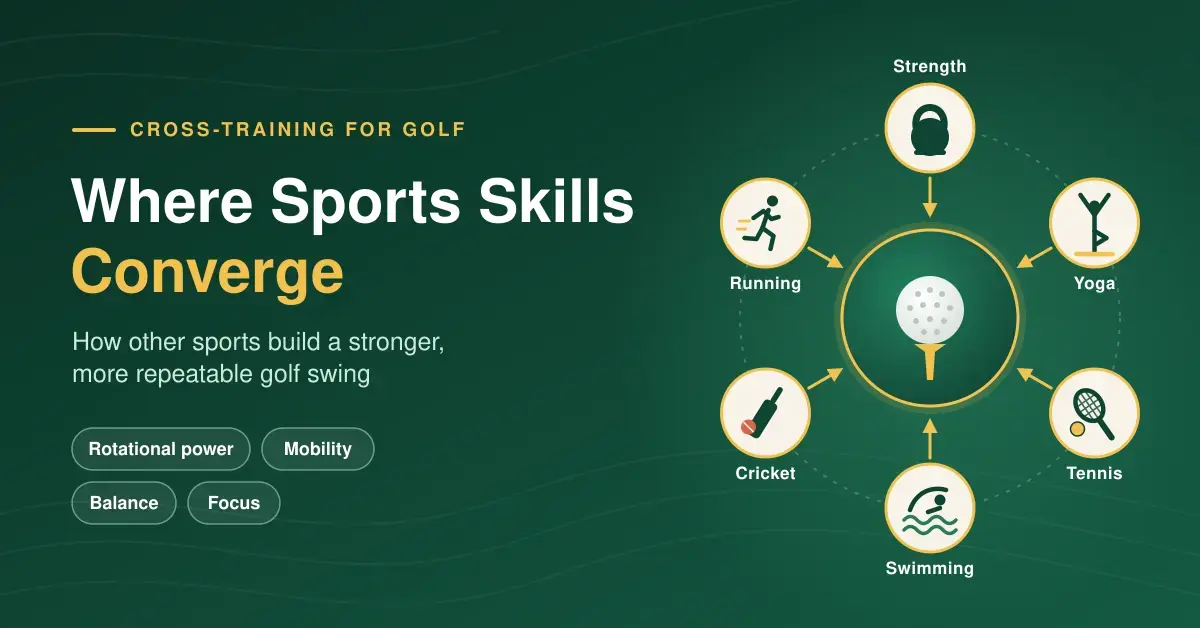
Golf rewards a repeatable, powerful and controlled swing, and the athletic qualities behind that swing — rotational power, mobility, balance and steady nerves — can be built in more than one place. Cross-training simply means practising other sports or forms of exercise alongside golf so the physical and mental skills carry across. This guide explains why that transfer happens, which activities complement golf best, what the research actually shows, and how to add cross-training without disrupting your regular practice.
Key Points
- Cross-training transfers because golf shares core athletic skills — rotational power, coordination, balance and focus — with many other sports.
- Strength and conditioning has the strongest evidence, with reviews showing roughly 4–6% gains in clubhead speed and driving distance.
- Yoga improved swing rotation (the X-Factor) by about 2–3° in a six-week study using two short sessions a week.
- Low-back pain is the most common golf injury (up to ~34% of cases); mobility and core work help prevent it.
- Golf is physical: walking 18 holes is roughly 11,000–17,000 steps and can burn 1,200–1,500 calories carrying your bag.
- Add it gradually: 1–2 sessions a week, matched to your goal, without replacing actual golf practice.
What does golf actually demand from your body?
Golf is more physical than its gentle reputation suggests, which is why athletic training carries over so well. Walking 18 holes typically logs somewhere between roughly 11,000 and 17,000 steps and covers about four to eight miles (6.4 to 13 km), and a player who walks while carrying their bag can burn in the region of 1,200 to 1,500 calories per round — falling to about 600 to 800 calories in a motorised cart.
The swing itself is a fast, one-sided rotation. Each shot loads the core, hips, legs and shoulders, and you repeat that motion 70 to 100 times a round once practice swings are counted. The muscle groups researchers most often link to golf performance are the legs and hips, the trunk, and grip strength — the same qualities that many other sports develop. Understanding those demands makes it clear why a tennis court, a pool or a yoga mat can quietly sharpen your golf swing.
How does cross-training improve your golf game?
Cross-training helps because golf shares its underlying athletic building blocks with many other sports, so training one skill tends to strengthen the others. The place where these sports skills converge is in the fundamentals: hand-eye coordination, timing, weight transfer, rotational power, balance and concentration. A tennis serve, a baseball swing and a golf drive are all coordinated kinetic-chain movements that fire the legs, hips, trunk and arms in sequence, so improving that sequence in one setting can benefit another.
Variety also protects you. Repeating a single asymmetrical motion is a known driver of overuse injury, so mixing in low-impact and full-body activities balances the body, reduces monotony and lowers burnout. The goal is not to replace golf practice but to build a broader athletic base that supports it — and to keep the training enjoyable enough that you stick with it.
Which sports complement golf best?
No single sport is a magic substitute for practising golf, but several develop clearly transferable skills. The comparison below summarises what each one tends to build, followed by a closer look at each.
Cross-Training Sports for Golf Compared
| Activity | Main golf benefit | Impact on body | Best suited to |
|---|---|---|---|
| Strength & conditioning | Distance and clubhead speed (~4–6%) | Moderate–high | Players chasing power |
| Yoga / mobility | Swing rotation, flexibility, injury prevention | Low | All levels, back-pain prevention |
| Tennis / padel | Hand-eye coordination, footwork, timing | Moderate | Coordination and balance |
| Squash | Footwork, reactions, decision-making | High | Fitness and agility |
| Swimming | Full-body endurance, breathing control | Low | Older players, injury recovery |
| Baseball / softball | Rotational power and timing | Moderate | Power and coordination |
| Martial arts | Balance, body control, mental toughness | Moderate | Focus and composure |
Tennis and racquet sports
Tennis develops the hand-eye coordination, timing and lateral footwork that golfers rely on. Tracking a fast-moving ball trains visual focus, while the constant changes of direction build balance and single-leg stability that translate into a more grounded swing. The rotational nature of groundstrokes also loads the core in a golf-like pattern. A newer racquet option, padel, offers similar coordination and footwork benefits in a smaller, social, doubles-friendly format.
Squash
Squash sharpens footwork, reaction speed and lower-body endurance. The sudden accelerations, stops and weight shifts around the court mirror the dynamic weight transfer needed in the golf swing, and the tactical side — reading angles and anticipating an opponent — trains the on-course decision-making that separates good rounds from frustrating ones. Because it is high-intensity, squash also builds cardiovascular fitness that helps you stay sharp over a full round.
Yoga and mobility work
Yoga targets the flexibility, balance and body awareness that a repeatable swing depends on, and it has the clearest supporting evidence. In a study at Abertay University in Scotland, golfers who did two 15-minute yoga sessions a week for six weeks improved the rotation between their hips and torso — the so-called X-Factor — by around two to three degrees, which corresponded to greater clubhead speed and a small gain in hand speed. Better hip and mid-back mobility matters for another reason too: when those areas do not move well, the lower back compensates, and low-back pain accounts for up to about a third (roughly 34%) of all golf injuries.
Swimming
Swimming provides a low-impact, full-body workout that builds cardiovascular endurance and shoulder and core strength without loading the joints. That makes it especially useful for older golfers, anyone returning from injury, or players who want conditioning that does not add wear to the back. The rhythmic, controlled breathing swimming demands also carries over to staying calm and composed under pressure on the course.
Baseball and softball
Baseball and softball share the golf swing’s rotational, ground-up power sequence, so hitting practice can reinforce timing, hip rotation and the feeling of driving force from the legs through the trunk. The main caveat is technique: a baseball swing is more horizontal and arm-driven than a golf swing, so treat it as general power and coordination work rather than a template for golf mechanics.
Martial arts
Martial arts such as karate, taekwondo or judo build balance, coordination, core control and mental discipline. Practising precise, repeatable movements develops the body awareness that underpins a consistent swing, and the mental-toughness element — staying composed and focused — is directly useful during tense competitive rounds. As with baseball, the value is in the athletic and mental qualities, not in copying specific strikes into your swing.
What about dedicated strength and conditioning?
Structured strength and conditioning has the strongest evidence of any cross-training for adding distance. Systematic reviews of resistance-training studies report average improvements in clubhead speed, ball speed and driving distance in the range of about 4% to 6% when the programmes work. Combining general strength work with golf-specific movements tends to beat generic lifting alone, and one 11-week golf-specific programme increased clubhead speed by roughly 1.6% — about five extra metres of carry — without harming accuracy or putting.
The muscle groups that matter most are the legs and hips, the trunk, and the grip, so exercises like squats, hinges, rotational core work and grip training are sensible priorities. Pairing this with technical practice is where the gains show up on the scorecard; you can read more about building a reliable action in this guide to improving your swing.
How do you add cross-training without hurting your golf?
Add cross-training gradually and keep golf itself as the priority, so the extra work supports your game rather than competing with it. A few practical principles help:
- Start small. One or two sessions a week of a complementary activity is enough to see benefits; the yoga research used just two short sessions weekly.
- Match the goal to the sport. Choose yoga or mobility for flexibility, strength work for distance, swimming for low-impact conditioning, and racquet sports for coordination and footwork.
- Protect recovery. Avoid heavy, unfamiliar training the day before a competitive round, and leave time to recover so fatigue does not creep into your swing.
- Warm up properly. Around 10 minutes of dynamic stretching — walking lunges, squats, trunk rotations — before golf or cross-training raises the injury threshold far more than static stretching alone.
- Keep the right footwear and kit. Stable, supportive shoes reduce injury risk across activities; see this guide to choosing golf shoes for how footwear supports a grounded swing.
What are the most common cross-training mistakes golfers make?
The biggest mistake is treating another sport as a direct substitute for golf technique, and there are a few others worth avoiding:
- Copying the wrong mechanics. A baseball or tennis swing is not a golf swing; borrow the athleticism, not the movement pattern, or you may groove faults into your action.
- Overtraining and fatigue. Adding intense sessions on top of a full golf schedule can leave you tired and sore, which shows up as inconsistent contact rather than lower scores.
- Ignoring recovery and warm-up. Jumping into high-intensity squash or heavy lifting cold is a fast route to the very overuse injuries cross-training is meant to prevent.
- Neglecting the actual game. Fitness and coordination help, but no amount of tennis replaces time spent on putting, chipping and course management, which is where most strokes are saved. If you are new to the sport, start with the fundamentals in this guide on how to play golf.
- Expecting instant results. The measured gains — a few degrees of rotation or a few percent of clubhead speed — build over weeks of consistency, not a single session.
Who benefits most from cross-training for golf?
Cross-training suits almost every golfer, but the ideal mix depends on your goals and starting point. Beginners and casual players benefit most from coordination and balance work — racquet sports and yoga — that speeds up the learning curve. Competitive players chasing distance gain the most from targeted strength and conditioning. Older golfers and anyone managing back or joint issues are best served by low-impact options such as swimming and mobility work, which build fitness while protecting the body. Whatever your handicap, the aim is a balanced athletic foundation that supports a repeatable swing, and it pairs naturally with tracking your progress through your handicap.
Sources
- Abertay University — Yoga and golf swing study
- Effects of Resistance Training on Golf Clubhead Speed and Hitting Distance: A Systematic Review (PubMed)
- Eight Weeks of Strength and Power Training Improves Club Head Speed in Collegiate Golfers (PubMed)
- OrthoInfo (AAOS) — Golf Injury Prevention
- Mass General Brigham — Common Golf Injuries
- PGA of America — Yoga for Golfers
- England Golf — Calories burned playing a round of golf
Vanliga frågor (FAQ)
Does cross-training really improve your golf swing?
Yes, within limits. Research links strength and conditioning to clubhead-speed and distance gains of around 4% to 6%, and a six-week yoga study showed measurable improvements in swing rotation. Cross-training builds the mobility, power and balance a good swing needs, but it works best alongside regular golf practice rather than instead of it.
Which single sport is best for improving my golf?
There is no single best sport, because it depends on your goal. For flexibility and swing rotation, yoga has the clearest evidence; for extra distance, dedicated strength training helps most; for coordination and footwork, tennis or squash are excellent; and for low-impact conditioning, swimming is ideal.
How often should I cross-train as a golfer?
One to two focused sessions a week is enough to see benefits without interfering with your golf. The yoga study that improved swing rotation used just two 15-minute sessions weekly, so short, consistent sessions add up over several weeks.
Can cross-training help prevent golf injuries?
It can. Low-back pain is the most common golf injury, and it is often driven by limited hip and mid-back mobility that forces the lower back to compensate. Mobility work, core strength and low-impact conditioning improve that movement and, combined with a proper warm-up, reduce injury risk.
Will playing other sports mess up my golf swing?
Only if you copy their mechanics directly. A baseball or tennis swing follows a different path from a golf swing, so use those sports for general athleticism, coordination and power rather than as a technique model, and keep dedicated golf practice as your main source of swing mechanics.