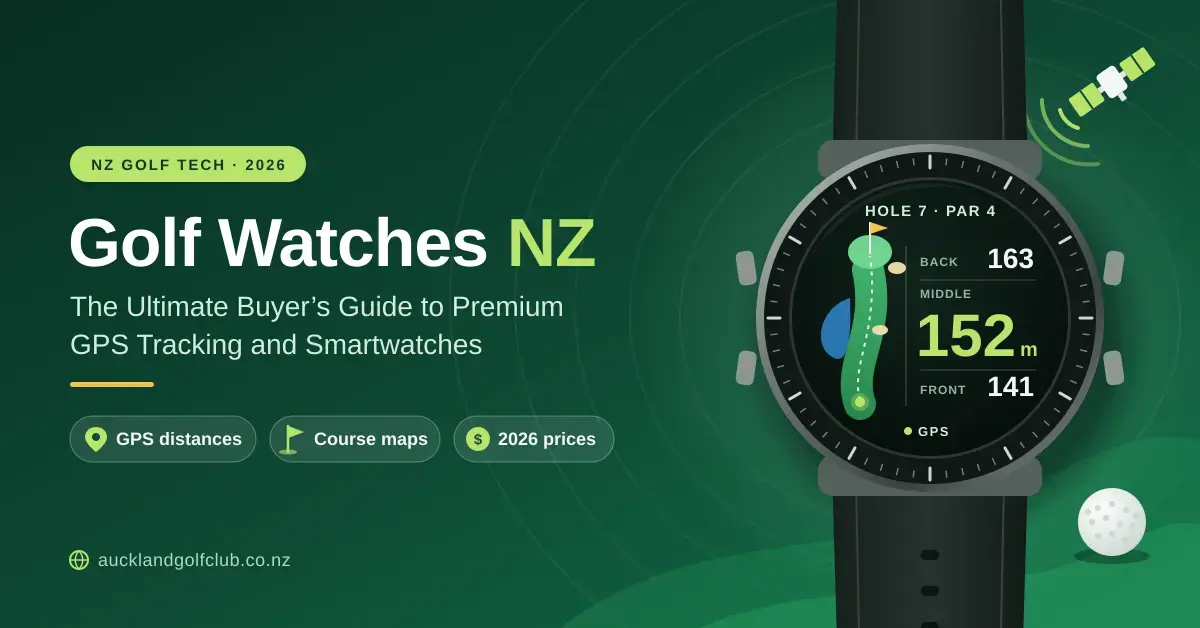
A golf GPS watch is a wrist-worn device that shows how far you are from the front, middle and back of the green, plus hazards and layup points, using preloaded course maps and satellite positioning. For New Zealand players comparing golf watches NZ retailers stock — whether you want a simple distance readout, a full-colour smartwatch, or a premium mapping model — the right watch removes yardage guesswork, speeds up play and helps you commit to a club.
This guide explains how the technology works, the main types and brands sold in New Zealand, realistic 2026 prices, which advanced features actually lower scores, the tournament rules you must follow, and the common mistakes buyers make. The aim is to help you match a device to your game rather than to the most expensive option on the shelf.
Quick Facts
- What it is: a wrist-worn GPS device showing distances to the green, hazards and layups on preloaded course maps.
- Main brands in NZ: Garmin and Shot Scope, with an Apple Watch golf app as a phone-linked alternative.
- Typical price (NZD): entry distance watches from about $399; colour smartwatches $629–$839; Shot Scope V5 around $549.99; premium AMOLED mapping $1,299.90–$1,399.90.
- Course maps: 36,000 (Shot Scope) to 43,000+ (Garmin) preloaded worldwide, including NZ courses.
- Subscription: none required on Garmin or Shot Scope watches.
- Battery (GPS mode): about 15 hours on colour smartwatches, 15–20 hours on AMOLED models, up to 30 hours on entry distance watches.
- Competition use: allowed under Rule 4.3 with slope, wind and caddie features off, unless a local rule bans all devices.
- Warranty: genuine NZ stock typically carries a two-year manufacturer warranty.
What is a golf GPS watch and how does it work?
A golf GPS watch calculates distance by linking to global positioning satellites rather than firing a laser beam. The watch knows its own location to within a few metres, compares that to a stored map of the hole, and displays the distance to key points on the green and to hazards. Because the maps are preloaded, most watches work straight out of the box with no phone, no mobile signal and no internet connection needed on the course.
Leading models carry very large course libraries — Garmin watches hold 42,000 to 43,000+ courses worldwide and Shot Scope holds around 36,000 — including New Zealand courses. The watch finds your course automatically when you arrive, then updates the numbers as you walk. The practical payoff is a confident number on every shot, even when you cannot see the flag.
Golf watch vs laser rangefinder: which should you choose?
A golf watch gives satellite distances to preset targets at a glance, while a laser rangefinder gives a precise distance to anything you can physically see through the viewfinder. The biggest practical difference is line of sight: a watch still reads the green distance when your view is blocked by a dogleg, a ridge, trees or sea fog, whereas a laser needs an unobstructed line to the flag.
Lasers are generally more precise to a specific pin, and they need no course maps. Watches are faster, keep both hands free, double as fitness trackers and automatically track your round. Many keen golfers eventually carry both, but for most players a watch is the easier everyday tool. If you want to understand the wider kit that suits local play, our guide to choosing golf gear for New Zealand conditions puts wearables in context.
Choosing the right type: distance-only vs full-colour mapping
The first decision is how much visual detail you want on your wrist. Players who only want a quick, distraction-free yardage need very different hardware from those who want to study dogleg angles, carry distances and green slope before pulling a club. Buying more watch than you will use is a common and expensive mistake; buying too little leaves you squinting at a dim screen or missing data you wanted.
| Attribute | Entry-level distance GPS | Mid-tier colour smartwatch | Premium AMOLED mapping |
|---|---|---|---|
| Display | High-contrast monochrome, very sunlight-readable | Daylight-readable colour screen | Bright colour AMOLED touchscreen |
| Main data | Front / middle / back of green | Colour hole shapes, hazards, layups | Touch-target maps and green contours |
| Shot tracking | Manual or basic scoring | Automatic shot detection | Automatic tracking, optional club sensors |
| Off-course use | Basic watch and step count | Notifications, some sport profiles | Full health tracking, payments, music |
| Battery in GPS mode | Up to ~30 hours | Around 15 hours | Around 15–20 hours |
Entry-level distance watches
Entry-level watches focus on big, clear front/middle/back numbers and little else. They suit purists, seniors and anyone who finds menus distracting, and their battery life is outstanding — the Garmin Approach S12, for example, runs up to 30 hours in GPS mode and around 10 weeks as an everyday watch. Expect to pay from about $399 NZD.
Mid-tier colour smartwatches
Mid-tier models add a colour screen, automatic shot detection and smartphone notifications while keeping play simple. The Garmin Approach S44 (around $629 NZD) and S50 (around $839 NZD) are the typical sweet spot for club golfers who also want a day-to-day smartwatch with health tracking.
Premium AMOLED mapping watches
Premium watches use a bright AMOLED touchscreen with full vector maps, green contours and a virtual caddie. They are the most capable and the most expensive, and their always-on colour screens use more power, so GPS battery life sits around 15–20 hours rather than days. These suit data-driven players who want every tool on their wrist.
The main golf watch brands in New Zealand
Two brands dominate the New Zealand golf-watch market: Garmin and Shot Scope, with an Apple Watch running a golf app as a phone-linked alternative for those who already own one. Golf wearables now overlap with mainstream sports technology — brands better known for apparel and footwear, such as Adidas, helped push connected fitness into everyday use — but for dedicated course data, Garmin and Shot Scope are the names NZ retailers stock most.
- Garmin Approach S70: the flagship, sold at $1,299.90 NZD (42mm) and $1,399.90 NZD (47mm). It pairs an AMOLED touchscreen with full-colour vector maps, a Virtual Caddie that factors in wind and your own shot history, and access to 43,000+ courses with no subscription.
- Garmin Approach S50 and S44: the value mid-tier, roughly $839 and $629 NZD. Both offer colour maps, automatic shot tracking (AutoShot) and smart notifications; the S50 adds broader smartwatch features such as health tracking, payments and music.
- Shot Scope V5 and X5: a strong rival with no subscription fees. The V5 (around $549.99 NZD) comes with 16 automatic shot-tracking tags, 36,000 preloaded courses and 100+ performance statistics including Strokes Gained; the newer X5 refines the design and tracking range.
- Garmin Approach S12: the simple, long-battery entry point from about $399 NZD, focused on clear green distances and weeks of battery life.
Watch Comparison
| Model | Type | Display | Courses | Battery (GPS) | Approx. NZ price |
|---|---|---|---|---|---|
| Garmin Approach S12 | Distance only | Monochrome | 42,000+ | Up to 30 hrs | $399 |
| Garmin Approach S44 | Colour smartwatch | Colour touchscreen | 42,000+ | ~15 hrs | $629 |
| Garmin Approach S50 | Colour smartwatch | Colour touchscreen | 43,000+ | ~15 hrs | $839 |
| Garmin Approach S70 | Premium mapping | AMOLED touchscreen | 43,000+ | ~15–20 hrs | $1,299.90 (42mm) / $1,399.90 (47mm) |
| Shot Scope V5 | Colour GPS + tracking | Colour display | 36,000 | Multi-round | $549.99 |
| Shot Scope X5 | Premium GPS + tracking | Colour display | 36,000 | Multi-round | Varies by retailer |
Which advanced features actually help your scoring?
The features that lower scores are the ones that give you a more honest number and a clearer target. Flagship processors pack far more than a distance replacement, but not every feature matters to every player — here is what each one does and when it helps.
PlaysLike slope-adjusted distance
PlaysLike distance tells you how far a shot actually plays once elevation is taken into account. Firing up to a raised green or down into a valley makes the straight-line yardage misleading; a built-in barometric altimeter calculates the true effective distance so you can take the right amount of club. Note that this feature must be switched off in most competitions.
Wind and weather data
Wind data overlays the current wind direction and speed onto the hole map by syncing with your phone’s weather feed. Knowing whether you face a 15 km/h headwind or a crosswind — common on exposed Kiwi coastal courses — helps you adjust your target line and club. Like slope, wind assistance is a non-conforming feature for formal play.
Dynamic front/middle/back distances
Dynamic green distances recalculate from where you actually stand, not from the centre of the fairway. If you pull a drive into the trees or onto an adjacent hole, the watch rebuilds the front/middle/back numbers for your real angle of approach, which fixed course markers cannot do.
Green contours and automatic shot tracking
Premium watches can show a colour-coded map of the putting surface, highlighting where slopes break, false fronts sit and safe tiers lie before your approach — a natural companion to good green reading, which we cover in our guide to reading the greens and putting. Automatic shot tracking, meanwhile, records where each shot finishes so you can see your true club distances over time and, over a season, work towards a lower handicap.
Are golf watches legal in competition?
Yes — a golf watch is allowed in most competitions under Rule 4.3 of the Rules of Golf, provided you use it only for distance and direction. The rule specifically bans using features that measure elevation or slope, read wind, give club recommendations or process other performance data during a round. If your watch has slope, wind or virtual-caddie modes, switch them off before your opening tee shot.
There is one important exception: a committee can prohibit all distance-measuring devices for an event by adopting Model Local Rule G-5. When that local rule is in force, even a simple distance-only watch may not be used. Always check the hard card or notice board before a medal round, club championship or pennants fixture.
How much do golf watches cost in NZ, and where do you buy them?
Golf watches in New Zealand span roughly $399 to $1,400 NZD depending on display and features. As a rough guide: entry distance watches start near $399; colour smartwatches run about $629 to $839; the Shot Scope V5 sits around $549.99; and premium AMOLED mapping models reach $1,299.90 to $1,399.90. Genuine local stock usually carries a two-year manufacturer warranty and local servicing, which is worth confirming before buying a grey-import to save a little.
You can buy from national golf retailers, on-course pro shops and reputable online stores. If you prefer to see and compare models in person and get fitting advice, specialist stores such as Golf HQ in Auckland and the golf warehouse chains stock the main Garmin and Shot Scope ranges. Shopping during mid-winter clearances or end-of-season sales often trims the price.
How to care for your golf watch
A simple post-round routine protects the battery, screen seals and charging pins for years of heavy play. Golf watches take constant swing vibration, sweat, dew and UV, so a few minutes of care goes a long way.
- Rinse after the round: wipe the case with fresh, cool water and gently clean the charging pins with a soft cloth to clear skin oils, dirt and course fertiliser that can block charging.
- Do not store it damp: never seal a wet watch inside a trundler pocket or leave it in a hot car; dry it and let it air to protect the internal seals.
- Keep software and maps updated: sync over Wi-Fi or the app so renovated bunkers, re-shaped greens and new routings stay accurate.
- Manage battery drain: if you wear it daily, lower screen brightness, shorten the always-on timeout and close high-drain sport apps to stretch time between charges.
Common mistakes when buying and using a golf watch
Most disappointment comes from a few avoidable errors rather than a bad device. Knowing them before you buy saves money and on-course frustration.
- Overbuying features: paying flagship money for slope and contours you never use. If you only want clear green numbers, an entry watch is better value and lasts far longer per charge.
- Ignoring battery reality: assuming an AMOLED watch lasts days in GPS mode. In full tracking it is closer to 15–20 hours, so charge before a 36-hole day.
- Leaving tournament features on: forgetting to switch off slope, wind or caddie modes, which breaches Rule 4.3 and can cost you the round.
- Skipping updates: relying on an out-of-date map after a course has been re-shaped, then trusting a wrong number.
- Buying unsupported grey stock: saving a little on an import with no local warranty, then having no easy repair path.
- Trusting GPS for the exact pin: a watch reads to the middle of the green, not the flag’s daily position — for a precise pin number a laser is more exact.
Sources
Frequently Asked Questions (FAQ)
How does a golf GPS watch work without a phone or internet?
The watch links directly to positioning satellites and compares your location to course maps already stored on the device. Because those maps are preloaded, it works on the course with no mobile signal or data connection. Your phone is only needed occasionally to update maps and software or to view detailed statistics afterwards.
Do golf watches need a subscription in New Zealand?
No. The mainstream watches from Garmin and Shot Scope include lifetime access to their course libraries, map updates and performance apps in the purchase price, with no monthly or annual fee. You can use the device straight out of the box with no hidden ongoing cost.
Are golf watches legal in club competitions and tournaments?
Yes, under Rule 4.3 you may use a watch for distance and direction in most competitions, but features such as slope, wind and club advice must be switched off. A committee can still ban all distance-measuring devices for a specific event through Model Local Rule G-5, so check the local rules before you play.
How accurate is a golf watch compared with a laser rangefinder?
A watch is accurate to within a few metres to the front, middle and back of the green and works even when the target is hidden. A laser rangefinder is more precise to a specific visible point, such as the exact pin position, but needs a clear line of sight. Many golfers use a watch for general yardages and a laser when they want an exact pin number.
How long does a golf watch battery last for a round?
Easily longer than one round. Simple monochrome models such as the Garmin Approach S12 run up to 30 hours in GPS mode, while bright AMOLED models like the Approach S70 deliver roughly 15–20 hours — still three or four full 18-hole rounds. Lowering screen brightness and the always-on display extends this further.