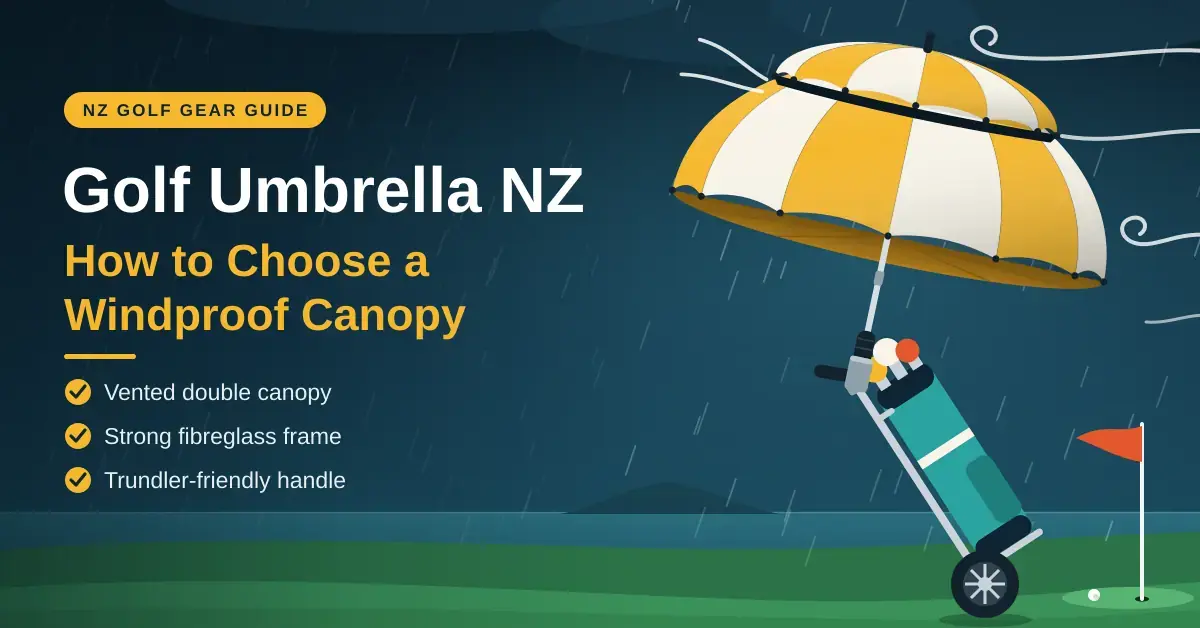
A golf umbrella is one of the most practical pieces of kit an Auckland golfer can carry, because New Zealand weather rarely reads the forecast. A round that starts in still sunshine can turn into driving rain and gusting wind by the back nine, and a cheap high-street umbrella will simply invert and leave you soaked. The difference between a frustrating, wet round and a comfortable one usually comes down to a few pieces of engineering: the canopy design, the frame material and how the handle sits in your golf trundler.
This guide explains what actually separates a good golf umbrella from an ordinary one, how the main canopy designs behave in wind, what to check before you buy, roughly what you should expect to pay in New Zealand, and how to make your umbrella last. It is written for local conditions, including the exposed coastal courses around the Hauraki Gulf and Hawke’s Bay where wind, not rain, is the real test.
Key Points
- Canopy design decides wind performance. Vented double canopies and radial-tension frames resist inversion far better than single-layer umbrellas.
- Size is a trade-off. 54-inch arc for one player; 62–68-inch to cover a bag or two people — but bigger catches more wind.
- Frame material matters. Fibreglass and composite ribs flex and recover; cheap metal ribs bend and rust.
- Blunt is the local benchmark. The Auckland-designed Blunt Sport is wind-tested to 115 km/h, UPF50+, ~$229 NZD.
- Check the handle. A straight handle fits standard trundler umbrella holders.
- Dry it open every time to prevent mildew and rust.
What makes a golf umbrella different from a normal umbrella?
A golf umbrella is larger, stronger and built to shed wind rather than fight it. Where a compact commuter umbrella aims to fit in a bag, a golf umbrella is designed to cover you, your bag and often your trolley, and to survive gusts that would destroy a standard frame. The umbrella may be a familiar everyday object, but the version you want on a windy fairway is a very different tool. A good golf umbrella is designed with a larger canopy, stronger frame and better wind resistance to provide reliable protection in exposed conditions.
How big should a golf umbrella be?
Most golf umbrellas are measured by their arc — the curved length across the open canopy — not their flat diameter, so a “62-inch” umbrella has a smaller straight-line width than the number suggests. As a rule of thumb, a single player is well covered by a 54-inch (around 137 cm) arc, while a 62 to 68-inch (roughly 157 to 173 cm) arc gives enough spread for you and your bag, or two people walking together. Bigger canopies catch more wind, so size is a trade-off, not simply “bigger is better”.
Why does frame material matter?
The frame decides whether an umbrella survives its first serious storm. Cheap steel or aluminium ribs bend permanently and can rust, while high-quality golf umbrellas use fibreglass or carbon-composite shafts and ribs that flex under load and spring back. Fibreglass is also a poor electrical conductor, which is safer than metal in a storm, though as covered below no umbrella makes it safe to stay out in lightning.
Single, double and radial-tension canopies compared
The canopy design is the single biggest factor in how an umbrella handles wind, and there are three broad approaches. A traditional single canopy is one solid sheet of fabric; it is cheap and light but flips inside-out easily. A double (vented) canopy adds a second, overlapping layer with a mesh gap so wind can escape through the top instead of lifting the whole umbrella. A radial-tension design, pioneered by Blunt, spreads the load to the canopy edge so the whole surface stays taut. The table below sets out how they compare.
| Attribute | Single canopy | Double (vented) canopy | Radial-tension canopy |
|---|---|---|---|
| Wind resistance | Low; inverts in gusts | High; vents bleed off pressure | Very high; edge tension resists inversion |
| Typical frame | Light steel or aluminium | Fibreglass or composite ribs | Engineered composite ribs and struts |
| Rib tips | Exposed metal points | Plastic-capped ends | Rounded, blunt tips (no sharp points) |
| Weight | Lightest | Moderate | Slightly heavier |
| Best for | Sheltered, occasional use | Most club golfers | Exposed, windy coastal courses |
Blunt: the Auckland-made windproof design
Blunt is a New Zealand umbrella brand whose radial-tension design was created specifically to survive wind, which makes it the reference point for windproof golf umbrellas here. The company was founded in 1999 by Auckland design engineer Greig Brebner, who set out to fix umbrellas that break in a gust and jab passers-by with sharp tips. The result is the patented Radial Tensioning System (RTS) and the brand’s signature rounded “Blunt” tips.
Instead of stretching fabric over pointed metal ribs, RTS uses struts that push tension outward and distribute it evenly around the canopy edge, so the whole surface stays firm and aerodynamic. Blunt states its umbrellas are wind-tested to 115 km/h. For golf, the relevant model is the Blunt Sport: a 146 cm canopy rated UPF50+, weighing just under a kilogram, and priced around $229 NZD at the time of writing. It is the brand’s largest umbrella and is sized to cover a golfer and a cart. It is a premium option — you can protect your gear for far less — but on an exposed links it earns its keep.
How to choose a golf umbrella: features to check
Before you buy, work through a short technical checklist rather than choosing on colour or logo. The features below are the ones that decide whether an umbrella lasts more than a season and whether it actually keeps you and your kit dry.
Does the handle fit your trundler?
A straight, uniform handle is essential if you push a trolley, because it needs to slot into the umbrella holder on manual and electric trundlers such as Motocaddy, MGI or Clicgear. Oversized flares and pistol grips often will not seat properly in the holder tube, so check the handle shape against your trolley before buying. Keeping the umbrella on the trundler also frees your hands and helps keep your club grips dry between shots.
How waterproof is the fabric?
Look for a high-density pongee canopy (often described as 190T or 210T) with a water-repellent coating so rain beads and rolls off. A well-coated canopy can be shaken mostly dry after a round, which matters if you store your bag in a car boot or a locker. Pair it with dedicated wet-weather golf clothing and you can keep playing comfortably through a passing squall.
Will it protect you from the sun?
A golf umbrella is not only for rain. New Zealand has some of the world’s highest UV levels, so a canopy rated UPF50+ — which blocks roughly 98% of ultraviolet radiation — doubles as portable shade on hot days. The shade it casts also feels noticeably cooler than open sun, which helps on a long summer round. A UV-rated umbrella sits alongside a hat and sunscreen as sensible sun protection.
Comparing golf umbrellas available in New Zealand
The New Zealand market carries most major golf brands alongside Blunt, and the right choice depends on your course and budget rather than the badge. The comparison below lists widely available options with their headline specifications and a link to each maker’s official page. Sizes are quoted as canopy arc, and prices move with sales and importers, so treat them as a guide.
Golf Umbrellas Compared
| Model | Canopy (arc) | Canopy type | Standout feature | Indicative NZ price |
|---|---|---|---|---|
| Blunt Sport | 146 cm | Radial tension, single layer | Wind-tested to 115 km/h; blunt tips; UPF50+ | ~$229 |
| Titleist Tour Double Canopy | ~68 in | Vented double canopy | Waterproof tour build; large coverage | ~$90–130 |
| Callaway 64″ Double Canopy | ~64 in | Vented double canopy | Fibreglass frame; auto open | ~$70–110 |
| PING Tour Umbrella | ~68 in | Vented double canopy | Rugged fibreglass shaft and ribs | ~$80–120 |
| TaylorMade 64″ Double Canopy | ~64 in | Vented double canopy | Soft EVA-foam grip; wide coverage | ~$70–110 |
| Sun Mountain UV Manual | ~68 in | Vented double canopy | UV-coated underside for sun protection | ~$60–100 |
What does a golf umbrella cost in New Zealand?
You can spend anywhere from about $25 to well over $200, and the price broadly tracks the frame quality. Entry-level umbrellas from department and discount stores generally run around $25 to $50; these are fine for the car or a sheltered course but rarely survive a strong gust. Mid-range and tour-branded double-canopy umbrellas from golf retailers typically sit around $60 to $130 and offer fibreglass frames and vented canopies. Premium windproof models such as the Blunt Sport are around $229. Pro shops and stores like the Golf Warehouse in Ellerslie often discount stock during winter clearances, which is the best time to buy up a tier.
Common mistakes golfers make with umbrellas
Most umbrella failures are avoidable and come down to habits rather than bad luck. Knowing the common mistakes below will save you money and a soaking.
- Buying on size alone. A huge single-canopy umbrella catches more wind and inverts faster than a smaller vented one; matching the design to your course matters more than raw diameter.
- Ignoring the handle shape. A beautiful umbrella that will not fit your trundler holder means carrying it by hand all day.
- Packing it away wet. Storing a soaked umbrella folded and sleeved causes mildew, fabric rot and rust; it is the single fastest way to ruin a good canopy.
- Staying out in lightning. Treating an umbrella as protection in a thunderstorm is dangerous — it is time to leave the course, not raise a pole.
- Choosing metal to save money. Cheap metal ribs bend permanently in one storm, so the saving disappears the first windy day.
How to care for your golf umbrella
A little maintenance dramatically extends an umbrella’s life, especially given the UV, salt air and fairway chemicals it meets. Keep it in good order and a quality canopy will last many seasons.
- Always air-dry it open. After a wet round, open the canopy fully in a ventilated space until completely dry before storing — never leave it damp in its sleeve or a car boot.
- Rinse, don’t scrub. Remove mud and grass with cool water; harsh detergents and stiff brushes strip the water-repellent coating.
- Lubricate the mechanism. A light silicone spray on the shaft runner and pivot points once or twice a year keeps the action smooth and prevents jamming.
- Store it protected. Slip the dry umbrella into its sleeve so the fabric is not snagged by irons, tees or alignment sticks in your bag.
Rounding out your rain kit with the right golf accessories, from towels to bag covers, means one shower no longer ends your day.
Sources
- BLUNT Umbrellas (New Zealand) — Radial Tensioning System and Sport specifications
- NZ Herald — Blunt umbrella company background and founder
- New Atlas — How the Blunt radial-tension design works
- Golf Warehouse NZ — Blunt Golf Sport umbrella listing
- More Sports — Golf umbrella size guide (arc vs coverage)
- Coolibar — UPF50+ golf umbrella UV performance
Vanliga frågor (FAQ)
What is the benefit of a double-canopy golf umbrella?
A double-canopy umbrella has two overlapping layers of fabric with a vented gap between them. When a gust hits, air escapes through the gap instead of lifting the whole canopy, which sharply reduces the chance of the umbrella turning inside-out. It is the most common upgrade over a basic single-layer umbrella and suits most club golfers.
Why do Blunt golf umbrellas cost more?
Blunt umbrellas use a patented Radial Tensioning System that spreads load evenly to the canopy edge and replaces sharp rib tips with rounded ones. That engineering, combined with composite frames and a wind rating of 115 km/h, makes them more expensive to build than a standard umbrella. For golfers on exposed, windy courses, the durability can justify the higher price.
Will a golf umbrella fit my electric trundler?
Usually yes, provided the handle is a straight cylinder rather than a flared or pistol grip. Most trolleys, including Motocaddy, MGI and Clicgear, use a universal umbrella holder that accepts a standard straight handle. Check the handle shape before buying, as an oversized base may not seat securely in the holder.
Is a fibreglass umbrella safe in a thunderstorm?
Fibreglass does not conduct electricity the way a steel or aluminium frame does, so it is safer than a metal umbrella, but no umbrella makes it safe to stay outside during lightning. If a storm is close, lower the umbrella, put down your clubs and get to a clubhouse or proper shelter immediately.
What size golf umbrella do I need?
For one person, a 54-inch (about 137 cm) arc is plenty. If you want to cover yourself plus your bag or trolley, or share with a playing partner, choose a 62 to 68-inch (roughly 157 to 173 cm) arc. Remember that larger canopies catch more wind, so on exposed courses a well-vented mid-size umbrella often outperforms a bigger basic one.