
Golf shoes are the only piece of equipment that stays in contact with the ground through every swing and every step of a round, which is why they influence balance, traction and comfort more than most players expect. In New Zealand’s damp, hilly and often changeable conditions, the right pair can be the difference between a stable footing and a slip on a wet side-hill lie. This guide explains how golf shoes work, the difference between spiked and spikeless designs, what waterproofing and fit systems actually deliver, roughly what they cost in New Zealand, and how to match a pair to the way you play. Every technical term is explained on first use so beginners and experienced golfers can both use it.
Key Points
- Grip first: spiked shoes give the most traction on wet, hilly NZ courses; spikeless shoes trade a little grip for walking comfort and street versatility.
- Waterproofing matters year-round: look for a membrane or treated leather with a stated 1–2 year guarantee, plus breathability for Auckland’s humidity.
- Weight helps walkers: most golfers walk 6–8 km (around 10,000–13,000 steps), so lighter, well-cushioned shoes reduce fatigue.
- Fit options: BOA dials give an even, adjustable fit; laces are lighter and cheaper. Wide fittings are available from FootJoy and New Balance.
- NZ pricing: roughly NZ$100–$450, with most models between NZ$150 and NZ$350.
Why do golf shoes matter on New Zealand courses?
Golf shoes matter because they anchor your body to the turf while you rotate at speed and while you walk several kilometres each round. During the downswing the feet resist rotational (twisting) force, and any slipping there leaks power and can throw the strike off line. New Zealand adds two specific challenges: clay-based soils around Auckland become genuinely slick after rain or heavy morning dew, and many local layouts are hilly, so you spend a lot of the round standing on slopes. A shoe built for grip and lateral (side-to-side) support helps you keep a solid base in exactly the situations where ordinary trainers would let go.
A round of 18 holes is also a real walk. Studies put the distance at roughly 6 to 8 kilometres, with some tracking projects recording closer to 10 kilometres once you count walking between shots and around greens, and step counts commonly land between about 10,000 and 13,000. Over that distance, cushioning and weight stop being luxuries. If you are still assembling the rest of your kit, our guides to golf clothing and everyday golf accessories cover the items that pair naturally with a good pair of shoes.
How the turf changes through the seasons
Auckland winters leave fairways soft and greasy, so grip is the priority; summer rounds are often played on firm, sun-baked ground where cushioning and breathability matter more. An outsole that performs across both wet and dry conditions is worth prioritising if you play year-round rather than switching shoes with the seasons.
What is the difference between spiked and spikeless golf shoes?
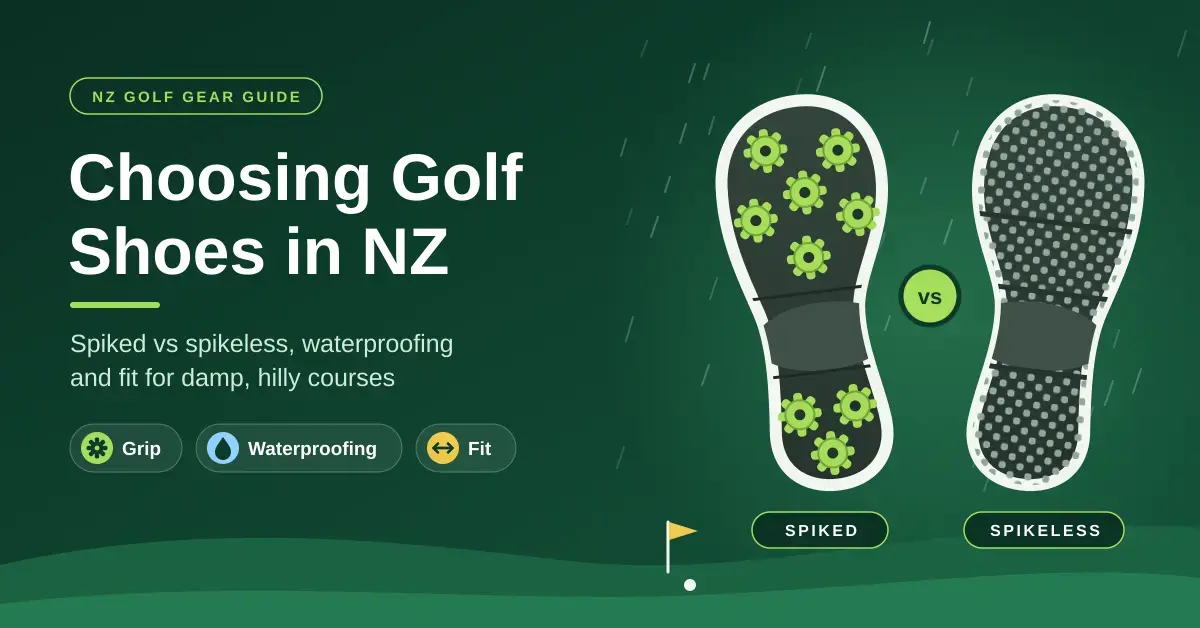
The core difference is the outsole: spiked shoes use replaceable cleats that dig into the turf, while spikeless shoes use moulded rubber lugs or nubs built into the sole. Spiked models give the most aggressive grip, especially on wet or sloping ground, which is why many competitive players and those with faster swings prefer them. Spikeless models grip slightly less on greasy slopes but are more comfortable to walk in, need no cleat changes, and can be worn straight from the car to the clubhouse to the street without damaging floors.
| Feature | Spiked golf shoes | Spikeless golf shoes |
|---|---|---|
| Primary grip | Replaceable plastic cleats | Moulded rubber lugs / nubs |
| Best for | Wet, hilly or competitive play | Dry, flatter or casual rounds |
| Comfort | Structured and firm | Softer, trainer-like |
| Versatility | Mostly on-course | Course-to-street wearable |
| Maintenance | Cleats wear out and need replacing | Easy to clean, no cleats to replace |
Where do hybrid soles fit in?
Some current outsoles blur the line, combining a low, spikeless-style profile with more aggressive traction elements for extra bite. They aim to offer close to spiked grip with spikeless convenience, and are a reasonable middle ground for players who want one pair for everything.
Are metal spikes allowed?
Traditional metal spikes have been phased out at most clubs because they damage greens; modern “spiked” shoes use soft plastic cleats. Before buying replacement cleats, check that they match your club’s policy and screw into your shoe’s fitting system, as cleat designs are not universal.
Which golf shoe brands are sold in New Zealand?
New Zealand retailers stock the same major brands found worldwide, each with recognisable technologies. FootJoy is the long-standing traditionalist choice, with the spikeless Pro/SL and the leather Premiere Series. adidas offers the lightweight ZG23 and the spikeless Codechaos (available with a BOA dial), alongside the tour-level Tour360. Nike’s Air Zoom Victory Tour is its premium performer, while ECCO is known for its own-tanned leathers and anatomical fit, and Skechers and New Balance are widely worn for out-of-the-box comfort and generous width options. The comparison element below links to each brand’s official range.
Golf Shoe Brand Comparison
| Brand | Known for | Example range | Official page |
|---|---|---|---|
| FootJoy | Traditional fit; spikeless Pro/SL and leather Premiere Series | Spikeless & spiked | footjoy.com |
| adidas | Lightweight ZG23, spikeless Codechaos (BOA option), Tour360 | Spikeless & spiked | adidas.com |
| Nike | Air Zoom Victory Tour performance range | Mostly spiked | nike.com |
| ECCO | Own-tanned leathers, anatomical last, hybrid soles | Mostly spikeless | ecco.com |
| Skechers | Out-of-the-box comfort, arch support | Spikeless & spiked | skechers.com |
| New Balance | Wide-fit options and cushioning | Spikeless & spiked | newbalance.co.nz |
Is a more expensive shoe better value?
Not automatically, but a well-made shoe that is looked after usually costs less per round over its life. A quality leather or premium synthetic pair, cleaned and stored properly, can last several seasons, whereas a very cheap model may lose its waterproofing or cushioning inside a year. Judge value on how often you play and how long the shoe holds up, not the sticker price alone.
How much do golf shoes cost in New Zealand?
Golf shoes in New Zealand generally sell for around NZ$100 to NZ$450, with most mainstream models falling between roughly NZ$150 and NZ$350. Entry-level and end-of-line spikeless shoes can be found under NZ$120, mid-range performance models sit in the NZ$200–$300 band, and premium leather or tour shoes climb toward NZ$450. Prices move a lot on sale, and previous-season colours are often heavily discounted, so it is worth comparing current stock at specialist retailers. A BOA dial closure typically adds a modest premium over the laced version of the same shoe.
What makes a golf shoe waterproof?
Waterproofing comes from either a treated leather upper or a waterproof membrane bonded inside the shoe that blocks liquid water while letting sweat vapour escape. In New Zealand’s humidity that breathability matters as much as the barrier itself, because a sealed but unbreathable shoe traps moisture inside. Most performance shoes carry a waterproof guarantee, commonly one to two years depending on the brand and model, so check the specific warranty rather than assuming a blanket figure. The table below matches protection levels to typical uses.
| Protection level | Typical material | Best use |
|---|---|---|
| Water-resistant | Treated mesh or knit | Light dew, dry summer practice |
| Standard waterproof | Synthetic leather with membrane | Most club rounds, moderate rain |
| Premium waterproof | Full-grain leather or high-end membrane | Heavy rain, winter competition |
How do you keep a shoe waterproof?
Waterproofing is not permanent. Wiping off mud, letting shoes dry away from direct heat, and occasionally reapplying a water-repellent treatment help the membrane keep working. A quality golf umbrella also takes a lot of the load off your shoes in a sudden Auckland downpour.
How much does cushioning and energy return matter?
Cushioning and energy return matter most to golfers who walk, because they reduce fatigue over the thousands of steps in a round. The layer doing this work is the midsole, the foam between the insole and the outsole. Modern golf shoes borrow from running-shoe design, using lightweight foams and, in some models, a firm plate in the forefoot that helps return energy as you push off. The practical payoff for a walking golfer is fresher legs late in the round, which supports better focus over the closing holes. Golf itself is a club-and-ball sport in which players use different clubs to send a ball around a course in as few strokes as possible. The game has a long history and has developed into a wide range of formats, from casual club play to professional competition.
Why is lateral stiffness important?
A good golf midsole is stiff from side to side so the foot does not roll over during a fast swing, yet flexible front to back so walking feels natural. That balance is what separates a purpose-built golf shoe from an ordinary trainer, and it is worth checking by twisting a shoe gently in-store before buying.
Laces or a BOA dial: which closure is better?
Both work well; the BOA Fit System simply trades laces for a dial that tightens a thin, strong lace evenly across the foot. On adidas Codechaos and similar models the dial (commonly BOA’s low-profile L6) is pushed in to engage, turned to tighten in small increments, and pulled up to release completely. The advantages are a consistent fit that will not come undone mid-round and even pressure that avoids “hot spots”, and you can fine-tune tension one-handed even wearing a glove. Traditional laces remain lighter, cheaper and easy to replace, so the choice comes down to convenience versus simplicity.
Who benefits most from BOA?
A dial suits golfers who want the most locked-in feel for a fast swing, anyone who plays several times a week, and players who find fiddly laces difficult, for example due to arthritis. If you rarely adjust your shoes mid-round, laces may be all you need.
What should walking golfers look for?
Walking golfers should prioritise weight and flexibility, because most New Zealand players walk rather than ride. A modern athletic golf shoe weighs roughly 350 to 400 grams, and over 10,000-plus steps small weight savings add up. Lightweight spikeless shoes with soft, responsive foam are built for this, giving trainer-like comfort with enough lateral support for the swing. If you regularly play hilly courses on the North Shore or elsewhere, a lighter, flexible model noticeably reduces leg fatigue.
Do socks make a difference?
Yes. Technical golf socks with arch support and moisture management reduce blisters and help keep foot temperature steady, so they are worth pairing with any performance shoe rather than treating as an afterthought.
How do you care for golf shoes?
Good care mostly comes down to cleaning, drying and storing shoes correctly, and it is where many golfers go wrong. After a round, wipe off mud and grass before it dries and stains or degrades the material. Let shoes air-dry at room temperature, never in front of a heater or in direct sun, both of which crack leather and can loosen the adhesives holding the sole together. Cedar shoe trees help by absorbing moisture and holding the shoe’s shape, and leather models benefit from an occasional conditioning cream.
What are the most common mistakes?
The most damaging habits are drying shoes with direct heat, leaving them in a hot car boot where sole adhesives can soften and separate, machine-washing leather or BOA shoes, and letting worn cleats go unreplaced until grip disappears. If a pair gets soaked, remove the insoles, wipe the outside and pack them loosely with crumpled paper to draw out moisture as they dry slowly.
Which golf shoe is right for you?
The right shoe depends on how and where you play. Competitive players and those who tackle wet, sloping courses such as Titirangi Golf Club tend to favour spiked shoes for maximum grip. Social players, and anyone who values walking comfort or wants a shoe that doubles for casual wear, are often better served by a spikeless model. If you have wide feet, brands like FootJoy and New Balance offer wide and extra-wide fittings, and if you play year-round in Auckland, waterproofing should sit near the top of your list. Trying shoes on late in the day, when feet are slightly larger, gives the most reliable fit. For ideas on where to put a new pair to use, see our overview of golf courses across New Zealand and the parkland layout at Remuera Golf Club.
Sources
Vanliga frågor (FAQ)
How often should I replace my golf shoes?
For someone playing once or twice a week, a good pair typically lasts around 18 to 24 months. Replace them sooner if the waterproofing fails, the midsole feels flat and unsupportive, or the outsole grip is visibly worn.
Can I wear spikeless golf shoes as everyday sneakers?
Yes, that is one of their main advantages. Bear in mind that walking on concrete or asphalt wears the rubber lugs down faster than grass does, which will shorten their useful life on the course.
Are spiked shoes better for hilly Auckland courses?
Generally yes. Cleats give better grip when you are standing on a side-hill lie, which is common on New Zealand’s hilly and volcanic terrain, so many players prefer spikes for those conditions and for wet winter rounds.
Do I need a special shoe for wide feet?
Not a different type of shoe, but the right fitting. Brands such as FootJoy and New Balance offer wide and extra-wide options, which prevent pinching and pressure points over a long round.
Why are some golf shoes so expensive?
Higher prices usually reflect premium materials and construction, such as full-grain leather, more durable waterproof membranes, and advanced midsole foams or plates. These can improve durability and comfort, though they are not essential for every golfer.