
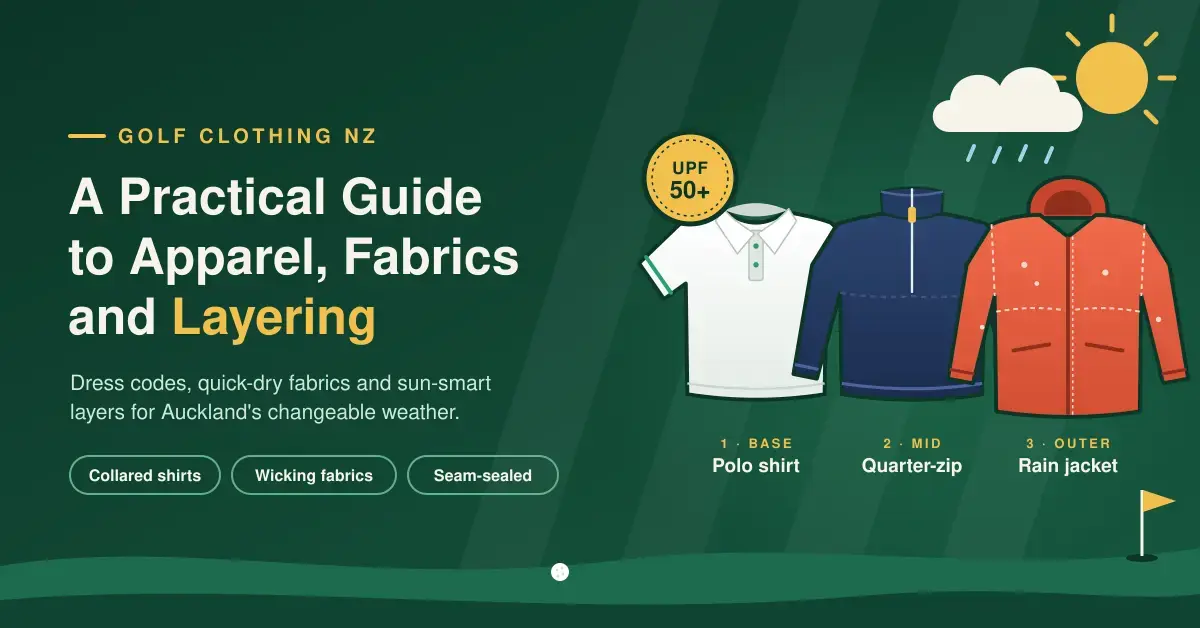
Golf clothing in New Zealand has one job with two sides: it needs to satisfy the collared-shirt dress codes at most Kiwi clubs while keeping you comfortable through Auckland’s fast-changing weather. Get it right and you barely notice what you are wearing from the first tee to the last putt; get it wrong and a heavy cotton shirt or a leaky jacket can quietly wreck your round. This guide explains the fabrics, garment types, features, prices and sun-protection standards you will meet when shopping for golf apparel in NZ, so you can build a practical wardrobe without overspending.
Key Points
- Fabric first: modern micro-polyester and polyester–elastane blends wick sweat and dry fast, unlike heavy cotton.
- Dress code: most NZ clubs require a collared shirt and non-denim trousers or tailored shorts.
- Layer up: a polo, a quarter-zip mid-layer and a seam-sealed rain jacket cover Auckland’s changeable weather.
- Sun protection: choose UPF 40+ or 50+ shirts – NZ has among the world’s highest UV and skin-cancer rates.
- Typical prices (NZD): polos $70–$150, mid-layers $110–$160, waterproof jackets $250–$600+.
What golf clothing you actually need in New Zealand
A functional golf wardrobe in NZ is built around a small number of layers you mix and match by season. You do not need a large collection to be comfortable and dress-code compliant; you need the right pieces in fabrics that move sweat and shrug off drizzle.
- Short-sleeve polo shirts – the everyday layer, worn in almost all conditions.
- Trousers and tailored shorts – non-denim, usually with belt loops.
- Mid-layers – quarter-zip pullovers or light fleeces for cool mornings.
- Waterproof jacket – a seam-sealed rain shell for the wet months.
- Windproof vest (gilet) – keeps your core warm while leaving your arms free.
Dress codes decide the baseline. Most traditional clubs, including well-known Auckland courses such as Titirangi and the wider spread of golf clubs around Auckland, expect a collared shirt (a mock-neck or skivvy is usually fine) and tailored trousers or shorts. New Zealand clubs commonly ban denim jeans, gym singlets, football shorts, drawstring track pants and swimwear, and many still ask for white or plain socks with shorts. Northern clubs tend to enforce these rules most strictly, so it is worth checking the specific club’s page before you play.
Technical fabrics vs cotton: what to wear next to your skin
The single most important clothing choice is fabric, not brand or colour. For decades fairways were dominated by 100% cotton pique polos, but cotton is hydrophilic: it soaks up sweat and rain, then turns heavy, cold and clingy. That damp weight sticks to your skin, causes chafing and subtly restricts the shoulder turn in your swing. Modern synthetics do the opposite – they pull moisture off the skin and dry quickly.
The table below compares the three fabric families you will see most often on NZ golf apparel labels. Prices are indicative RRPs for a men’s short-sleeve polo and vary widely with sales.
| Property | 100% cotton pique | Micro-polyester | Polyester–elastane blend |
|---|---|---|---|
| Moisture handling | Absorbs and holds sweat | Wicks sweat to the surface to evaporate | Wicks well and adds stretch |
| Stretch / swing freedom | Low; can bag out over time | Moderate; holds shape | High; true 4-way stretch |
| Drying speed | Slow | Fast | Fast |
| Weight when wet | Heavy and cold | Stays light | Stays light |
| Typical NZ price (polo) | $45–$85 | $75–$135 | $110–$170 |
How moisture-wicking fabric actually works
Moisture-wicking is not a coating that washes off – it is built into the yarn shape. Performance polyester is spun into fibres with grooved or cross-shaped cross-sections instead of smooth round ones. Those grooves create narrow channels that draw liquid sweat away from your skin by capillary action (the same effect that pulls water up a paper towel) and spread it across the outer face of the fabric, where a larger surface area lets it evaporate faster. The practical result is a shirt that feels dry sooner and does not cling. To keep that working, wash technical shirts in cold water with liquid detergent and skip fabric softener, which clogs the channels.
Golf shirts and polos: styles and brands compared
Golf shirts in NZ span everyday performance polos, tour-style prints and genuine luxury pieces, and most reputable ranges now meet club dress codes with structured, anti-curl collars. The differences that matter are fabric composition, fit and price rather than logos. Under Armour’s Playoff 3.0, for example, is a widely stocked performance polo with UPF 50+ and odour control at around $99.99 NZD RRP, while adidas builds its Ultimate365 polos from recycled polyester with an elastane blend for stretch.
New Zealand also has a home-grown option in Manu Golf, launched in 2024 by Tongan–Cook Islander founder Tunganekore ‘Kevin’ Fuavao. Its Polynesian-inspired polos use UPF 50+, 4-way-stretch fabric and are designed in NZ, including generous sizing that is often hard to find in imported lines. The table below sets out a representative cross-section; the price ranges are indicative NZD RRPs.
Brand Comparison
| Brand | Signature line | Fabric & tech | Typical polo price (NZD) |
|---|---|---|---|
| Under Armour | Playoff 3.0 / Iso-Chill | Polyester–elastane, UPF 50+, odour control | $90–$140 |
| adidas | Ultimate365 | Recycled polyester with elastane stretch | $120–$140 |
| Manu Golf (NZ) | Island prints | 4-way stretch, UPF 50+, designed in NZ | $70–$75 |
| FootJoy | Lisle & performance prints | Smooth lisle-feel synthetic blends | $120–$150 |
| PING | Performance polos & mid-layers | Moisture-wicking polyester, stretch quarter-zips | $100–$150 |
| Peter Millar | Luxury resort wear | Fine mercerised finishes, premium blends | $180–$250+ |
If you want to try shirts on and check sizing before committing, staff at a golf specialist such as the Golf Warehouse in Ellerslie can help you match fit and fabric to how you play.
Layering for Auckland’s weather: mid-layers, vests and rain gear
New Zealand’s maritime climate is the real reason a golf wardrobe needs planning. A round that starts in still sunshine can turn into a cold southerly or a downpour within an hour, so the smart approach is independent layers you can add or shed in seconds rather than one bulky garment.
- Mid-layers: Technical quarter-zip pullovers and light fleeces (from brands such as PING, adidas and Cutter & Buck, roughly $110–$160 NZD) trap warm air against your chest while venting excess heat. A quarter-zip lets you dump heat quickly by opening the collar.
- Waterproof shells: A genuine golf rain jacket is seam-sealed with waterproof zips and stretch panels so it does not bind your swing. Models like FootJoy’s HydroLite range or premium GORE-TEX suits from Galvin Green are built to stay 100% waterproof for years; expect to pay from about $250 NZD up to $600+ for the top GORE-TEX sets. A cheap shower jacket will wet out in real rain.
- Windproof gilets: On dry, windy days a windproof vest keeps your core insulated while leaving your arms completely free of fabric, which many players prefer for an unrestricted downswing.
Pair the jacket with a good golf umbrella and you can keep playing through most Auckland showers rather than running for the clubhouse.
Sun protection: why UPF matters more in New Zealand
Sun protection is not optional here. Australia and New Zealand have among the highest rates of skin cancer in the world, and NZ’s UV levels are markedly stronger than at comparable northern-hemisphere latitudes. A four-hour round is a long exposure, so clothing does a lot of the work that sunscreen alone cannot.
Look for a UPF (Ultraviolet Protection Factor) rating on summer polos. UPF measures how much UV a fabric blocks; a UPF 50+ garment lets through less than 1/50th of UV radiation and, per NZ guidance, offers all-day protection even for fair skin. Tightly woven or knitted synthetics in darker or richer colours generally rate higher than thin, pale cotton. Cancer Society NZ advises being SunSmart whenever the UV index is 3 or above – which in Auckland covers most of the golfing year – and pairing covering clothing with a broad-brim or legionnaire hat, sunglasses and SPF 30+ sunscreen on any exposed skin.
Features to check before you buy
Golf apparel is sports equipment that has to survive repeated washing and hard rotation, so a quick physical check beats being swayed by prints or logos. Run through this list before you pay:
- Stretch in both directions: pull the fabric horizontally and vertically. Performance garments usually blend about 5–15% elastane so they move with an aggressive swing without pinching across the back.
- Structured, anti-curl collar: inner stays or dense knit ribbing keep the collar sitting flat after washing, which also keeps you dress-code compliant.
- Silicone gripper waistband: a tacky strip inside trouser and short waistbands stops your shirt untucking mid-swing.
- Deep, flat pockets: mesh-lined pockets that lie flat hold spare balls, tees and a divot tool without bouncing.
- UPF rating on summer shirts: confirm a UPF 40+ or 50+ label rather than assuming coverage.
Clothing is only part of the kit. Sort your golf shoes for grip and waterproofing at the same time, and round out the bag with the golf accessories that make a wet or hot round manageable.
Common mistakes when buying golf clothing
Most wardrobe regrets come from a handful of avoidable errors rather than bad luck:
- Buying on price alone: a $40 cotton polo feels fine in the shop and miserable at the 12th hole in the rain. Fabric matters more than the ticket price.
- Ignoring the club dress code: turning up in a hoodie, gym singlet or denim can mean being turned away; check the specific club first.
- Skipping a real rain jacket: a fashion shell that is not seam-sealed wets through and then chills you. Buy purpose-built waterproofs.
- Forgetting sun cover: relying only on sunscreen leaves you exposed for four hours under strong NZ UV; a UPF shirt and hat do more.
- Using fabric softener: it coats the fibres and permanently reduces wicking, so technical shirts stop performing early.
- Wrong fit: a shirt that is too tight across the shoulders or too loose at the arms interferes with the swing – try before you buy where you can.
Where to buy golf clothing in NZ
You have three main channels in New Zealand, and most players use a mix. On-course pro shops carry a curated, club-appropriate range and let you try items on immediately. National golf retailers and warehouses stock the widest brand selection and run regular seasonal clearances – mid-winter and post-summer stock-takes are the best times for discounts on tour brands. Dedicated online stores, including NZ labels such as Manu Golf, are handy for specific lines and larger sizing, though you lose the fitting room. Whichever you choose, prioritise fabric and fit over branding, and buy the rain jacket and sun protection before you buy a second polo.
Sources
Frequently Asked Questions (FAQ)
What is the standard dress code at New Zealand golf clubs?
Most traditional NZ clubs expect neat, smart-casual attire: a collared polo (a mock-neck or skivvy usually counts), tailored trousers or shorts, and often white or plain socks with shorts. Denim jeans, gym singlets, football and drawstring shorts, hoodies and swimwear are generally not allowed. Rules vary by club and northern courses tend to be stricter, so check the specific club’s website before you play.
Why are cotton shirts discouraged for golf?
Cotton absorbs and holds moisture, so once you sweat or get caught in a shower a cotton shirt turns heavy, cold and clingy. That damp fabric sticks to the skin, can cause chafing and restricts your shoulder turn. Technical polyester and elastane blends wick that moisture away and dry quickly, keeping you lighter and more mobile through the round.
What does a UPF 50+ rating on a golf shirt mean?
UPF (Ultraviolet Protection Factor) rates how much UV radiation a fabric blocks. A UPF 50+ garment lets through less than one-fiftieth of UV, giving all-day protection even for fair skin. Because New Zealand has very high UV and among the world’s highest skin-cancer rates, a UPF 40+ or 50+ summer polo, plus a hat and sunscreen, is strongly recommended for a full round.
How much should I spend on golf clothing in NZ?
A performance polo typically costs $70–$150 NZD, tailored trousers or shorts around $110–$170, a quarter-zip mid-layer $110–$160, and a seam-sealed waterproof jacket from about $250 up to $600+ for premium GORE-TEX. You can start with one good polo, one mid-layer and one rain jacket, then expand during seasonal clearances rather than buying everything at once.
How do I wash technical golf apparel so it lasts?
Turn garments inside out and machine wash in cold water with a gentle liquid detergent. Never use fabric softener or bleach, as softener coats the fibres and permanently reduces the fabric’s ability to wick sweat. Hang the items to air dry in the shade and avoid high-heat tumble drying, which can damage stretch fibres and any UPF finish.