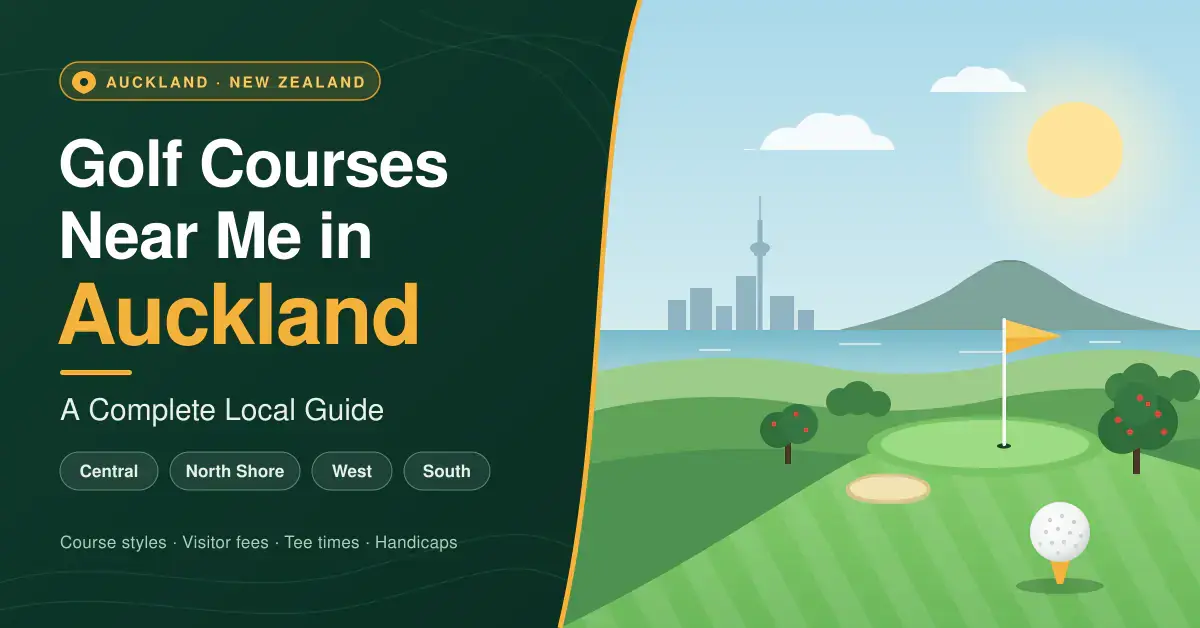
Searching for “golf courses near me” in Auckland returns dozens of options, from championship layouts that have hosted the New Zealand Open to friendly nine-hole clubs where visitors are welcome any day of the week. This guide explains how to find a course close to you, what the different course styles actually mean for your round, what a visitor pays, and how to book a tee time — using verified, current information rather than marketing language so you can pick the course that matches your location, budget and skill level.
Key Points
- Four regions: Auckland’s courses split into central, North Shore, West and South — most players are within a 45-minute drive of several.
- Two main styles: tree-lined parkland (accuracy) and sandy coastal links (low ball flight, wind).
- Visitor fees: roughly $55 to $350 for 18 holes depending on the course.
- Handicap: not needed for casual play; required for competitions (54 holes to establish an index under the World Handicap System).
- Booking: most clubs use DotGolf / the Golf NZ app for live tee-time availability.
How do I find golf courses near me in Auckland?
The quickest way to find golf courses near you is to search the region’s shared tee-booking platform rather than each club’s website one by one. Most Auckland clubs run their online bookings through DotGolf (the system behind the Golf NZ website and app), which lets you search by region or proximity, see live tee-time availability, and book as a visitor or a member. A general map search also works, but it will not show you which times are actually free.
Auckland’s courses cluster into four broad areas, and where you live usually decides your shortlist:
- Central: mature parkland clubs such as Remuera Golf Club and Maungakiekie, close to the CBD.
- North Shore: free-draining courses like Pupuke and North Shore, popular for winter play.
- West: the true links of Muriwai on the coast, plus parkland options inland.
- South: spacious, better-value parkland such as Pukekohe as the city grows southward.
Because Auckland sits on a narrow isthmus between two harbours, most residents are within a 45-minute drive of at least three or four quite different courses, so it is worth widening your search beyond the single closest club.
What are the main golf course styles in Auckland?
Auckland has two dominant course styles — parkland and links — and knowing the difference changes how you play. The soil and exposure of each course affect how the ball behaves, so the same swing produces very different results depending on where you tee off.
Parkland courses
Parkland courses are the most common type in Auckland. They are tree-lined, often built on clay or volcanic soils, and reward accuracy over raw distance. Remuera, Maungakiekie and Pukekohe are parkland layouts. In summer the fairways firm up and a low “bump-and-run” shot (a low chip that rolls to the target) is useful; in winter, softer greens accept higher approach shots. Central clay-based courses rely on good drainage, so they can play soft after heavy rain.
Links courses
Links courses are built on sandy coastal ground with few trees, firm turf and constant wind. Muriwai, laid out among the dunes near Muriwai Beach, is Auckland’s best-known true links. Here you play along the ground more than through the air, keeping the ball flight low against the Tasman breeze. Free-draining sand also means links and volcanic-soil courses stay playable through the wettest months, which is why golf on the North Shore is a favourite in winter.
Golf course architecture is a craft in its own right. Titirangi, in West Auckland, is New Zealand’s only course designed by Alister MacKenzie — the same architect responsible for Augusta National Golf Club — which is part of why it has hosted multiple New Zealand Opens.
Which golf courses are near me? A regional comparison
The table below compares a representative course from each part of Auckland, with the course style, par and an indicative 18-hole visitor green fee. Fees change and often differ for affiliated members of another Golf NZ club, so treat these as a guide and confirm on the club’s own site before you play.
Auckland Golf Course Comparison
| Course | Region | Style | Par | Indicative visitor 18-hole fee (2026) |
|---|---|---|---|---|
| Remuera Golf Club | Central | Parkland | 71 | ~$100 |
| Maungakiekie Golf Club | Central | Parkland | 72 | ~$90 |
| Pupuke Golf Club | North Shore | Parkland (undulating) | 70 | ~$55 |
| North Shore Golf Club | North Shore | Parkland (27 holes) | 72 | ~$155 |
| Titirangi Golf Club | West | Parkland (MacKenzie design) | 70 | ~$350 (overseas) |
| Muriwai Golf Club | West | Links | 72 | ~$120 |
| Pukekohe Golf Club | South | Parkland | 71 | ~$80 |
A few patterns are worth noting. Central and elite parkland clubs command the highest visitor fees; North Shore and South Auckland courses generally offer more capacity and better value; and being an affiliated member of any club (which requires a handicap) typically unlocks a lower “affiliate” rate almost everywhere.
How much does it cost to play golf in Auckland?
Casual visitor green fees in Auckland span a wide range, from roughly $50–$60 for a straightforward 18 holes up to $350 for a premier championship course. As a rough guide for 2026:
- Community and rural clubs (for example Pupuke on the North Shore): from about $55 for 18 holes.
- Mid-range parkland (Maungakiekie, Pukekohe): roughly $80–$90 for 18 holes.
- Premier and championship layouts (North Shore’s 27 holes, Muriwai, Remuera): about $100–$155 for visitors.
- Titirangi, the region’s most exclusive course: around $350 for an overseas visitor, with a lower rate for New Zealand residents.
On top of the green fee, budget for a shared electric cart (buggy) if the course is hilly, and for club or shoe hire if you are travelling light. Many clubs also use dynamic pricing, discounting quieter mid-week mornings — a simple way to play a better course for less.
Should I join a club or pay casual green fees?
Membership pays off once you play often; casual green fees suit occasional rounds. Auckland clubs offer tiered membership, from full seven-day playing rights to nine-hole, midweek, and discounted “young adult” categories for players under about 35. If you play more than once a week, full membership usually costs less over a year than the equivalent green fees, and it comes with an official handicap.
If you play only now and then, casual green fees keep things flexible and let you sample different courses. A middle path is to hold an inexpensive affiliated membership at any Golf NZ club: it gives you a handicap and access to lower “affiliate” green-fee rates at most other clubs, so you can roam the region cheaply.
Do I need a handicap to play in Auckland?
You do not need a handicap for a casual green-fee round, but you do need one to enter club competitions and most tournaments. A handicap is a number representing your playing ability, allowing golfers of different standards to compete fairly. New Zealand uses the World Handicap System, administered through Golf NZ affiliated clubs.
To establish a Handicap Index you must submit acceptable scores totalling 54 holes (for example three 18-hole cards) to a club, which are then processed and approved. Once issued, your index is recognised nationwide and visible through the Golf NZ website and app. If you are new to the game, it is worth reading up on what a golf handicap is before you sign up. Beginners can build the required scores at more forgiving, wider-fairway courses, while lower-handicap players often seek out layouts with high slope ratings to test their course management.
How do I book a tee time?
Book online through the club’s DotGolf portal or the Golf NZ app rather than turning up unannounced. The system shows live availability, lets you add playing partners or non-member guests (who are emailed automatically), and keeps a record of your upcoming bookings. You can generally cancel free of charge up to 11:59pm the day before your booked time.
Not every club has online booking switched on, so if you cannot find a course in the filters, phone it directly. At weekends and on public holidays booking ahead is essential; midweek you can sometimes walk on, but it is safer to check the portal first. Many clubs also publish GPS yardages for their hazards and greens that sync to a GPS golf watch or phone, removing the guesswork on an unfamiliar course.
Common mistakes when choosing a course near you
The most common mistake is choosing purely on distance and ignoring fit. A championship course with a high slope rating can be demoralising for a beginner, while a short executive layout may bore a low-handicapper. Other frequent errors include:
- Assuming the closest course is the cheapest. A club 20 minutes further away can be less than half the green fee.
- Turning up without a booking at the weekend and being turned away from a full sheet.
- Ignoring the dress code. Most clubs require a collared shirt and tailored shorts or trousers; denim and gym wear are usually not permitted.
- Overlooking winter drainage. After heavy rain, free-draining North Shore and links courses stay open while some clay-based central courses are soft or cart-restricted.
- Paying full visitor rates repeatedly instead of taking an affiliated membership to unlock lower fees region-wide.
If you are still learning the basics, spending time at a Pukekohe golf style parkland course or a driving range first will make your first full-course rounds far more enjoyable.
What are the wider benefits of playing locally?
Playing regularly at a nearby course delivers real health and social benefits alongside the game itself. A walked 18-hole round covers roughly 8–10 kilometres and can burn well over a thousand calories, making it accessible, low-impact exercise for a wide range of ages and fitness levels.
The social side matters too. Club competitions, coaching clinics and junior programmes make a local course an easy way to meet people, and many clubs run PGA-qualified coaching and club-fitting services on site. For newcomers to a suburb, the clubhouse is often one of the simplest routes into a local community.
Sources
- Titirangi Golf Club — Green fees
- Remuera Golf Club — official site
- Muriwai Golf Club — official site
- North Shore Golf Club — Green fees
- Maungakiekie Golf Club — Green fees
- Pupuke Golf Club — official site
- Auckland Unlimited — Auckland golf courses
- Golf NZ / DotGolf — tee booking terms
- Golf NZ — World Handicap System learning guide (2026)
Frequently Asked Questions
How do I find golf courses near me in Auckland?
Search the DotGolf tee-booking system or the Golf NZ app, which let you filter clubs by region and proximity and show live tee-time availability. Auckland’s courses fall into central, North Shore, West and South clusters, and most residents are within a 45-minute drive of several very different layouts.
How much does it cost to play golf in Auckland?
Visitor green fees range from about $55 for 18 holes at community clubs to roughly $80–$90 at mid-range parkland courses and $100–$155 at premier layouts. The most exclusive course, Titirangi, is around $350 for overseas visitors, with a lower resident rate. Fees change, so confirm with the club.
Do I need a handicap to play a casual round in Auckland?
No. A handicap is not required for casual green-fee play, but you will need one to enter club competitions or formal tournaments. New Zealand uses the World Handicap System, and you establish an index by submitting acceptable scores totalling 54 holes through a Golf NZ affiliated club.
Do Auckland golf courses have a dress code?
Most clubs require standard golf attire — typically a collared shirt with tailored shorts or trousers. Denim and athletic wear such as gym shorts are generally not permitted. Check the individual club’s website, as requirements are stricter at the more traditional central clubs.
Do I need to book a tee time in advance?
At weekends and on public holidays, booking ahead is essential. Midweek you can sometimes walk on, but it is safer to reserve online first. You can usually book and cancel free of charge through the club’s DotGolf portal up to 11:59pm the day before your round.