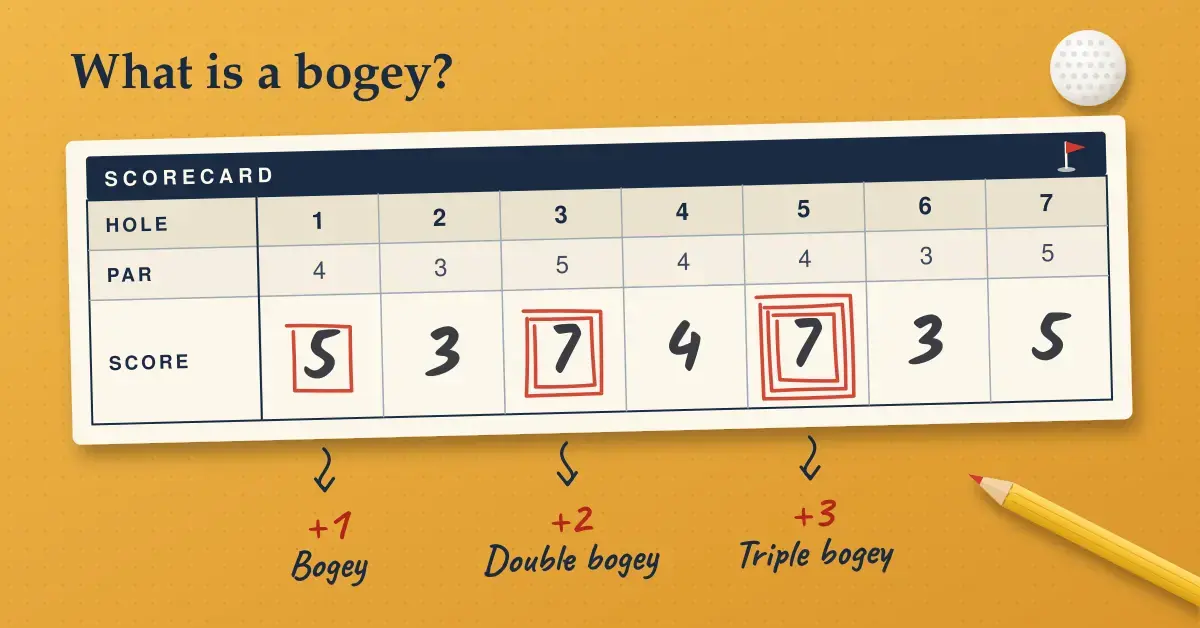
A bogey in golf is a score of one stroke over par on a single hole. If a hole is a par 4 and you take five shots to get the ball in the cup, you have made a bogey. It is one of the first scoring words most new golfers learn, and it anchors a whole family of terms – double bogey, triple bogey and beyond – that describe exactly how many strokes over par you took.
Key Points
- A bogey is one stroke over par on a single hole (for example, a 5 on a par 4).
- A double bogey is two over par and a triple bogey is three over par.
- The naming continues: quadruple bogey (four over), quintuple bogey (five over) and so on.
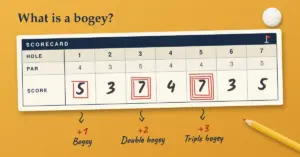
- On a scorecard you write the actual stroke count; a square drawn around the number is a common way to mark a bogey.
- Bogey golf means averaging about one over par per hole – roughly 90 on a par-72 course.
- The word comes from a late-1800s English “ground score” and an imaginary opponent, Colonel Bogey.
What is a bogey in golf?
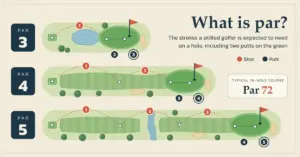
A bogey is one stroke over the par of a hole. Par is the standard number of strokes a skilled golfer is expected to need to complete a hole, so a bogey simply means you used one more shot than that standard. The term applies to a single hole, not to your whole round.
Because par changes from hole to hole, the actual number that counts as a bogey changes too. What stays constant is the “one over” relationship:
- A 4 on a par 3 is a bogey.
- A 5 on a par 4 is a bogey.
- A 6 on a par 5 is a bogey.
If you are still getting comfortable with the underlying standard, it helps to understand exactly what par in golf means first, because every scoring term – including bogey – is defined in relation to it. A bogey is the mirror image of the more celebrated “under par” results: where a bogey is one over, a birdie in golf is one under.
What is a double bogey?
A double bogey is a score of two strokes over par on a hole. On a par 4 that is a 6; on a par 3 it is a 5; on a par 5 it is a 7. For many club and recreational golfers, double bogeys are common and do a surprising amount of damage to a scorecard, because they add two shots to the total in a single hole.
Double bogeys usually come from one serious error compounded by a second – a tee shot out of position, a chip left short, then two putts – rather than from being beaten by the hole in every respect. For that reason, cutting out double bogeys is one of the fastest ways most improving golfers lower their scores.
What is a triple bogey?
A triple bogey is a score of three strokes over par on a hole: a 7 on a par 4, a 6 on a par 3, or an 8 on a par 5. A triple bogey almost always involves more than one mistake on the same hole – for example a penalty from a lost ball or a water hazard, followed by a missed recovery. Golfers sometimes call a hole like this a “blow-up hole”, because one bad sequence wipes out the good work done elsewhere in the round. A common way an ordinary bogey turns into a triple is chasing a lost hole with a hero shot – trying to rescue par with a high-risk recovery instead of taking the safe option and accepting one dropped stroke.
What comes after a triple bogey?
The naming pattern continues past a triple bogey using the same Latin-style prefixes. Each step adds one more stroke over par:
- Quadruple bogey – four over par (an 8 on a par 4).
- Quintuple bogey – five over par.
- Sextuple bogey – six over par.
- Septuple bogey – seven over par, and so on.
In practice, most golfers stop naming the score once it climbs past a triple or quadruple bogey and simply refer to the number itself, or to the hole as a disaster.
How bogeys fit into golf’s scoring terms
A bogey is easiest to understand next to the rest of the scoring ladder. Scores better than par have their own bird-themed names, while scores worse than par are all bogeys of one size or another. The table below shows how each term lines up against par and what it looks like on a par 3, par 4 and par 5.
Golf Scoring Terms Compared
| Term | Strokes vs par | On a par 3 | On a par 4 | On a par 5 |
|---|---|---|---|---|
| Albatross | 3 under | – | 1 (hole-in-one) | 2 |
| Eagle | 2 under | 1 (hole-in-one) | 2 | 3 |
| Birdie | 1 under | 2 | 3 | 4 |
| Par | Even | 3 | 4 | 5 |
| Bogey | 1 over | 4 | 5 | 6 |
| Double bogey | 2 over | 5 | 6 | 7 |
| Triple bogey | 3 over | 6 | 7 | 8 |
The “under par” end of the table is where the rarer achievements sit. One under is a birdie, two under is an eagle in golf, and three under is an albatross in golf – so rare that most golfers never make one. Bogeys live at the opposite, far more familiar, end of the same scale.
Where does the word “bogey” come from?
The word “bogey” comes from late-19th-century English golf, and its meaning has shifted over time. According to golf historians, in 1890 Hugh Rotherham, secretary of the Coventry Golf Club, came up with the idea of a standard score that a good golfer should take on each hole. He called it the “ground score”.
The name changed at Great Yarmouth Golf Club, where the secretary, Dr Browne, ran competitions against this ground score. A member named Mr C. A. Wellman is said to have complained that playing against this fixed standard was like playing a “regular bogey man” – a reference to a popular music-hall song of the day, “Hush! Hush! Hush! Here Comes the Bogey Man”. The ground score became known as the “bogey score”, and golfers imagined they were playing a phantom opponent, Mr Bogey.
In 1892, Colonel Seely-Vidal of the United Services Club at Gosport worked out the bogey for his own course. As every member held a military rank, they felt they could not compete against a mere “Mister” Bogey, so the imaginary player was given the honorary rank of colonel – and “Colonel Bogey” was born. The name later inspired the famous marching tune.
So originally a bogey was a target, not a mistake. The meaning changed in the 20th century. As equipment and players improved, scores came down, but the fixed concept of “par” – based on expert scoring – became the universal standard. The old bogey score was usually a shot or two easier than par, and over time “bogey” settled into its modern meaning of one stroke over par.
How do you mark a bogey on a scorecard?
You record a bogey on a scorecard by writing the actual number of strokes you took in the box for that hole. If you made a 5 on a par 4, you write “5”. The scorecard already prints the par for each hole, so the bogey is implied by the difference.
Many golfers also use a visual shorthand, borrowed mainly from how scores are drawn on television graphics and some printed cards:
- A square drawn around the number marks a bogey.
- A double square marks a double bogey.
- A circle marks a birdie, and a double circle an eagle.
This is a convention, not a rule of golf, so you are free to ignore it in casual play. When you are keeping score for a handicap, what matters is the accurate stroke count, which is then read against your golf handicap rather than the symbol you draw.
What is “bogey golf” and a “bogey golfer”?
“Bogey golf” means averaging about one stroke over par per hole across a full round. On a standard par-72 course, playing bogey golf for all 18 holes produces a score of around 90. It is a common informal benchmark: breaking 90 is often described as the point where a golfer has graduated from beginner to a solid, consistent club player, roughly in line with an 18 handicap.
“Bogey golfer” has a second, more precise meaning in the official rating systems that sit behind handicaps. Under the course-rating method used by the USGA and R&A, a “bogey golfer” is a defined model player with a Handicap Index of about 20.0 for men and 24.0 for women. Course raters work out the expected score for this player – the Bogey Rating – and compare it with the scratch golfer’s expected score to calculate a course’s Slope Rating, the measure of how much harder a course plays for higher handicappers than for experts.
New Zealand golfers who hold an official handicap do so through the World Handicap System administered by Golf NZ, which uses exactly these course and slope ratings to turn your scores into a portable Handicap Index.
Is a bogey a bad score?
Whether a bogey is a bad score depends entirely on the golfer, because par is set to the standard of an expert. For a touring professional, a bogey is a dropped shot and a genuine disappointment; the best players in the world build their rounds around avoiding them.
For a beginner or a high-handicap club golfer, a bogey is often a perfectly good result – sometimes the target for the hole. Making bogeys steadily, rather than mixing pars with blow-up holes, is a sign of controlled, consistent golf. In Stableford and net competitions, a bogey can even earn a point or win a hole once your handicap strokes are applied, so it is far from a failure for most players.
The useful way to judge a bogey is against your own game, not against par in the abstract. If you are working your way down from scores of 100 or more, a round full of bogeys is real progress. If you are chasing a single-figure handicap, the same round is a day to forget.
Bogeys in match play versus stroke play
A bogey counts differently depending on the format you are playing. In stroke play – the most common format, where you add up every shot – a bogey simply adds one extra stroke to your running total for the round.
In match play, where you compete hole by hole against an opponent, the size of the number matters less. A bogey only costs you if your opponent scores better on that hole; if you both make a bogey, the hole is halved. This is why players sometimes concede a hole or pick up once they can no longer win it, a tactic that makes no sense in stroke play. If you want to follow how these scores are displayed during a tournament, our guide to reading a golf leaderboard explains how over-par and under-par totals are shown.
Sources
- Scottish Golf History – Origin of the term bogey
- Colonel Bogey March – origin of the name (Wikipedia)
- National Club Golfer – What is a double bogey?
- Golf Compendium – Triple bogey, quadruple bogey and the scores that follow
- Stymie Golf – Bogey rating and the bogey golfer (20.0 men / 24.0 women)
- Maine State Golf Association – Maximum hole score (net double bogey)
Frequently asked questions
What is the plural of bogey in golf?
The plural is “bogeys”. You would say a golfer “made three bogeys on the back nine”. The spelling “bogies” usually refers to other meanings of the word and is not used for golf scores.
Is a bogey better or worse than a par?
A bogey is worse than a par, because it takes one extra stroke. Par means you matched the hole’s standard score; a bogey means you needed one more shot than that. In order from best to worst on a single hole, the common run is eagle, birdie, par, bogey, double bogey.
What is a net bogey?
A net bogey is a bogey after your handicap strokes are taken into account. If a hole gives you one handicap stroke and you make a double bogey, your net score for that hole is a bogey. Net scoring lets golfers of different abilities compete fairly in the same competition.
What is the highest score I should write down for handicap purposes?
Under the World Handicap System, the maximum score you record on any hole for handicap purposes is a net double bogey – that is, two over par plus any handicap strokes you receive on that hole. This cap stops one disaster hole from distorting your Handicap Index, so you can pick up once you reach that number.