
An eagle is one of the most satisfying — and rarest — things a golfer can put on a scorecard. In plain terms, you score an eagle when you finish a single hole two strokes under par. That is a serious feat for anyone, and it happens far less often than the pars and birdies most players chase week to week. To understand why an eagle is such a big deal, it helps to see how it sits alongside the other scoring terms you hear on the course. If you are keen to start hunting one of your own, this guide from golf.co.nz can help you find a course near you.
What is an eagle in golf?
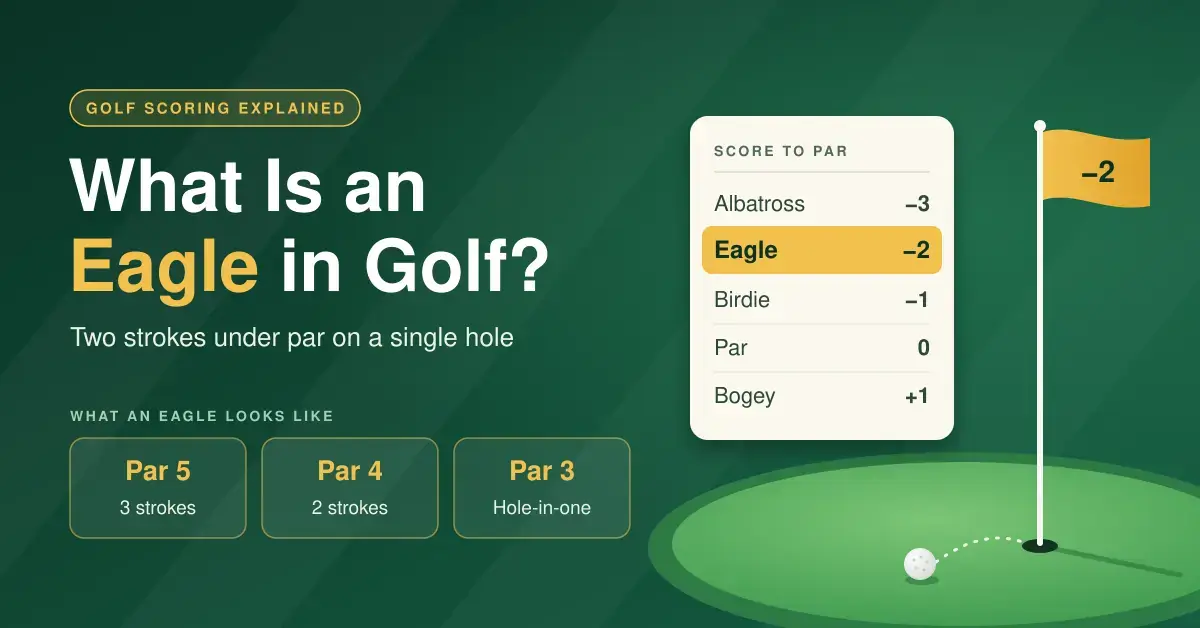
An eagle is a score of two strokes under par on one hole. Par is the number of shots a proficient golfer is expected to need on a hole, so beating that number by two means you have played the hole exceptionally well. Because the target changes with the length of the hole, an eagle looks different depending on the par:
- On a par 5 — three strokes. Usually the player reaches the green in two shots and holes a single putt.
- On a par 4 — two strokes. This normally means driving onto or near the green and then holing out, or holing a long approach shot.
- On a par 3 — one stroke, which is a hole-in-one (also called an ace).
In other words, an eagle is always “two better than expected” for that particular hole, whether the hole is short or long. The scoring itself does not change your official handicap on the spot, but a run of eagles and birdies will lower it over time.
Key Facts
- What it is: A score of two strokes under par on one hole.
- On a par 3: A hole-in-one (an ace).
- On a par 4: Two strokes — usually a drive onto the green and one putt, or holing a long approach.
- On a par 5: Three strokes — most often reaching the green in two, then one putt.
- Where it happens most: Short, reachable par 5s.
- How rare it is: Even the PGA Tour’s leading eagle-makers average only about 0.25 eagles per round.
- One better: An albatross (double eagle), three strokes under par.
How does an eagle compare to par and a birdie?
An eagle only makes sense once you understand the scores just below it. Golf uses a ladder of terms that describe how many strokes above or below par you finished a hole, and the eagle sits near the very top of that ladder.
What is par?
Par is the regulation number of strokes an expert golfer is expected to take on a hole, allowing for two putts once on the green. It is set by the hole’s length, terrain and hazards. Most courses are built from par-3, par-4 and par-5 holes, with par 3s the shortest and par 5s the longest. Finishing a par-4 hole in exactly four strokes is a par — and for many club golfers a solid par is the highlight of the round.
What is a birdie?
A birdie is one stroke under par — three on a par 4, for example. Birdies are far more common than eagles but still take a near-perfect hole to achieve, typically reaching the green in regulation and then holing a single putt. An eagle demands one more stroke saved on top of that, which is why it is so much harder to pull off.
Comparison
| Term | Relative to par | Par 3 | Par 4 | Par 5 |
|---|---|---|---|---|
| Albatross (double eagle) | 3 under | – | Hole-in-one | 2 strokes |
| Eagle | 2 under | Hole-in-one | 2 strokes | 3 strokes |
| Birdie | 1 under | 2 strokes | 3 strokes | 4 strokes |
| Par | Level | 3 strokes | 4 strokes | 5 strokes |
| Bogey | 1 over | 4 strokes | 5 strokes | 6 strokes |
How rare is an eagle?
Eagles are rare even for the best players in the world. On the PGA Tour, the golfers who make the most eagles still average only about a quarter of an eagle per round — in the region of 0.22 to 0.28 eagles per round across a season, or roughly one eagle every four rounds. That is the tour’s leaders; the field as a whole makes them far less often.
For an amateur, the numbers are far steeper. Reaching a par-5 green in two shots is already beyond most club players, so a large share of amateur eagles come from holing out from off the green or from an unexpectedly long putt. Many keen golfers play for years before recording their first eagle, and plenty of casual players never do. That rarity is exactly what makes it such a prized moment.
Where do eagles usually happen?
Most eagles are scored on short, reachable par 5s. On these holes a long, accurate drive followed by a strong second shot can put the ball on the green with only a putt left for the eagle. Reachable par 4s are the next most common source — a big drive onto or beside the green sets up a chip or putt for the two. Par-3 eagles are the rarest of all, because they require a hole-in-one, which is largely a matter of a great shot meeting a slice of luck.
How do you score an eagle?
There is no guaranteed formula, but you can tilt the odds in your favour by focusing on the parts of the game that create eagle chances. The aim on a par 5 is to give yourself a putt for the eagle, which means reaching the green in two.
Build driving distance and accuracy
Reaching a par-5 green in two starts with a long, straight drive that leaves a manageable second shot. Distance without control just brings hazards into play, so work on both. Practising your swing at the driving range, doing golf-specific strength work and checking your speed with a launch monitor all help. Carrying the right mix of clubs in your bag for the distances you actually hit matters too.
Sharpen your long approach
Even a great drive leaves a long second shot into the green, often with a fairway wood or hybrid. Practising these longer approach clubs — and learning to shape the shot to hold the green — turns “close” into “on the green with a putt for eagle.” Accuracy from 200-plus metres is what separates an eagle chance from a bogey scramble.
Trust your putting and short game
The last stroke of an eagle is almost always a putt or a chip. Long eagle putts rarely drop, so lag them close enough to tap in for a birdie if the eagle slips by. Reliable chipping also matters, because holing out from just off the green is one of the most realistic ways for an amateur to make an eagle.
Common mistakes when chasing an eagle
Trying to force an eagle often costs more strokes than it saves. Keep these traps in mind:
- Over-swinging for distance. Swinging out of your shoes to reach a par 5 in two usually finds trouble. A controlled swing that keeps the ball in play protects your score even when the eagle does not come off.
- Ignoring the layup. If the green is guarded by water or bunkers, laying up to a comfortable wedge distance often gives a better birdie chance — and a much safer worst case — than a risky go for the green.
- Racing eagle putts. Long putts hit too hard can run well past, turning a two-putt birdie into a bogey. Prioritise pace so a missed eagle still leaves a simple birdie.
- Chasing eagles on the wrong holes. Long par 5s and tight par 4s are not realistic eagle opportunities for most players. Pick your moments on genuinely reachable holes.
Eagle vs albatross, condor and other rare scores
The eagle is impressive, but the scoring ladder does not stop there. Going one better is an albatross — three strokes under par, also known as a double eagle — which typically means holing a second shot on a par 5 or an ace on a par 4. Rarer still is the condor, four under par, which almost only happens as a hole-in-one on a par 5 and is one of the least-recorded feats in the sport. In the other direction, one over par is a bogey, two over a double bogey, and so on. Seen together, these terms show just how far below the expected score an eagle really sits.
Where does the term “eagle” come from?
The word “eagle” grew out of the older golf term “birdie.” In early 20th-century American slang, calling something a “bird” meant it was excellent, and a hole played one under par became a birdie. When players wanted a name for the even better score of two under par, they reached for a bigger, grander bird — the eagle, the national symbol of the United States. The term spread from the US and was in use in Britain by around 1919, becoming widely accepted through the 1920s and 1930s.
Who realistically scores eagles?
Eagles are within reach of stronger players who can reach par 5s in two, but they remain occasional even for them. Professionals and low-handicap amateurs make the majority of eagles, usually on reachable par 5s. Mid- and high-handicap golfers are far more likely to record their eagles by holing out with a chip or a long putt rather than by reaching a green in two. Whatever your level, an eagle is best treated as a memorable bonus rather than a score you can plan on — which is exactly why golfers talk about theirs for years afterward. If you want to test your game on a variety of holes, you can find golf courses across New Zealand to play.
Sources
Frequently Asked Questions (FAQ)
What is an eagle in golf in simple terms?
An eagle is a score of two strokes under par on a single hole. That means three strokes on a par 5, two strokes on a par 4, or a hole-in-one on a par 3.
Is an eagle better than a birdie?
Yes. A birdie is one stroke under par, while an eagle is two strokes under par. An eagle saves one more stroke than a birdie on the same hole, which makes it rarer and harder to achieve.
What is an eagle on a par 3?
An eagle on a par 3 is a hole-in-one, because two under par on a par-3 hole equals a single stroke. It is the least common way to make an eagle and usually needs a great shot plus some luck.
What is better than an eagle in golf?
An albatross, also called a double eagle, is better — it is three strokes under par. Rarer still is a condor, four under par, which almost only occurs as a hole-in-one on a par 5.
How often do professional golfers make eagles?
Not very often. Even the PGA Tour players who make the most eagles average only about 0.22 to 0.28 per round over a season — roughly one eagle every four rounds — and the wider field makes them far less frequently.