
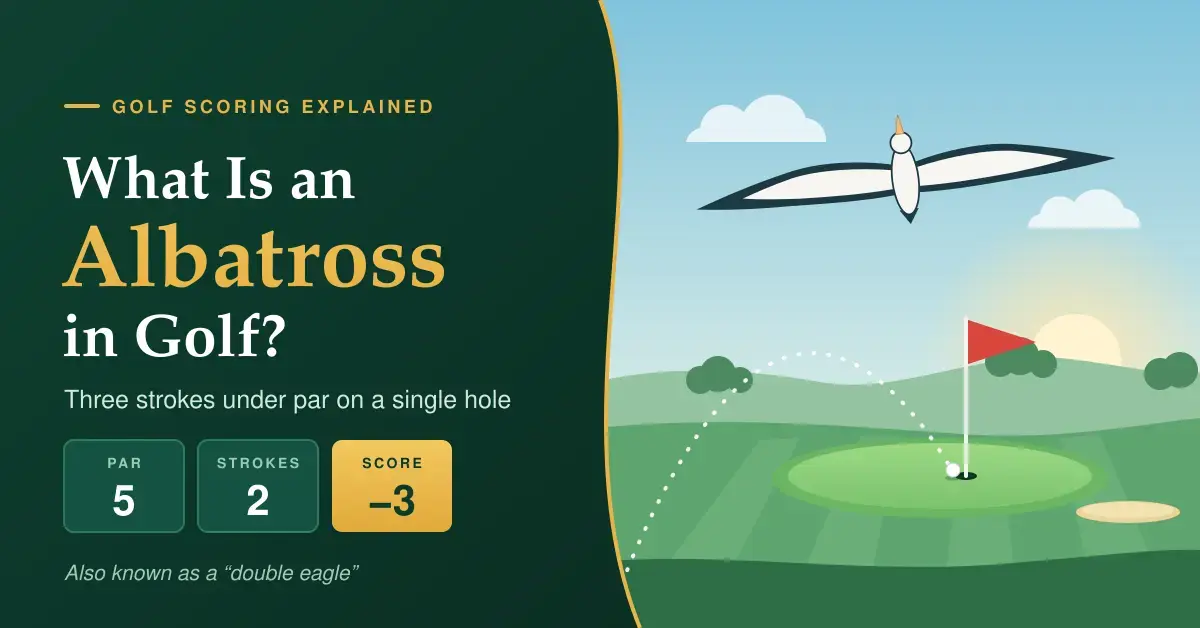
An albatross in golf is a score of three strokes under par on a single hole — for example, holing out in two shots on a par 5, or making a hole-in-one on a par 4. It is one of the rarest scores in the sport, harder to achieve than a hole-in-one, and it is also known as a “double eagle.” This guide explains what an albatross is, why it has that name, how it happens, exactly how rare it is, and how it compares with the other scoring terms you will hear on the course.
Key Points
- An albatross is a score of three strokes under par on a single hole.
- It is also called a double eagle, mainly in the United States.
- The usual way to make one is a 2 on a par 5; a hole-in-one on a par 4 also counts.
- It is rarer than a hole-in-one — roughly 6 million to 1 for an average golfer.
- An even rarer score, four under par, is called a condor.
What is an albatross in golf?
An albatross is a hole completed in three strokes fewer than the hole’s par. Par is the number of strokes a skilled golfer is expected to need on a hole, so scoring three under that figure is an exceptional result. In practice there are only two realistic ways it happens:
- A 2 on a par 5 — the most common route. The player reaches a long hole in two shots and holes the second, usually a long approach or a chip that rolls in.
- A 1 on a par 4 — a hole-in-one on a par 4, which is even less likely because it needs a single, very long, very accurate tee shot to find the cup.
Because a par-5 albatross needs the player to reach the green in two, it almost always occurs on holes where a long, straight drive leaves a manageable second shot. A downhill or downwind par 5, or a shorter one that stronger players can reach, gives the best chance. Even then, the approach still has to finish in the hole rather than merely close to it.
Why is it called an albatross?
The name comes from golf’s tradition of using birds to describe scores under par, and the albatross — one of the largest birds in the world — represents the biggest achievement in that family. The scale runs from a birdie (one under par), to an eagle (two under par), and then the albatross (three under par). Each step up the ladder is named after a more impressive bird, matching how much rarer the score is.
In the United States the same score is usually called a “double eagle,” because it is one better than an eagle. That term is a little misleading — a double eagle is not twice an eagle’s two-under, it is one stroke better at three-under — but the two names, albatross and double eagle, describe exactly the same result. The bird-based naming is more common in Britain, New Zealand and much of the Commonwealth.
How do you make an albatross?
You make an albatross by finishing a hole three strokes under its par, and reaching that point calls for both power and precision in a single moment. The key is that the ball has to end up in the hole, not just on the green. A player might do everything right — a long drive, a bold second shot from the fairway — and still only make an eagle if the ball stops short of the cup.
The practical requirements are demanding:
- Distance off the tee. On a par 5, you need a drive long enough that the green is within range of your second shot. Most amateur golfers cannot reach a par 5 in two at all, which rules out an albatross for them before the second shot is even played.
- Accuracy on the approach. The second shot, often struck with a fairway wood or long iron from 200-plus metres, has to be online enough to catch the hole. Learning a repeatable, powerful action helps — see our guide on how to swing a golf club.
- A slice of luck. Even tour professionals rely on a favourable bounce and roll for the ball to disappear. This is why albatrosses are celebrated as much for their fortune as for their skill.
How rare is an albatross?
An albatross is rarer than a hole-in-one, which makes it one of the least common scores in golf. The most widely cited figure puts the odds of an average golfer making an albatross at roughly 6 million to 1, while a low-handicap or professional player — who can actually reach par 5s in two — is often quoted at closer to a million to 1. By comparison, an ordinary golfer’s odds of a hole-in-one are usually given as about 12,500 to 1.
Part of the reason for the rarity is simply access: it is estimated that fewer than one in ten golfers can reach a par 5 in two shots, so the vast majority never have a realistic chance at the score. Across a whole year of golf worldwide there are tens of thousands of holes-in-one but only a few hundred recorded albatrosses.
Albatross vs. hole-in-one
An albatross is three under par, while a hole-in-one is simply completing a hole in one shot. The two overlap only on a par 4: an ace there is both a hole-in-one and an albatross. On a par 3, a hole-in-one is a birdie-beating result but only two under par, so it is not an albatross. This is why an albatross is considered the greater feat — a hole-in-one on a par 3 needs one great shot, whereas a par-5 albatross needs two outstanding shots in a row.
Albatross vs. condor
A condor is four strokes under par on a single hole, making it even rarer than an albatross. In practice a condor almost always means a hole-in-one on a par 5, which requires an enormous, perfectly placed drive and usually a very particular course layout (a sharp dogleg the player can cut across, or thin air at high altitude). Only a handful of condors have ever been documented, which is why the albatross — not the condor — is the score most golfers regard as the pinnacle they might realistically dream of.
Golf Scoring Terms Compared
| Term | Strokes vs. par | Typical example | Rarity |
|---|---|---|---|
| Condor | 4 under | 1 on a par 5 | Almost unheard of (a few ever) |
| Albatross (double eagle) | 3 under | 2 on a par 5, or 1 on a par 4 | Extremely rare (~6,000,000 to 1) |
| Eagle | 2 under | 3 on a par 5 | Uncommon |
| Birdie | 1 under | 3 on a par 4 | Common for skilled players |
| Par | Even | 4 on a par 4 | The expected score |
| Bogey | 1 over | 5 on a par 4 | Very common |
| Double bogey | 2 over | 6 on a par 4 | Very common |
Famous albatrosses in golf history
The most famous albatross in golf history was made by Gene Sarazen at the 1935 Masters, and a few landmark examples show how memorable the score can be:
- Gene Sarazen, 1935 Masters. Sarazen holed a 4-wood from around 220 yards on the par-5 15th at Augusta National to erase a three-shot deficit in one swing. Dubbed “the shot heard ’round the world,” it helped force a playoff, which he won, and it put the young Masters tournament on the map.
- Louis Oosthuizen, 2012 Masters. Oosthuizen made an albatross on the par-5 2nd hole in the final round, only the fourth-ever double eagle at the Masters and the first on that hole, sending his approach shot rolling across the green and into the cup.
- Young Tom Morris, 1870 Open Championship. One of the earliest recorded albatrosses in top-level play came at Prestwick, where Morris scored a 3 on a hole then set as a par 6.
Albatrosses in New Zealand golf
Albatrosses are as rare in New Zealand as they are anywhere else, and while club golfers occasionally record one, verified professional examples are hard to pin down. New Zealand has produced world-class players — most notably Sir Bob Charles and, more recently, Open champion Ryan Fox — and the country’s reachable par 5s give the score a genuine, if slim, chance. Clubs and reachable par-5 layouts around Auckland, such as Titirangi Golf Club, are exactly the kind of courses where an albatross can happen. If you play in a professional field, the New Zealand Open is the premier stage where such a moment would draw national attention. Because no official national register of amateur albatrosses is kept, individual claims should be treated as anecdotal unless confirmed by the club or tournament involved.
Common mistakes and misconceptions
The most common mistake is confusing an albatross with an eagle or a hole-in-one, so it helps to be clear about what each term actually means:
- Assuming a hole-in-one is always an albatross. It is not. A hole-in-one on a par 3 is two under par; only an ace on a par 4 counts as an albatross.
- Mixing up an albatross and an eagle. An eagle is two under par (for example a 3 on a par 5), while an albatross is three under. Reaching a par 5 in two and two-putting is an eagle, not an albatross.
- Thinking “double eagle” means four under. Despite the name, a double eagle is three under par, exactly the same as an albatross.
- Believing you can plan for one. An albatross cannot be strategised into existence. Good driving distance and a solid handicap improve your chances of reaching par 5s in two, but the ball still has to drop, which is largely down to luck.
- Recording the score incorrectly. On a scorecard an albatross is just the raw number of strokes (a 2 on a par 5). The bird name is a description of the result, not something you write in the box.
Sources
- PGA of America — Odds of a hole-in-one, albatross, condor and golf’s unlikely shots
- Golf News Net — How rare is an albatross (double eagle) in golf?
- LiveAbout — Odds of making a double eagle (albatross)
- ESPN Classic — Sarazen’s masterful double eagle
- Golf Compendium — Every double eagle in Masters history
Vanliga frågor (FAQ)
Is an albatross the same as a double eagle?
Yes. Albatross and double eagle are two names for the same score: three strokes under par on a single hole. “Albatross” is the common term in Britain, New Zealand and much of the Commonwealth, while “double eagle” is used mainly in the United States.
What is an example of an albatross?
The clearest example is a 2 on a par 5, where a player holes their second shot. A hole-in-one on a par 4 also counts, because it too finishes the hole three strokes under par.
Is an albatross rarer than a hole-in-one?
Yes. An albatross is considered rarer than a hole-in-one. An average golfer’s odds of an albatross are often quoted at around 6 million to 1, compared with roughly 12,500 to 1 for a hole-in-one, largely because most players cannot reach a par 5 in two shots.
What is better than an albatross?
A condor, which is four strokes under par on one hole, is better than an albatross. A condor almost always means a hole-in-one on a par 5 and is so rare that only a handful have ever been recorded.
What is the difference between an eagle and an albatross?
An eagle is two strokes under par on a hole, while an albatross is three strokes under. On a par 5, a 3 is an eagle and a 2 is an albatross, so an albatross is always one stroke better than an eagle on the same hole.