A golf leaderboard is the scoreboard of professional golf: a live, ranked list that tells you who is leading a tournament, by how much, and how the rest of the field is chasing. Once you know how to read one, a leaderboard becomes far more than a list of names — it is a window into strategy, form and pressure. This guide explains exactly how a leaderboard works, how to follow one live in New Zealand and around the world, and how to interpret the deeper statistics behind the numbers, using verified results from the 2026 season as worked examples.
Key Points
- A golf leaderboard ranks players by their cumulative score to par — the lowest score sits at the top.
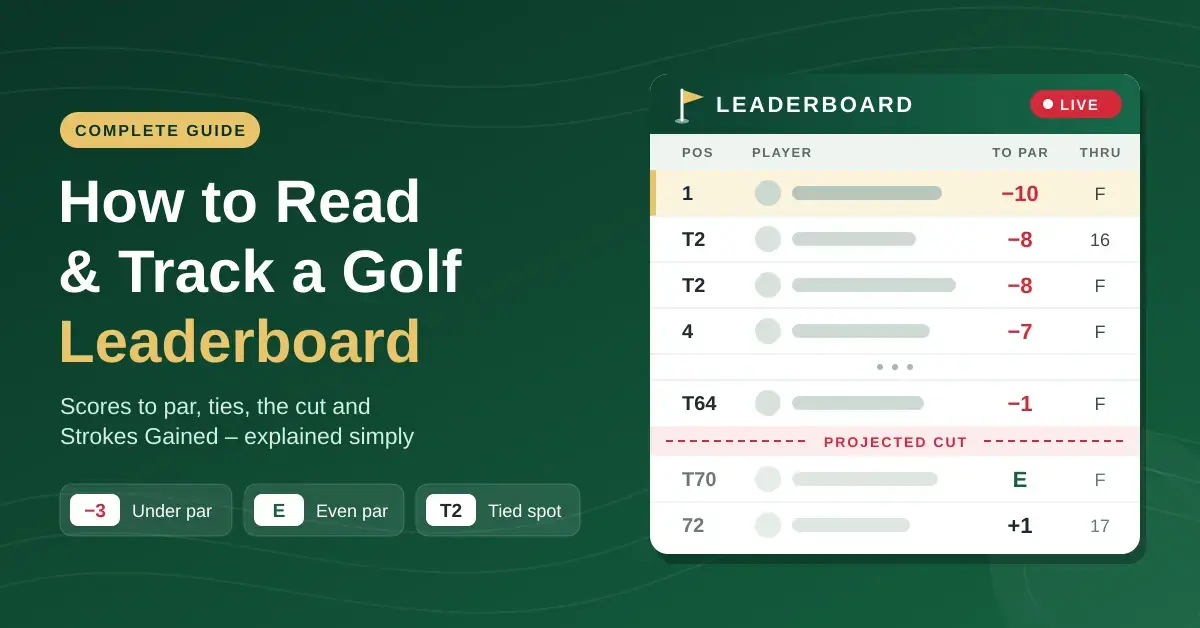
- A red, minus figure is under par; “E” is even par; a positive figure is over par.
- “T” means tied: two or more players share that position and any prize money.
- The cut, made after 36 holes, trims the field so only contenders play the weekend.
- Strokes Gained compares every shot to the field average across four areas of the game.
- 2026 NZ Open: Daniel Hillier won at Millbrook on 22-under, the first Kiwi champion since 2017.
- 2026 Masters: Rory McIlroy won back-to-back, one shot ahead of Scottie Scheffler.
What a golf leaderboard actually shows
A golf leaderboard ranks every player in a tournament by their score relative to par, with the lowest score at the top. In stroke play — the format used in almost every professional event — the winner is simply the player who takes the fewest strokes over 72 holes. Instead of showing raw totals, boards usually display a running figure such as “-12” (twelve under par) because it is easier to compare players who have completed different numbers of holes.
Most leaderboards show, from left to right: the player’s position, their name, their total score to par, the round-by-round scores, and their aggregate stroke total. Live boards add a “Thru” column (how many holes a player has played) and a “Today” column (their score in the current round), so you can see who is charging and who is fading in real time.
Reading positions, ties and “to par”
“To par” is the number that matters most on a leaderboard. Par is the number of strokes an expert golfer is expected to need for a hole or a course; beating it produces a red, minus figure, while a positive figure means over par. A player on “E” is exactly even par. Because scores accumulate across four rounds, a leader on -20 has banked twenty strokes’ worth of advantage over the course, not a single round.
When two or more players share the same score, the board marks them with a “T” for tied — so “T3” means a group sharing third place. Ties are settled for the trophy by a play-off if they occur at the very top after 72 holes, but for every other position the players simply share the ranking and split the relevant prize money. Understanding the difference between a solo position and a tie is the first skill of reading any board.
What the cut line means
The cut is the score a player must beat after 36 holes (two rounds) to keep playing on the weekend. Most professional tournaments field well over 100 players for the first two days, then reduce the number — commonly to around the top 65 and ties — so that only those in contention continue. In the 2026 New Zealand Open, the halfway cut fell at a few under par, and the players who survived it went on to fight for the title over the weekend.
Watching the “projected cut” during the second round tells you how hard a course is playing. A cut line drifting deeper under par signals benign, scoring-friendly conditions; a cut climbing toward even par usually means wind, firm greens or difficult pins. For a player sitting on the bubble, Friday afternoon becomes a nerve test as the number moves with every group that finishes.
Golf scoring terms you will see on every leaderboard
Every leaderboard is built from hole-by-hole scoring terms, each defined by its result relative to par. Knowing them makes the running total instantly readable: a run of red numbers is a birdie streak, while a “big number” is the double or triple bogey that wrecks a card. The table below compares the terms you will meet most often, and you can read more in our explainers on what a birdie means and how handicap rankings translate the same idea for amateurs.
Golf Scoring Terms Compared
| Term | Score on the hole | What it means |
|---|---|---|
| Albatross | 3 under par | Extremely rare, e.g. a 2 on a par 5 |
| Eagle | 2 under par | A standout hole, often on a reachable par 5 |
| Birdie | 1 under par | The bread-and-butter of a low round |
| Par | Even | The expected score for the hole |
| Bogey | 1 over par | A dropped shot |
| Double bogey + | 2 or more over par | A “big number” that can wreck a card |
| To par (total) | Cumulative vs par | The running figure shown on the leaderboard |
How to follow live golf leaderboards in New Zealand and worldwide
You can follow a live golf leaderboard for free through official tournament and tour channels, which update shot by shot. For New Zealand events, the New Zealand Open and the national tours publish real-time boards during competition weeks, while global events are best followed on the organising body’s own site.
- New Zealand Open and domestic events: the official NZ Open site and the Asian Tour / PGA of Australasia platforms carry live scoring.
- PGA Tour: the tour’s official app and website show live boards plus Strokes Gained data, and our guide to tracking the PGA Tour explains how to make sense of it.
- The majors: each major — the Masters, PGA Championship, U.S. Open and The Open — runs its own live leaderboard during tournament week.
- DP World Tour and LIV: both publish live scoring, though the formats differ; see our overview of LIV Golf for how its team-and-individual boards work.
Many fans also track the market alongside the scoreboard, comparing the leaderboard against the latest golf betting odds to see how the field’s chances are priced through the day. Treat that purely as entertainment and background context rather than a guide to how the tournament will finish; see the responsible-gambling note near the end of this article.
Strokes Gained and the numbers behind the leaderboard
Strokes Gained is the statistic that explains why a player sits where they do on the leaderboard. Developed by Columbia University professor Mark Broadie and adopted by the PGA Tour, it compares every shot a player hits against the field’s average from the same position, then adds up the gains and losses. A drive that leaves an easier approach than average “gains” a fraction of a stroke; a missed short putt “loses” one. The methodology breaks into four areas — off the tee, approach, around the green and putting — so a leaderboard leader’s edge can be traced to a specific part of the game.
This is how analysts move beyond the raw board. A player can be on the same score as a rival but have reached it in a completely different way — one through relentless ball-striking, another through a hot putter. The record of past major champions, such as former U.S. U.S. Open winner Gary Woodland is a good example of how strength in a single performance category can shape a tournament. The table below summarises the technical metrics elite leaderboards now track alongside the score.
| Metric | What it measures | Why it matters |
|---|---|---|
| SG: Tee-to-Green | Total strokes gained excluding putting | Isolates ball-striking dominance |
| Greens in Regulation | Reaching the green with at least two putts to spare for par | Indicates iron-play accuracy and consistency |
| Driving Accuracy | Percentage of fairways hit from the tee | Critical on tight, tree-lined courses |
| Scrambling | Percentage of pars saved after missing the green | Shows short-game resilience under pressure |
| Putts per GIR | Putts taken on greens hit in regulation | Reflects both approach quality and putting |
The 2026 New Zealand Open leaderboard, decoded
The 2026 New Zealand Open produced one of the most memorable leaderboards in the event’s history. Played at Millbrook Resort near Queenstown in early March, it was won by local professional Daniel Hillier, who finished on 22-under-par 262 for a two-shot victory over Australia’s Lucas Herbert. Hillier became the first New Zealander to win the national Open since Michael Hendry in 2017, ending a nine-year drought for home players and closing with a final-round 67.
Reading the final board shows where the tournament was decided: Hillier’s rounds of 63-68-64-67 reflect sustained low scoring rather than one freak day, the hallmark of a controlled, front-running win. The table below reconstructs the top five.
| Pos | Player | To Par | R1 | R2 | R3 | R4 | Total |
|---|---|---|---|---|---|---|---|
| 1 | Daniel Hillier (NZ) | -22 | 63 | 68 | 64 | 67 | 262 |
| 2 | Lucas Herbert (AUS) | -20 | 70 | 65 | 62 | 67 | 264 |
| T3 | Tomoyo Ikemura (JPN) | -17 | 68 | 69 | 63 | 67 | 267 |
| T3 | Kerry Mountcastle (NZ) | -17 | 68 | 64 | 64 | 71 | 267 |
| 5 | Travis Smyth (AUS) | -16 | 68 | 63 | 69 | 68 | 268 |
The 2026 Masters leaderboard: how golf’s biggest board finished
The 2026 Masters, the 90th edition, finished with Rory McIlroy winning back-to-back green jackets — the headline result of the year’s first major. Played from 9–12 April at Augusta National Golf Club (par 72, 7,565 yards), it saw McIlroy hold off world number one Scottie Scheffler by a single stroke, joining Jack Nicklaus, Nick Faldo and Tiger Woods as the only players to win the Masters in consecutive years.
The Masters leaderboard is a case study in why the “Thru” and “Today” columns matter. Augusta’s back nine — and its famous stretch known as Amen Corner — routinely reshapes the board on Sunday afternoon, so a one-shot margin that looks settled can swing on a single hole. Following the live board there is less about the overall total and more about who has holes in hand and who has the toughest run home.
NZ PGA Championship 2026: reading a wind-affected board
A leaderboard also tells you about the weather. At the 2026 Quinovic New Zealand PGA Championship, played in fierce coastal wind, American Austen Truslow won on 6-under 274 for a three-stroke victory, with 17-year-old amateur Cooper Moore an eye-catching runner-up. On a board like this, the winning score sits far higher than a calm-weather event, and Strokes Gained around the green becomes decisive as players scramble for pars rather than chase birdies. When you see a leaderboard bunched near even par, wind and firm conditions are almost always the reason.
Common mistakes when reading a golf leaderboard
Most misreadings come from ignoring context rather than misreading the numbers. Avoid these frequent errors:
- Comparing totals instead of “to par.” A player on 210 after three rounds is not necessarily behind one on 138 after two — always read the to-par figure and the “Thru” column.
- Forgetting who is still on the course. An early finisher may top the board temporarily while the leaders still have holes to play; the “clubhouse leader” is not the same as the tournament leader.
- Treating a tie as a fixed order. A “T2” group shares the position and prize; the board does not rank players within a tie.
- Overlooking the cut. A great opening round means little if the player misses the 36-hole cut and never reaches the weekend.
- Judging on score alone. Two players on the same number can be in very different form; the underlying Strokes Gained data often tells the real story.
Modern boards update shot by shot and are cross-checked by on-course scorers, a level of transparency that protects the integrity of results — unlike the scoring controversies that have dogged other televised contests over the years, such as the case documented on Wikipedia. In professional golf, the number you see has already been verified against the player’s signed card.
Who benefits from tracking leaderboards
Leaderboard literacy is useful well beyond elite fandom. Club golfers use professional boards to study course management and shot selection; fans use them to follow national players such as Hillier across global tours; and newcomers use them as a fast, structured way to learn the sport’s scoring language. For Auckland golfers in particular, reading how the world’s best manage risk on par-5s and defend a lead is a practical route into better decision-making on their own rounds.
Responsible gambling: Golf betting is entertainment, not a source of income, and no leaderboard analysis, statistic or tip improves the odds set by a bookmaker. Betting is restricted to those aged 18 and over. In New Zealand, sports betting is offered domestically through TAB NZ, and free, confidential help is available from the Gambling Helpline on 0800 654 655 or at gamblinghelpline.co.nz. If gambling stops being fun, stop.
Sources
Vanliga frågor (FAQ)
Who won the 2026 New Zealand Open?
Daniel Hillier won the 2026 New Zealand Open at Millbrook Resort, finishing on 22-under-par 262 for a two-shot victory over Lucas Herbert. He was the first New Zealander to win the title since Michael Hendry in 2017.
Who won the 2026 Masters Tournament?
Rory McIlroy won the 2026 Masters at Augusta National, one stroke ahead of Scottie Scheffler. It was his second Masters in a row, making him one of only four players to win the event in consecutive years.
What does “Strokes Gained” mean on a golf leaderboard?
Strokes Gained is a statistic that compares each shot a player hits against the field average from the same position, then totals the gains and losses. It splits into off the tee, approach, around the green and putting, showing exactly where a player is winning or losing ground.
What does the “T” next to a position mean?
The “T” stands for “tied,” meaning two or more players share that position with the same score. A tie for the lead after 72 holes is decided by a play-off; all other tied positions simply share the ranking and prize money.
Where can I follow a live golf leaderboard for New Zealand events?
The official New Zealand Open website and the Asian Tour and PGA of Australasia platforms carry live, shot-by-shot leaderboards during tournament weeks, and national golf bodies publish real-time scoring for major domestic events.