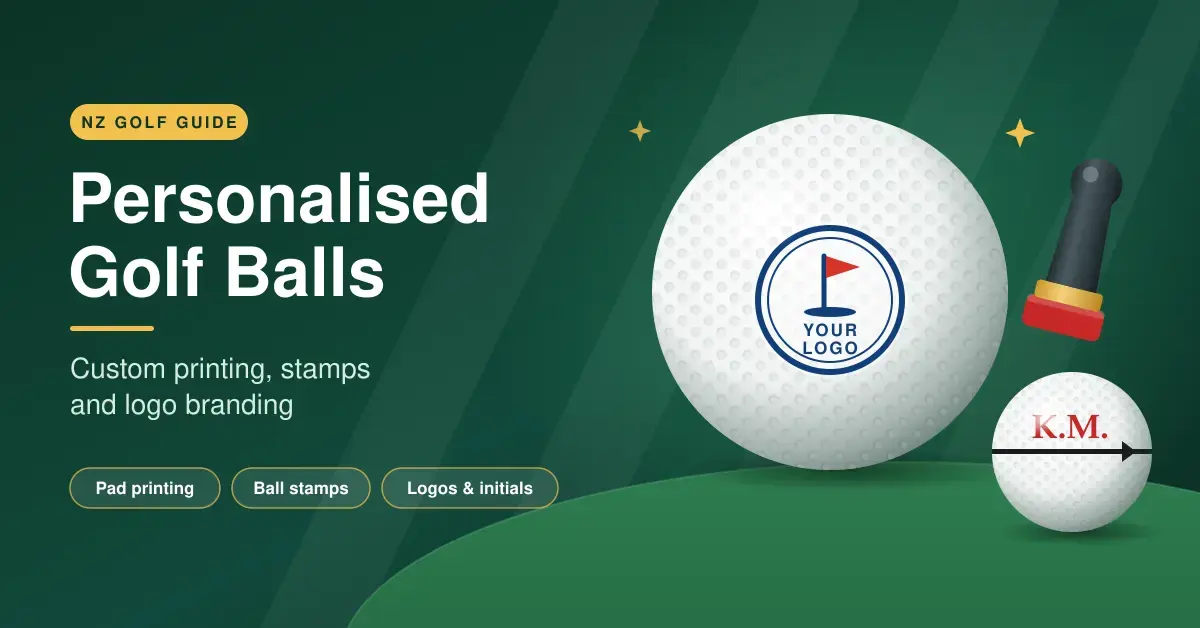
Personalising a golf ball means adding a permanent visual marker — a logo, a set of initials, a symbol or an alignment line — to a standard tour or distance ball. It serves two practical purposes: it helps you identify your own ball under the Rules of Golf, and it turns a box of balls into corporate branding, a gift or a tournament keepsake. This guide explains the methods used in New Zealand, what each one costs, the artwork you need to supply, and how to keep the print looking sharp.
The two main routes are commercial pad printing (best for logos and volume orders) and a handheld golf ball stamp (best for marking your own gear on the spot). Below, each option is broken down so you can match the method to your budget, quantity and deadline.
Key Points
- Two main methods: commercial pad printing for logos and volume; a handheld self-inking stamp for marking your own balls on the day.
- Minimum order: logo runs usually need 12 dozen (144 balls) plus a one-off plate/setup fee; text and initials can be ordered in small boxes.
- Artwork: supply vector files (.AI, .EPS, vector .PDF) with Pantone (PMS) colours and text converted to outlines.
- Print area: roughly 20–25 mm across — about a thumbnail — so detail must be simple and sharp.
- Turnaround: about 7–10 working days after proof approval; allow 3–4 weeks for events.
- Flight: the cured ink film is under 0.1 mm thick and does not measurably affect ball flight.
What are personalised golf balls?
Personalised golf balls are ordinary golf balls carried with an added, printed or stamped design on the cover. The ball itself is unchanged — the same construction, compression and dimple pattern you would buy off the shelf — with a small graphic applied to one panel. That graphic can be a company logo, a name or monogram, a novelty line of text, or a putting alignment aid.
Because the marking sits on the cover, it does not change how the ball is built or certified. If you want to understand what is under that cover first, our overview of golf balls and how they are constructed covers the core, mantle and cover layers, and the guide to how many dimples a golf ball has explains the surface the print has to sit on.
How custom golf balls are made
Commercial custom balls are made with pad printing, an industrial process that transfers ink onto the curved, dimpled cover. A golf ball is not a flat surface: its cover is covered in hundreds of shallow dimples, so a rigid print head cannot make even contact. Pad printing solves this with a soft silicone pad.
The design is first etched into a metal or polymer plate. Ink fills the etched image, a flexible silicone pad presses down onto the plate to pick the ink up, and the same pad then presses onto the ball, moulding itself into the dimples to lay down an even layer. The ink cures as a very thin film — typically under 0.1 mm thick — so it follows the dimple walls rather than filling them, and the ball’s flight is not measurably affected. Multi-colour logos repeat the cycle once per colour, with the plate re-registered each time.
Two alternatives exist. A self-inking stamp applies a single-colour design by hand and is covered further down. Adhesive stickers also exist but are not recommended for play: they sit proud of the cover, create a raised edge that can affect roll and flight, and peel under impact.
Pad printing vs stamping vs stickers
| Feature | Commercial pad printing | Self-inking stamp | Adhesive sticker |
|---|---|---|---|
| Detail | High — multi-colour logos, fine text, vector graphics | Moderate — single colour, bold initials or a symbol | Low — edges blur and lift |
| Durability | Cured ink film, resists normal play wear | Quick-dry permanent ink, resists water once set | Poor — lifts under impact and washing |
| Effect on flight | Negligible (ink under 0.1 mm) | Negligible (thin ink film) | Noticeable — raised edge disturbs roll |
| Minimum quantity | Usually 12 dozen (144) for logos | One ball at a time | N/A |
| Best for | Corporate, events, gifts in volume | Marking your own gear on the day | Not recommended for play |
Ways to personalise a golf ball
There are four common design types, each suited to a different buyer. Choosing the right one is mostly about who the ball is for and how many you need.
Corporate logos
A printed company logo is the most common commercial order. Businesses hand out branded balls at conferences, client days and charity tournaments so the brand is visible on every shot. This is the format that carries a minimum order and a plate setup fee, because a plate has to be made for the logo.
Monograms, names and initials
Initials or a name printed in a clean font are a popular gift for birthdays, weddings, retirements or Father’s Day. Small quantities are possible — many suppliers sell text personalisation in 3-ball or single-dozen boxes because no bespoke plate is needed for standard fonts.
Novelty text
Short humorous lines (“If found, please hit better”) suit social rounds and group trips. Like monograms, they use a standard character set and can be ordered in small numbers.
Alignment lines
Competitive players print a bold line or triple-track band across one side of the ball to help square the face and aim putts. Many tour balls now offer a factory alignment aid; a custom line lets you set the length and style you prefer.
Artwork file requirements
For any logo run you must supply print-ready vector artwork, because the print area is tiny — most NZ suppliers work within a circle of roughly 20 mm to 25 mm, about the size of a thumbnail. A low-resolution web image will look blurred at that scale. Three requirements come up with almost every print house:
- Vector files, not photos. Supply .AI, .EPS or vector .PDF. Vector art stores the design as maths, so it stays crisp when shrunk to ball size. Standard .JPG or .PNG files are made of fixed pixels and pixelate on a 20 mm canvas.
- Pantone (PMS) colours. Give the exact PMS code for each colour so ink can be mixed to match your brand rather than approximated.
- Text converted to outlines. Convert any type to outlines or paths before sending. That locks the letter shapes into the file so the design prints correctly even if the shop does not own your font.
Suppliers such as Golf Warehouse NZ ask for exactly this — outlined vector files (.ai, .eps, .pdf, .cdr) with PMS colours — before a job goes to plate. Getting it right first time avoids re-proofing delays.
Golf ball stamps: the DIY alternative
A golf ball stamp is a handheld tool that marks a single ball in seconds, and it is the practical choice when you do not want to wait for a print run or meet a minimum order. It fits in a bag pocket and is reusable across as many balls as you like.
- Self-inking mechanism. Better stamps re-ink the design face automatically each time the cap closes, so there is no separate ink pad to manage.
- Quick-dry ink. Oil-based permanent inks are formulated to set in roughly 10 to 15 seconds and then resist water, dew and grass.
- Ball identification. Under the Rules of Golf you are responsible for identifying your ball; a distinct mark lets you do that with confidence. Playing a wrong ball carries the general penalty — two strokes in stroke play, or loss of the hole in match play — and in stroke play you must correct the error before teeing off at the next hole or you are disqualified. A clear personal mark is a simple way to avoid that.
- Design choice. Kits offer initials plus symbols such as flags, targets, shamrocks and custom emblems.
A stamp complements the rest of your kit; see the golf accessories guide for the other small items worth carrying.
What it costs and where to order in NZ
For a logo order, budget for three separate costs: the balls themselves, a one-off plate/setup fee, and the print charge. New Zealand suppliers price these transparently. Golf Warehouse NZ, for example, requires a minimum of 12 dozen (144) balls, quotes balls from around $0.37 each on entry ranges, a print pad setup from about $40 and a print plate from about $46; higher-tier tour balls cost more per unit. Small text or monogram orders skip the plate fee and can be bought in far smaller boxes.
Turnaround is usually about 7 to 10 working days from the moment you approve the digital proof — some NZ suppliers quote up to 7 working days for straightforward jobs. For an end-of-year event, order three to four weeks ahead to allow for proofing and peak demand. If you would rather see options in person, an Auckland retailer such as the one in our Golf Warehouse Ellerslie custom-fitting guide can walk you through brands and print samples.
NZ Printing Options Compared
| Supplier | What they offer | Notes |
|---|---|---|
| Golf Warehouse NZ | Logo pad printing on major brands | Min 12 dozen; balls from ~$0.37 each, pad setup from ~$40, plate from ~$46; outlined vector files with PMS colours |
| Golf HQ | Custom printed golf balls | Print area about 18×16 mm; turnaround up to ~7 working days |
| Custom Gear | Promotional branded golf balls | Boxed or individually branded sets, nationwide |
| Prestige Products | Pad print and direct digital | Pad print ~25 mm circle; digital ~20 mm circle |
Custom gear for corporate golf days
Branded balls work best as part of a matched welcome pack rather than on their own. Pairing them with a few other customised items keeps a company’s branding visible across the round and makes the pack feel considered.
- Logo balls — printed by pad printing; seen on every shot.
- Printed tees — cheap, high-volume and used on every drive; see the guide to golf tees for materials and sizes.
- Embroidered towels — used constantly to clean clubs, so the logo stays in view on the cart.
- Laser-etched divot tools — a durable keepsake that stays in a pocket long after the day.
If you are choosing a venue for the day, Auckland options such as Formosa Golf Club host corporate and charity events regularly.
Common mistakes to avoid
Most problems with custom balls come from the ordering stage, not the printing itself. A few recurring errors are easy to prevent:
- Sending a low-resolution logo. A screen-grabbed .PNG will not print cleanly at 20 mm. Ask your designer for the original vector file before you order.
- Skipping PMS colours. Leaving colour to the printer’s judgement risks a shade that does not match your brand. Specify the code.
- Ordering too late. Proof approval plus a 7–10 day run means last-minute event orders often miss the date. Allow three to four weeks.
- Choosing a dark ball without an underbase. On coloured or high-visibility covers, an opaque white base layer is needed under the design or the colours look muted; confirm the supplier includes it.
- Using stickers for play. They lift under impact and disturb roll. Use printing or a stamp instead.
Caring for printed golf balls
Printed graphics last longest when they are kept out of harsh sun and strong solvents. The ink is a thin cured film, so a little care preserves it across many rounds.
- Keep them out of direct UV. Prolonged sunlight is the main cause of fading and cracking. Store balls in their sleeves or a cool, dark cupboard between rounds.
- Clean gently. Use a soft cloth with warm water and a little dish soap. Avoid acetone, nail-polish remover and industrial degreasers, which dissolve the ink.
- Watch the ball washer. Sand trapped in a course ball washer can grind against the print. Give heavily marked balls a gentle hand-clean instead.
Sources
- Golf Warehouse NZ — Logo Printing (minimums, setup fees, file requirements)
- Golf HQ NZ — Custom Printed Golf Balls (print area, turnaround)
- Prestige Products NZ — Custom Printed Golf Balls (pad vs digital print sizes)
- R&A — Rules of Golf, Rule 6 (playing the wrong ball)
- USGA — How to proceed after playing a wrong ball
Frequently Asked Questions (FAQ)
What is the minimum order for custom logo golf balls in NZ?
For commercial logo printing, New Zealand suppliers typically set a minimum of 12 dozen — 144 balls — plus a one-off plate or setup fee. That threshold offsets the cost of making the printing plate for your design. Text-only personalisation, such as initials or a short phrase in a standard font, usually has no plate fee and can be bought in much smaller boxes, sometimes as few as three balls.
Does printing change how a golf ball flies?
No. Pad printing lays down an ink film under about 0.1 mm thick that follows the dimple walls rather than filling them, so the ball’s aerodynamics, spin and compression are not measurably altered. The ball plays the same as an unmarked one from the same box.
What artwork do I need to supply for a logo?
Supply print-ready vector artwork — .AI, .EPS or a vector .PDF — with your colours given as Pantone (PMS) codes and all text converted to outlines. The print area is only about 20–25 mm across, so a standard .JPG or .PNG web image will look blurred and pixelated at that size.
How long does a custom order take?
Most New Zealand print runs take about 7 to 10 working days from the date you approve the digital proof, and some suppliers quote up to 7 working days for simple jobs. For an event, order three to four weeks ahead so there is time for proofing and any reprint.
Why use a golf ball stamp instead of ordering printed balls?
A self-inking stamp is faster, cheaper for small numbers and reusable: it marks any ball in seconds with no minimum order or shipping wait. It applies a single-colour, quick-drying design that helps you identify your ball and avoid the two-stroke wrong-ball penalty. Ordered printing is the better choice only when you need logos, multiple colours or large quantities.