
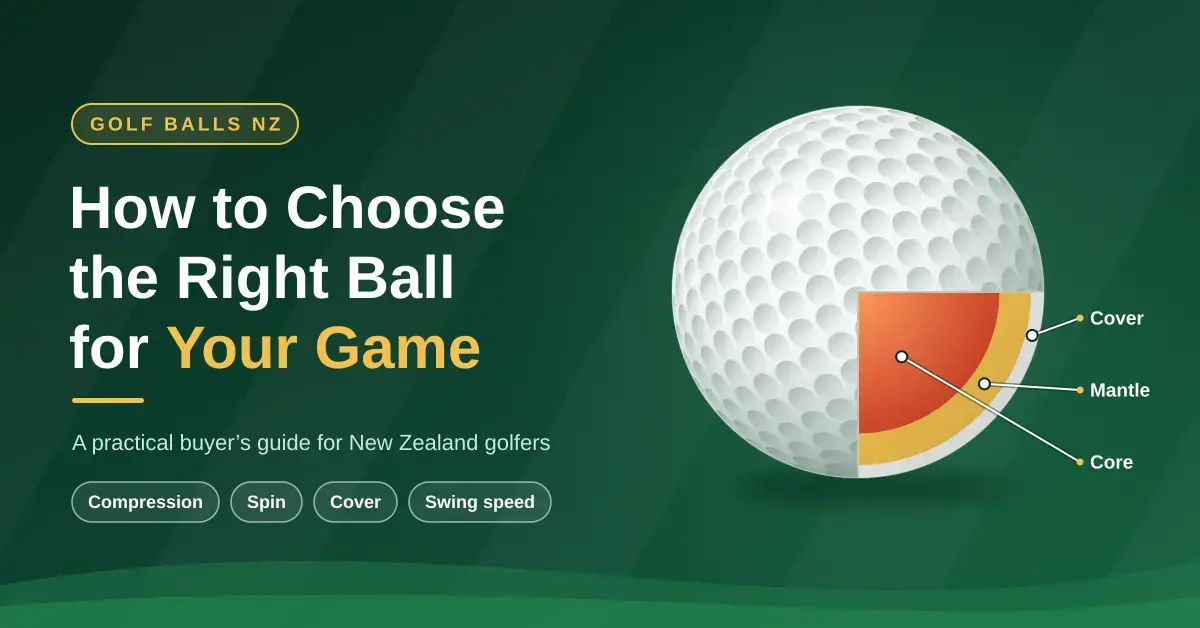
Your golf ball is the only piece of equipment you use on every single shot, yet it is one of the most overlooked choices in the bag. This guide explains how modern golf balls are built, what compression and spin actually do, how the leading models sold in New Zealand compare across brands, and how to match a ball to your own swing rather than to whatever won last weekend on television. The goal is practical: give you the facts to choose well, whether you are carrying the water at the Formosa golf course or reading the fast greens at Titirangi.
Key Points
- Most-played on tour: the Titleist Pro V1 family is the most widely used ball on the world’s professional tours, but that does not make it right for every amateur.
- Match compression to swing speed: firmer tour balls (compression ~95–110) suit faster swings; softer balls (under ~75) help slower, smoother swings keep their distance.
- Cover decides spin and price: cast urethane gives high greenside spin at a premium price; ionomer (Surlyn) covers are firmer, more durable and cheaper.
- NZ price spread: premium tour dozens run around $100–$105, mid-tier from about $60–$85, and value balls from roughly $45.
- Fit, don’t follow: a few minutes on a launch monitor beats copying the ball a professional uses.
Why your golf ball choice matters
The ball is the single common factor in every shot you play, from a driver off the tee to a two-foot putt. Because it is the one component that touches the clubface each time, small differences in its construction have an outsized effect on distance, trajectory, spin and feel. Matching those properties to your swing is one of the cheapest ways to shave shots — a new dozen costs far less than a new driver.
There is no single “best” golf ball. The right model depends on your swing speed, the parts of your game you want to protect, the conditions you usually play in, and your budget. A ball that suits a professional swinging at over 160 km/h can actively cost distance for a mid-handicapper with a smoother tempo. Understanding the trade-offs is more useful than chasing whatever the tours are using.
How a golf ball is built
Modern golf balls are layered constructions, and the number of layers plus the cover material determine how the ball behaves. Manufacturers vary the chemistry and the count of internal layers to split the market into a few broad categories, each aimed at a different type of player.
| Construction | Typical layers | Cover material | Best suited to |
|---|---|---|---|
| Distance / value balls | 2-piece | Ionomer (Surlyn-type) | Maximum ball speed and low driver spin; helps reduce slices and hooks. Durable and affordable. |
| Mid-tier balls | 3-piece | Soft ionomer or urethane | A balance of distance and moderate greenside control for club golfers. |
| Tour balls | 3- to 5-piece | Cast urethane | Full performance: low long-game spin with high wedge spin and soft feel, for faster, more consistent swings. |
A tour ball uses its layers to do two opposite jobs. Off the driver, the firm inner core takes most of the impact, boosting ball speed while keeping spin low so the ball flies far and straight. Off a wedge, the soft urethane cover grips against the grooves to generate the high spin that stops the ball quickly on the green. Cheaper two-piece balls cannot separate these behaviours as cleanly, which is the main reason tour balls cost more.
Ionomer (Surlyn) versus urethane covers
The cover material is the single biggest clue to how a ball will perform and what it will cost. An ionomer cover — often referred to by the DuPont brand name Surlyn — feels firmer and more plastic-like, resists scuffs well, and produces less greenside spin, which suits distance and durability. A cast urethane cover feels softer, almost tacky, and grips the grooves for far more spin on short shots. Urethane is more expensive to manufacture, which is why it appears only on premium balls.
Compression: matching the ball to your swing speed
Compression measures how much a golf ball deforms against the clubface at impact, and it is the number to focus on when fitting a ball to your swing. A firmer, high-compression ball needs a faster swing to compress fully; if you cannot generate that speed, you lose ball speed and launch height rather than gaining control. A softer, low-compression ball compresses more easily at moderate speeds, which can help slower swingers keep their distance.
The table below is a starting point, not a rule. A proper fitting on a launch monitor will always beat a chart, because launch angle, spin and your typical miss all matter too.
| Swing profile | Driver clubhead speed | Compression to look for | Example models |
|---|---|---|---|
| Smooth / slower | Under ~137 km/h (85 mph) | Low (under ~70) | Titleist TruFeel, Tour Soft |
| Moderate / consistent | ~137–161 km/h (85–100 mph) | Mid (~75–90) | Titleist AVX, Callaway Chrome Soft, Srixon Z-Star |
| Fast / aggressive | Over ~161 km/h (100 mph) | High (~95–110) | Titleist Pro V1, Pro V1x, Left Dash |
How to find your swing speed
You do not have to guess. Most pro shops and golf retailers can read your clubhead speed on a launch monitor in a few minutes, and many will do it as part of a ball or club fitting. Booking a session for custom fitting at Golf Warehouse Ellerslie or hitting a few shots in an indoor golf simulator gives you real numbers to work from, rather than choosing a ball by reputation alone.
Titleist Pro V1 vs Pro V1x
Within the premium tier, the Titleist Pro V1 family is the most widely played ball on the world’s professional tours, which is a large part of its reputation. Many amateurs, though, treat the Pro V1 and Pro V1x as interchangeable when they are tuned quite differently. Choosing the wrong one can cost you launch height or create gapping problems with your irons.
- Pro V1: a 3-piece ball with a solid core, a measured compression of roughly 98, and a 388-dimple tetrahedral pattern. It flies on a mid, penetrating trajectory with a very soft feel and lower long-game spin — ideal if you want a flatter, more boring flight.
- Pro V1x: a 4-piece ball with a dual core, a firmer compression of roughly 108, and a 348-dimple pattern that supports a higher flight. It launches higher and spins a little more through the irons and short game, suiting players who want more height and stopping power.
- Pro V1x Left Dash: a firmer, lower-spinning variant of the Pro V1x aimed at very fast swings that need to keep spin down; it is usually a custom or specialist order.
If you want to understand the dimple side of the story in more depth, see our guide on how many dimples a golf ball has and why the pattern changes ball flight.
The rest of the Titleist range
Not every golfer needs — or can activate — a firm tour ball, and Titleist builds a wider range for different swing speeds and budgets. New Zealand retail prices below are recent dozen prices and move with promotions and exchange rates, so treat them as a guide.
- Titleist AVX (around $84.95 a dozen): a 3-piece urethane ball with a lower, piercing flight and low long-game spin. Its compression sits near 75, softer than the Pro V1, which appeals to players wanting a soft feel and a flatter trajectory.
- Titleist Tour Soft (around $69.95): an ionomer-covered ball with a large core that helps mid-to-higher handicappers generate easy ball speed with a soft feel.
- Titleist Velocity (around $59.95): built purely for distance, with a firm ionomer cover and low spin to cut side-spin off the tee.
- Titleist TruFeel (around $44.95): the softest and most affordable ball in the line, a good fit for slower swings, beginners and casual winter rounds.
How premium balls compare across brands
Titleist is not the only maker of tour-level balls, and several rivals compete directly with the Pro V1 range on spin, feel and price. The table below sets out the main premium and near-premium options so you can compare construction and compression side by side rather than relying on marketing. Compression figures are drawn from independent testing and vary slightly between sources.
Premium Golf Ball Comparison
| Ball | Construction | Cover | Approx. compression | Positioning |
|---|---|---|---|---|
| Titleist Pro V1 | 3-piece | Cast urethane | ~98 | Mid, penetrating flight; soft feel; low long-game spin |
| Titleist Pro V1x | 4-piece | Cast urethane | ~108 | Higher flight; firmer feel; more iron and wedge spin |
| Titleist AVX | 3-piece | Cast urethane | ~75 | Lower, piercing flight; very soft feel; low spin |
| Callaway Chrome Soft | 3-piece | Cast urethane | ~75 | Soft feel with tour control at moderate swing speeds |
| TaylorMade TP5 | 5-piece | Cast urethane | ~85 | Five layers blending low driver spin with greenside bite |
| Srixon Z-Star | 3-piece | Cast urethane | ~90 | Lower-compression tour ball with high driver and wedge spin |
| Bridgestone Tour B XS | 3-piece | Cast urethane | ~84 | Soft feel; among the highest wedge-spin tour balls |
The practical takeaway is that “tour ball” covers a range of feels. The Srixon Z-Star and Callaway Chrome Soft sit softer than the Pro V1x, the Bridgestone Tour B XS is known for high wedge spin, and the TaylorMade TP5 uses five layers to blend low driver spin with greenside bite. Testing two or three against each other on and around the greens is the surest way to find your match.
Choosing a ball for New Zealand conditions
New Zealand’s varied climate places different demands on your ball through the year, so adjusting your choice by season can save shots. New Zealand also has a strong sporting culture that rewards this kind of attention to equipment — the same instinct that made big-hitting cricketers such as Lance Cairns household names shows up in golfers who fine-tune their gear to the conditions.
- Firm summer greens: when greens run fast and firm, a urethane ball such as the Pro V1 gives the wedge spin you need to stop approaches near the flag.
- Wet winter turf: cold air and damp fairways cut ball speed and rollout, so a lower-compression ball like the Tour Soft or TruFeel that you can compress easily often plays better.
- Coastal wind: on exposed links, a lower-spin, penetrating ball such as the AVX or standard Pro V1 holds its line in a crosswind better than a high-launching model.
- Low winter light: optic-yellow versions of most Titleist models, including the Pro V1 series, are far easier to track in flat morning light and help cut lost-ball penalties.
Alignment aids and launch-monitor balls
Golf balls have become training tools as well as playing equipment, with two features worth knowing about. Both are genuine, verifiable technologies rather than gimmicks.
- Factory alignment lines: Titleist offers the Pro V1 and Pro V1x with printed alignment stripes (marketed as AIM), available in several colours, so you can line up putts without hand-drawing a line with a stencil.
- Radar Capture Technology (RCT): Pro V1, Pro V1x and Pro V1x Left Dash RCT balls carry a radar-reflective mark in the casing layer that lets indoor radar launch monitors — including TrackMan 4, FlightScope, Garmin Approach R10, Full Swing KIT and Rapsodo — measure spin directly rather than estimate it, lifting indoor spin accuracy to over 99%. They are legal for outdoor play but fly like a standard Pro V1, so they are best kept for indoor practice and fittings.
Common mistakes when buying golf balls
The wrong ball choice usually comes from a handful of avoidable errors:
- Buying the tour ball because the pros do: without the swing speed to compress it, a firm tour ball can cost distance and feel harder, not better.
- Ignoring the short game: distance balls give up greenside spin, so a big driver number can come at the expense of stopping power on approaches.
- Changing models every round: feel and roll-out differ between balls, especially around the greens; sticking to one model builds consistency.
- Overpaying while learning: beginners lose more balls, so an expensive urethane ball is costly and its high spin can exaggerate a slice. A durable, lower-spin ball is more forgiving.
- Storing balls badly: a sealed dozen kept cool and dry holds its performance for years, but leaving balls in a hot car boot over summer can degrade the core.
Where to buy and how to save in New Zealand
Titleist and rival balls are stocked by national golf retailers, local pro shops and reputable online stores across New Zealand. To keep costs down, watch for seasonal promotions such as Titleist’s “buy three dozen, get one free” personalisation events, and consider ordering personalised golf balls during those windows so a printed name or logo also makes lost balls easier to identify. Buying by the season — a value ball for winter, a tour ball for summer scoring — often makes more sense than playing one premium model all year.
Sources
- Titleist – Comparing Pro V1 and Pro V1x
- Titleist – Radar Capture Technology (RCT) golf balls
- MyGolfSpy – Titleist Pro V1x (2025) Ball Lab
- Today’s Golfer – Best premium golf balls tested
- Stymie – Golf ball compression chart
- Golf360 NZ – Titleist golf balls (NZ pricing)
- The Club Room NZ – Titleist golf balls (NZ pricing)
Frequently Asked Questions (FAQ)
What is the difference between the Titleist Pro V1 and Pro V1x?
The Pro V1 is a 3-piece ball with roughly 98 compression that flies on a mid, penetrating trajectory with a very soft feel and lower long-game spin. The Pro V1x is a firmer 4-piece ball at roughly 108 compression that launches higher and spins a little more through the irons and short game, so it suits players who want more height and stopping power.
Why do tour golf balls cost so much more than distance balls?
Tour balls use multi-layer construction and a cast urethane cover, which is expensive to manufacture. That combination lets one ball deliver low spin and high speed off the driver yet high spin and control off a wedge — a range of behaviour that a simple two-piece ionomer ball cannot match. The added cost pays for that versatility and the soft feel.
Should a beginner play a premium ball like the Pro V1?
Usually not. Beginners and high-handicappers tend to lose more balls and often fight a slice or hook, which a high-spin tour ball can exaggerate. A durable, lower-compression, lower-spin ball such as the Titleist TruFeel or Tour Soft flies straighter, feels forgiving and costs far less to replace, making it the sensible starting point.
Does cold weather change how a golf ball performs?
Yes. Cold air is denser, adding drag that trims carry distance, and lower temperatures make the core firmer and less lively at impact. Many players switch to a lower-compression ball in winter so they can still compress the core fully and keep ball speed stable, and choose optic-yellow versions to track flight in flat light.
What are Titleist RCT balls and do I need them outdoors?
RCT (Radar Capture Technology) balls have a radar-reflective mark in the casing that lets indoor radar launch monitors measure spin directly instead of estimating it. They are legal outdoors but fly exactly like a standard Pro V1, so there is no on-course advantage — they are worth buying only if you do a lot of indoor simulator practice or fittings.