A golf tee is the cheapest item in the bag, yet it is the one piece of equipment you use before almost every long shot. The tee sets the ball at a repeatable height, and that height changes how the clubface meets the ball, how much backspin you generate and how consistent your launch is off the box. Getting it right costs a few dollars; getting it wrong quietly leaks distance and accuracy.
This guide explains the three tee materials you will find on New Zealand shelves, the length and height each club actually needs, what the Rules of Golf allow, the specialty designs worth knowing about, and where to buy tees locally without overpaying. The aim is practical accuracy rather than a sales pitch — a tee is a tool, and the best one is simply the one that suits your clubs and your course.
Key Points
- Material matters: bamboo is the durable, biodegradable all-rounder; plain wood is cheapest; plastic lasts but is discouraged on many courses.
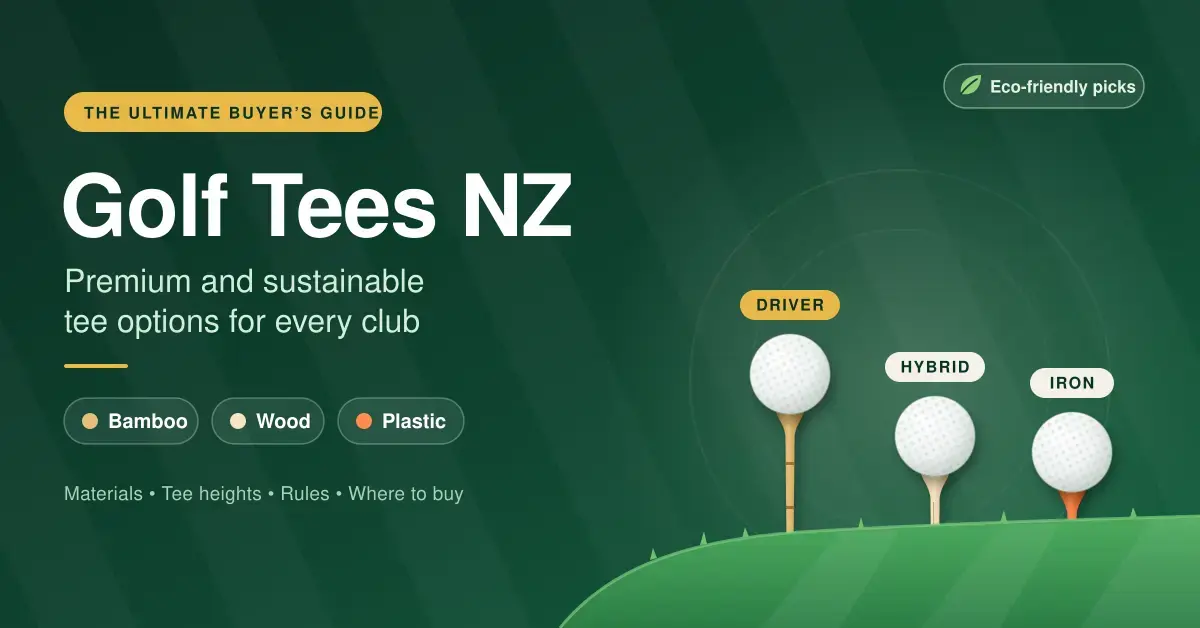
- Change height by club: tall for the driver (half the ball above the face), low for fairway woods and hybrids, barely off the turf for irons.
- Common lengths: 25 mm and 32 mm (irons), 54 mm (woods/hybrids), 70 mm and 83 mm (driver).
- The rule: a tee may be no longer than 4 inches (101.6 mm) under Rule 6.2b.
- Buy in bulk: boxes of 100+ cut the per-tee cost; you will lose and break plenty.
Which golf tee material should you choose: bamboo, wood or plastic?
The first decision is material, because it drives both durability and how welcome the tee is on the course. For decades the choice was simple: cheap wooden pegs that snapped, or rigid plastic that lasted. Today bamboo sits between the two and has become the default eco-friendly option, while plastic has fallen out of favour on many maintained courses. The table below compares the three on the factors that matter in real play.
| Factor | Hardwood (birch/pine) | Bamboo | Moulded plastic |
|---|---|---|---|
| Durability | Low — snaps or splinters, often within a round | Good — flexible fibres resist breaking, but not unbreakable | High — can last many rounds |
| Biodegradable | Yes — breaks down in the soil | Yes — bamboo is a fast-decomposing grass | No — fragments persist for years |
| Kind to mowers | Yes — cut cleanly by cutting reels | Yes — splinters without dulling blades | Risk — shards can nick reels and puncture tyres |
| Typical price | Lowest per tee in bulk | Low to moderate | Moderate to high |
| Best for | Budget bulk buyers | Everyday play and eco-minded golfers | Range mats and repeat use where allowed |
Why does bamboo hold up better than ordinary wood?
Bamboo lasts longer than birch or pine because it is botanically a grass, not a tree, so its stalks are packed with long, aligned fibres. When a driver meets the ball at the 140–160 km/h that is common for club golfers, a bamboo peg tends to flex and absorb the impact rather than shear off, so a single tee often survives several drives. It is a genuine step up in toughness over cheap wood — but it is still a natural material and will eventually split, so treat "durable" as "longer-lasting," not "permanent."
When does a plastic tee still make sense?
Plastic tees earn their place mainly at driving ranges and in practice nets, where they sit in a rubber mat, take repeated hits and are never left in turf. If your course permits them and you are teeing on artificial surfaces, a reusable plastic or rubber tee is economical. On maintained grass courses, however, the case against plastic is strong enough that many golfers avoid it entirely, and some clubs ask visitors to as well. If you are kitting out a home practice setup, pair durable tees with the rest of your golf accessories rather than carrying them onto the course.
What tee length and height do you actually need?
Tee height should change with the club, and it is the single most common thing recreational golfers get wrong. Tees are sold by length — commonly 25 mm and 32 mm (short), 54 mm (about 2⅛ inches), 70 mm (2¾ inches) and 83 mm (3¼ inches) — but length is only a starting point. What matters is how much of the ball sits above the clubface once the tee is pushed into the ground, and that depends on the club you are hitting.
Tee Size and Height Guide
| Club | Suggested tee length | Ball position at address |
|---|---|---|
| Driver (460cc) | 70–83 mm | About half the ball above the top of the face |
| Fairway wood (3-wood) | 54 mm | Roughly one-third of the ball above the face |
| Hybrid / rescue | 32–54 mm | Just above the face, close to a clean lie |
| Irons (par-3 holes) | 25–32 mm | Ball just clearing the grass, like a perfect lie |
How high should you tee a driver?
For a driver, set the ball so that roughly half of it sits above the top edge of the clubface at address. Modern 460cc heads have their sweet spot slightly above centre, so a higher tee lets you strike the ball on a gentle upswing, which raises launch and reduces the spin that eats into carry. A long tee of 70 mm or 83 mm gives you the range to do this; push it in until the ball height looks right rather than burying it to a fixed depth. Tee too low and you catch the ball on a downward path with too much spin; tee too high and you risk sky-marks on the crown or a weak pop-up.
What about fairway woods and hybrids?
Fairway woods and hybrids need far less tee. Push the peg in so only the very top shows and the ball sits just above the turf — around a third of the ball above the face for a 3-wood, less for a hybrid. A 54 mm tee is usually ample. These clubs are designed to sweep the ball off a low tee or clean lie, so a tall tee only encourages you to hit up on them and thin the shot.
How do you tee irons and short par-3s?
For irons, the ball should barely clear the grass. Use a short 25 mm or 32 mm tee, or push a longer one almost flush, so the ball sits at roughly the height of a perfect fairway lie. Your iron swing bottoms out into the turf, so a low tee simply removes bad lies and imperfections without changing your natural downward strike. Teeing an iron too high leads to thin, ballooning shots.
Are golf tees regulated by the Rules of Golf?
Yes. Under Rule 6.2b of the Rules of Golf, a tee must not be longer than 4 inches (101.6 mm), and it must not be designed to indicate the line of play or to influence how the ball moves. That upper limit is why you will rarely see a tee longer than 83 mm on the shelf — anything much taller starts to bump against the rule once you account for the part in the ground. The rules do not dictate how far you push the tee in, so how high the ball actually sits is up to you, within that overall length cap. For casual social rounds this is academic, but it matters in club competitions and is worth knowing before you buy an unusually tall novelty tee. If you play regularly, it sits alongside other equipment rules such as the limit on how many clubs you can carry in your bag.
Why are courses moving away from plastic tees?
Courses discourage plastic tees mainly to protect expensive machinery and to reduce litter. When a plastic peg breaks it leaves a hard, sharp shard that can nick the precision cutting cylinders used on greens and tees, or puncture the tyres on mowers and carts — small damage that adds up to real maintenance cost over a season. Natural tees, by contrast, are chopped up harmlessly and break down into the soil.
There is an environmental angle too. Many New Zealand courses run through coastal dunes or native bush that shelter birdlife such as tūī, pīwakawaka and pūkeko, and brightly coloured plastic fragments are both persistent litter and a potential hazard to foraging wildlife. Choosing a biodegradable tee is a low-effort way to leave the fairways you play — from your home club to the wider spread of Auckland’s golf courses — in the condition you found them.
What specialty tee designs are worth knowing about?
Beyond the plain peg, several designs aim to add consistency or reduce friction. None will transform a swing, but each solves a specific problem.
- Gauge-marked and striped tees: printed bands along the shank let you push the tee to the same depth every time by matching the grass line to a stripe, which removes guesswork on firm summer or soft winter ground.
- Castle or step tees: a moulded collar or stepped base stops the tee at a fixed depth, giving a repeatable height without any judgement — useful for beginners chasing consistency.
- Brush or bristle tees: the ball rests on flexible bristles instead of a solid cup, reducing the contact area and, according to their makers, cutting friction and deflection at impact. They are durable and reusable, though usually plastic-based.
- Prong or crown tees: plastic tees with pronged tops that support the ball on small points to lower resistance; effective, but they carry the same course drawbacks as any plastic peg.
For most players a simple bamboo or wooden tee in the right length does everything needed. Specialty designs are worth trying if you specifically struggle to tee at a consistent height, not as a distance upgrade.
Where can you buy golf tees in New Zealand and what do they cost?
Tees are widely stocked, and buying in bulk is the obvious way to keep the per-tee cost down. New Zealand specialists such as Golf Warehouse and Golf Hound carry bamboo and wooden tees in packs from around 20 up to 100 or more, and clubhouse pro shops usually keep the popular lengths behind the counter. General sports retailers and online marketplaces stock them too, though quality and length labelling vary.
- Small accessory packs (about 20–30 tees): handy for the bag or as a top-up; the highest price per tee.
- Bulk boxes (100 or more): the best value for regular players, and worth it because you will lose and break tees constantly.
- Mixed-length packs: a sensible first buy so you can find the driver, wood and iron heights that suit you before committing to a single size.
If you are already booked in for a fitting or a club purchase, it is easy to grab tees at the same time — the pro shop at the Golf Warehouse in Ellerslie and similar stores carry them alongside balls and gloves. It is also worth matching your tee height habits to the ball you play, since the two together shape your launch off the tee; see the guide to choosing golf balls for how spin and launch interact.
What are the most common mistakes golfers make with tees?
The biggest error is using one tee height for every club. A height that launches your driver will ruin an iron shot, and vice versa — so carry at least two lengths and change them by club. Other frequent mistakes include:
- Teeing the driver too low, which forces a downward strike, adds spin and costs carry.
- Teeing irons too high, producing thin or ballooning shots instead of a clean, descending strike.
- Buying only on price and ending up with brittle wood that snaps every few swings, which is a false economy against slightly dearer bamboo.
- Leaving broken plastic on the tee box — a litter and machinery hazard that many clubs specifically ask you to avoid.
- Ignoring the 4-inch rule with novelty tees, which can make you non-conforming in competition.
Fixing these costs nothing and does more for consistency off the tee than most equipment changes.
Sources
Frequently Asked Questions
What is the main benefit of bamboo tees over ordinary wooden ones?
Bamboo tees are tougher because bamboo is a grass with long, aligned fibres that flex and absorb impact rather than snapping. A single bamboo tee often survives several drives where a cheap wooden peg might break on the first heavy strike, so a pack tends to last longer. They are still natural and fully biodegradable, so they break down in the soil and are safe for course mowers. Just remember they are longer-lasting, not indestructible.
How high should I tee the ball for a driver?
Set the ball so about half of it sits above the top edge of the driver face at address. That height lets you catch the ball slightly on the upswing, which raises launch and reduces spin for more carry. A 70 mm or 83 mm tee gives you the length to do this; push it into the ground until the ball height looks right rather than to a fixed depth. Teeing lower adds spin and costs distance, while teeing much higher risks sky-marks and pop-ups.
Is there a legal limit on how long a golf tee can be?
Yes. Under Rule 6.2b of the Rules of Golf, a tee must be no longer than 4 inches (101.6 mm), and it must not be built to show the line of play or influence the ball. The rules do not limit how far you push it into the ground, so the ball can sit lower than 4 inches, but the tee itself cannot exceed that length. This matters in competition; for casual rounds it simply means avoiding unusually tall novelty tees.
Why do some golf clubs discourage plastic tees?
Clubs discourage plastic tees mainly to protect machinery and cut litter. Broken plastic leaves hard, sharp shards that can nick the cutting reels on mowers or puncture cart and mower tyres, adding to maintenance costs. Plastic also does not biodegrade, so fragments persist as litter on the course, which is a concern where fairways run through dunes or native bush that shelter wildlife. Biodegradable wood or bamboo tees avoid both problems.
Where can I buy tees in bulk in New Zealand?
New Zealand golf specialists such as Golf Warehouse and Golf Hound sell bamboo and wooden tees in bulk packs, and most clubhouse pro shops stock the common lengths. Buying a box of 100 or more brings the per-tee cost right down, which is sensible because tees are lost and broken constantly. If you are unsure which length suits you, start with a mixed-length pack to find your driver, wood and iron heights before buying a single size in bulk.