Handicap rankings in New Zealand are built on the World Handicap System (WHS), the single method Golf New Zealand uses to turn your scores into a portable number that compares your ability with any other golfer in the country. Rather than a simple scoring average, the system measures how you play at your best and adjusts for how hard each course actually is. This guide explains the mechanics behind that number – Course Rating, Slope Rating, the best-8-of-20 calculation, playing-condition adjustments and the safeguards that keep rankings honest – and how those rankings decide the strokes you receive and the grade you play in. If you are completely new to the concept, start with our primer on what a golf handicap is and then return here for the detail.
Key Facts
- System: World Handicap System (WHS), adopted in New Zealand in April 2020
- Administered by: Golf New Zealand, through the DotGolf platform
- Core number: Handicap Index – the average of your best 8 of the last 20 Score Differentials
- To get started: club membership plus scores covering at least 54 holes
- Maximum Index: 54.0 for all players
- Updates: recalculated after each posted score, with a daily revision
What do handicap rankings in New Zealand actually measure?
A handicap ranking measures demonstrated ability, not average performance. New Zealand adopted the World Handicap System in April 2020, replacing the older national scheme and bringing local golfers onto the same standard used across most of the golfing world. The headline figure is your Handicap Index: a decimal number (for example 14.6) that represents your scoring potential and travels with you to every affiliated course.
The word “potential” matters. The system is designed so that a handful of poor rounds do not immediately wreck your number, because it rewards your better days. That is a deliberate contrast with pure ranking formulas used in other games, such as the Elo rating system in chess, where a player’s rating rises or falls based on individual results. Golf’s index instead looks at a rolling window of recent scores and keeps your best ones to the front.
Because the Index is standardised, a 10.0 in Auckland represents the same ability as a 10.0 in Queenstown. That portability is what lets a scratch golfer and a 24-handicapper play a fair match, and it underpins everything from club competitions to the wider world of golf in New Zealand.
How is your Handicap Index calculated?
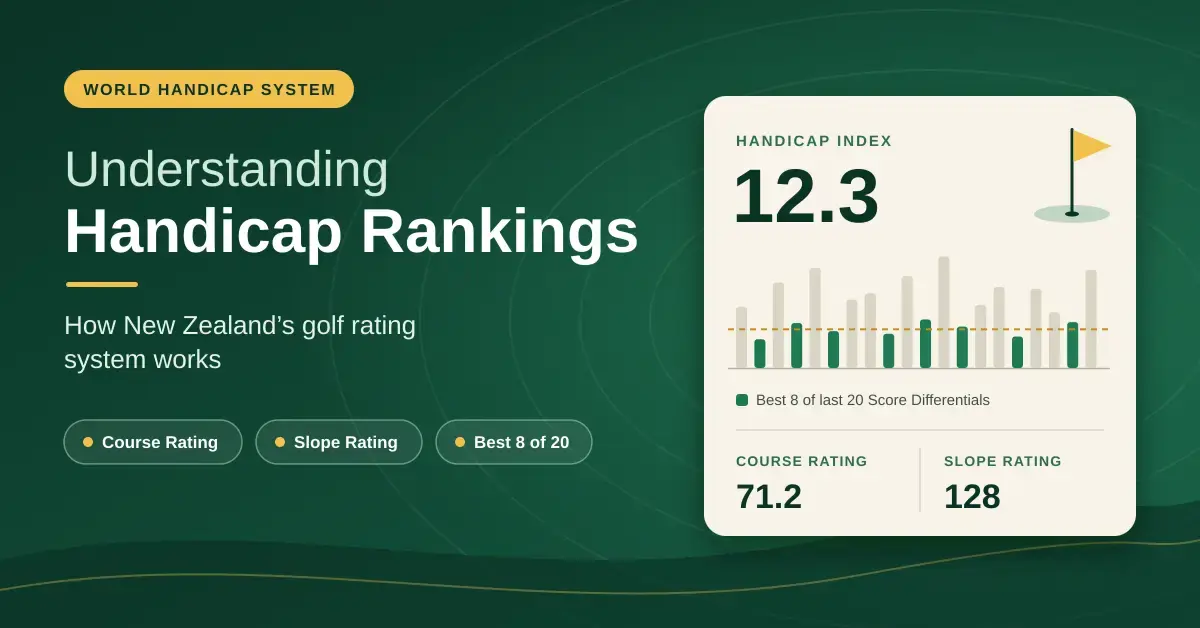
Your Handicap Index is the average of the best 8 Score Differentials from your most recent 20 rounds. It is not a lifetime average and not your last score – it is a rolling snapshot that updates as new rounds come in and old ones drop off the back of the list.
What is a Score Differential?
A Score Differential is what one round is worth after it has been adjusted for the difficulty of the tees you played. The calculation converts your adjusted gross score into a number on a common scale using the formula: Score Differential = (113 ÷ Slope Rating) × (Adjusted Gross Score − Course Rating − PCC). You do not need to work this out yourself; the national system does it automatically each time a score is posted. The point to remember is that a 92 at a brutal links course can produce a lower (better) differential than an 88 at an easy parkland track.
Why does the best 8 of 20 matter?
Keeping only your best 8 of 20 means the Index reflects what you are capable of shooting, not what you shoot on an average day. It also explains a common surprise: your Index can rise even after a good round if an excellent score from several weeks ago has just dropped out of your most recent 20 and been replaced by something slightly weaker.
- Rolling window: only your last 20 posted rounds count, so recent form drives the number.
- Best 8 used: the other 12 rounds are ignored for the calculation on any given day.
- Daily revision: the Index is recalculated whenever you post a score, so it can change from one day to the next.
- 54-hole minimum: you need scores covering at least 54 holes before a first Index is issued.
Course Rating and Slope Rating: the two numbers behind every course
Every set of tees is assessed to produce two numbers that standardise your score. Without them, a round at a demanding course could not be compared fairly with a round at an easy one, and the whole ranking system would collapse.
What is Course Rating?
Course Rating is the score a scratch golfer (a 0.0 Index) is expected to shoot under normal conditions, written to one decimal place. It often differs from par: a tough par-72 might carry a Course Rating of 73.5, meaning it plays harder than its card suggests. A trained rating team assesses effective playing length (allowing for roll, elevation and prevailing wind) and obstacles such as bunkers, water, trees, rough and green contouring.
What is Slope Rating?
Slope Rating measures how much harder a course plays for a bogey golfer than for a scratch golfer – in other words, how quickly difficulty ramps up for the average player. The scale runs from 55 to 155, and a course of standard relative difficulty has a Slope Rating of 113. The higher the Slope, the more strokes a mid- or high-handicapper receives there.
| Slope Range | Relative Difficulty | Typical Auckland Example |
|---|---|---|
| 113 – 120 | Standard | Flatter parkland with generous fairways |
| 121 – 135 | Challenging | Tree-lined or undulating layouts |
| 136 – 155 | Very high | Exposed coastal or heavily protected courses |
Tight, mature tracks such as Titirangi Golf Club illustrate how Slope climbs as fairways narrow and recovery shots get harder, while an open course with wide fairways sits nearer the standard 113.
How does your Index become the strokes you get on the day?
Your Handicap Index is converted into a Course Handicap for the specific tees you are playing, and then into a Playing Handicap for the specific competition format. This two-step conversion is why your “strokes” change from course to course even though your Index has not moved.
The Course Handicap formula
The current WHS formula is: Course Handicap = (Handicap Index × Slope Rating ÷ 113) + (Course Rating − Par). The “Course Rating − Par” term was added in the 2024 revision so that every region of the world now calculates it the same way. In plain terms, a 15.0 Index might receive around 18 strokes on a high-Slope course but only 14 on a gentle one.
What is a Playing Handicap?
The Playing Handicap applies a handicap allowance to the Course Handicap for fairness in a given format – for example, 95% of Course Handicap is common in singles stroke-play events. This is the figure that finally appears on your card and tells you how many strokes you give or receive on each hole.
How does the Playing Conditions Calculation (PCC) work?
The Playing Conditions Calculation adjusts every score posted at a course on a given day to account for abnormal weather or course set-up. Auckland’s wind and rain can change scoring difficulty dramatically, and the PCC stops your ranking from being punished for playing in a gale when others played in calm air.
At the end of each day the system compares the scores actually returned with the scores it expected. If play was clearly harder or easier than normal, it applies a single adjustment – within a range of −1.0 to +3.0 – to every Score Differential for that day. Most days the PCC is 0.0, because conditions were within the normal range.
| PCC Value | Meaning | Effect on your differential |
|---|---|---|
| −1.0 | Played easier than expected | Scores tightened slightly |
| 0.0 | Played as expected | No adjustment |
| +1.0 to +3.0 | Played harder than expected | Scores eased to reflect the difficulty |
What are the soft cap and hard cap safeguards?
The soft cap and hard cap stop a temporary slump from inflating your handicap too far, too fast. Both work from your Low Handicap Index – the lowest Index you have reached in the preceding 12 months – which acts as an anchor.
When your Index would rise more than 3.0 strokes above that Low Index, the soft cap suppresses the increase beyond 3.0 by 50%, slowing the climb. The hard cap then sets an absolute ceiling, preventing your Index from ever rising more than 5.0 strokes above your Low Index over the rolling year. Together they make it very hard to manufacture a high handicap for a single event.
| Safeguard | Triggers when the Index would rise | Effect |
|---|---|---|
| No cap | Up to 3.0 above the Low Index | Full movement allowed |
| Soft cap | More than 3.0 above the Low Index | Increase beyond 3.0 cut by 50% |
| Hard cap | Would exceed 5.0 above the Low Index | Further increase blocked |
What is an Exceptional Score Reduction?
An Exceptional Score Reduction (ESR) pulls your Index down immediately after a round that is far better than your current ability suggests. It is the counterpart to the caps and keeps the system responsive when you genuinely improve.
If a round produces a Score Differential 7.0 to 9.9 strokes below your Handicap Index, the system applies an extra −1.0 adjustment to your Index. If the differential is 10.0 strokes or more below your Index, the adjustment is −2.0. This is applied on top of the normal best-8-of-20 calculation, so a breakthrough round is reflected straight away rather than being diluted.
Key Points
- Your Handicap Index measures potential, not your average score.
- Course Rating and Slope Rating adjust every round for how hard the tees are.
- The PCC (−1.0 to +3.0) corrects for abnormal weather or set-up.
- Soft and hard caps limit how fast your Index can rise above its 12-month low.
- An Exceptional Score Reduction (−1.0 or −2.0) applies after a standout round.
- Convert your Index to a Course Handicap for the tees you actually play.
How does DotGolf manage the national system?
DotGolf is the technology platform that administers handicaps for affiliated golfers across New Zealand. Founded in 1999, it is now jointly owned by The R&A and Golf New Zealand, and it runs the central database that stores every posted score and recalculates every Index.
Whether you enter a score through a clubhouse terminal, an online portal or an app, the round is synced to that national database, your differentials are computed, the PCC is applied and your Index is revised. Club Handicap Committees can review a member’s scoring record and the system flags unusual patterns, which is how the sport discourages “sandbagging” – deliberately keeping a handicap higher than it should be to win prizes. Reliable rankings depend on golfers posting all their eligible rounds, not just the good ones.
How do handicap rankings sort players into grades and divisions?
Clubs use Handicap Index bands to split fields into grades (often called divisions or flights) so that players compete against others of similar ability. This is why a 22-handicapper is not pitted directly against a single-figure golfer for the same net or gross prize. The exact bands vary from club to club, but a typical Auckland championship is organised along these lines:
- Lower grade (A): single-figure and low-index players, often up to around 9.
- Middle grade (B): a broad band of mid-handicappers.
- Higher grade (C): higher-index players, up to the maximum.
Moving from one grade to the next – particularly breaking into single figures – is a recognised milestone and a practical way to set goals for a season. The maximum Handicap Index under the WHS is 54.0 for all genders, which is designed to keep newcomers and improving players in the system.
How are elite and competitive rankings different from your Index?
Elite rankings measure tournament results, not scoring potential, so they are separate from the Handicap Index. The best amateurs carry a “plus” handicap (for example +2.0), meaning they are expected to beat the Course Rating and must give strokes back rather than receive them – but that number is still only a measure of ability.
Competitive standing is tracked through performances in ranking events, including the Jennian Homes Charles Tour and national amateur championships. Golf New Zealand uses recent form across these events to select representative teams, such as the side for the World Amateur Team Championship (the Eisenhower Trophy), which New Zealand famously won in 1992. If you want to understand how those results are displayed during an event, see our guide to reading a golf leaderboard.
How can you manage your handicap across Auckland’s varied courses?
You can manage your ranking by understanding how your game fits different course styles, because Slope and Rating mean the same score is worth different amounts at different venues. A straight, accurate iron player often scores best on tight parkland layouts, while a long hitter may prefer open fairways where driver mistakes are punished less.
- Parkland: accuracy off the tee keeps you out of trees and penalty areas.
- Coastal and exposed: controlling ball flight and using the ground game helps in wind.
- Hilly layouts: distance control on uneven lies matters more than raw power.
- Water-heavy courses: conservative targets protect your score and your differential.
Reviewing your posted scores by course type shows where you play your best golf and where a technical weakness is costing you shots. You can explore local options through our guide to golf courses around Auckland, and follow the professional game at events like the New Zealand Open to see how the same rating principles scale up.
Common mistakes golfers make with their handicap
The most common mistake is only posting good rounds. Because the Index already keeps your best 8 of 20, leaving out poor scores does not help you – it simply makes the number inaccurate and can breach the rules. A few other frequent errors are worth avoiding:
- Not posting at all: an Index built on too few recent rounds is unreliable and may be flagged.
- Confusing Index with Course Handicap: the portable Index is not the number of strokes you get on the day; always convert it for the tees you play.
- Expecting the number to only fall: a rising Index after a decent round is normal when an old low score drops out of your last 20.
- Playing the wrong tees: your Course Handicap is specific to a tee set, so posting from the wrong tees distorts the result.
- Ignoring 9-hole rounds: these count too, and under the current system each is turned into an 18-hole differential using an expected score for the holes not played.
Sources
Frequently Asked Questions (FAQ)
How do I get my first official handicap in New Zealand?
Join a club affiliated with Golf New Zealand and post scores covering at least 54 holes, which can be any combination of 18-hole and 9-hole rounds. Once enough scores are in the system, DotGolf issues your first Handicap Index.
How often does my Handicap Index update?
Your Index is recalculated each time you post a score, and a daily revision runs through the national system. In practice, if you return a card today your updated Index is ready the next day.
Why did my Index go up after a good round?
Your Index uses the best 8 of your most recent 20 rounds. If a very low score has just dropped out of that 20-round window, it can be replaced by a slightly higher one, nudging the Index up even though your latest round was solid.
What is a “plus” handicap?
A plus handicap, written with a plus sign such as +2.0, belongs to golfers who are better than scratch. Instead of receiving strokes, they add strokes to their score, effectively giving them back to the field.
What is the maximum Handicap Index allowed?
The World Handicap System caps the Index at 54.0 for all players. The high ceiling is intentional, keeping beginners and improving golfers inside the system while they work their number down.