A hole in one is a golf shot that finishes in the cup in a single stroke, played from the teeing ground at the start of a hole. It is also called an “ace”, and it is one of the rarest and most celebrated outcomes in the game: a score of 1 on a hole where most players take three, four or five shots.
Key Points
- Definition: a hole in one (or “ace”) is when your tee shot finishes in the cup in a single stroke.
- Where: almost always on par-3 holes, the shortest holes on a course (up to about 230 metres).
- Score: a 1 on the card; on a par 3 that is two under par, the same as an eagle.
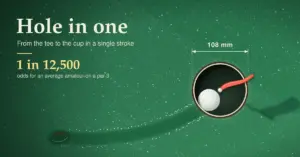
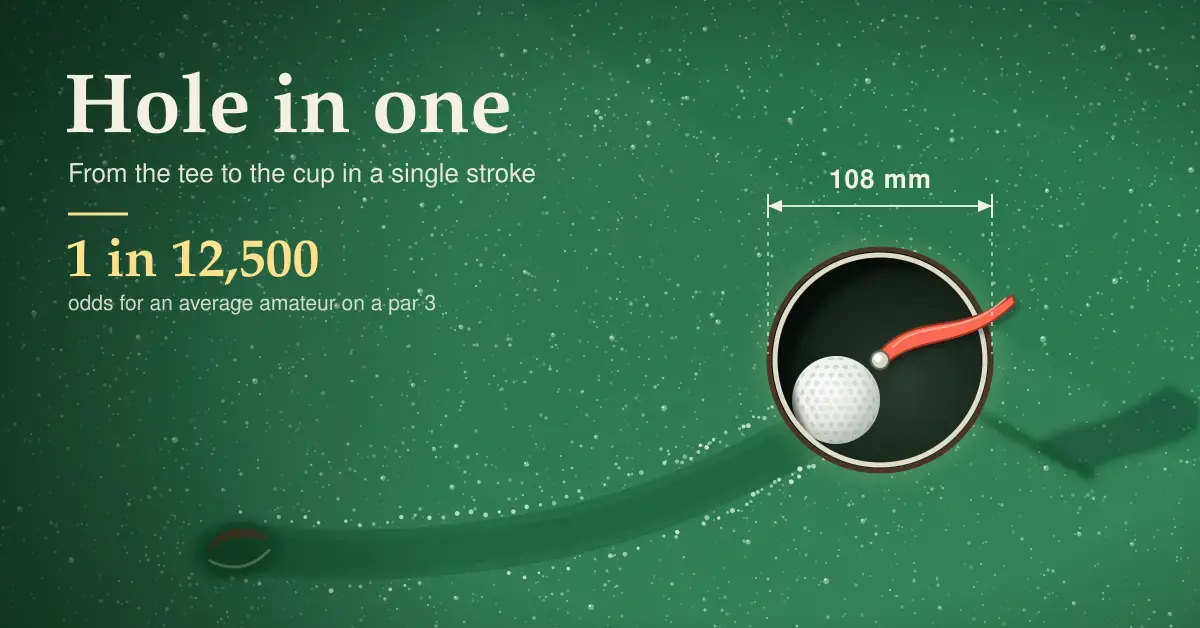
- Odds: about 1 in 12,500 for an average amateur and 1 in 2,500 for a tour professional on a par 3 (insurer estimates).
- The target: the hole measures 108 mm (4.25 inches) across, a little over two and a half golf balls wide.
- The rule: the whole ball must come to rest below the surface of the green, with no penalty strokes involved.
What is a hole in one in golf?
A hole in one happens when the ball you hit from the tee to start a hole comes to rest in the cup, with no shots in between. Because it takes only one stroke, it is the lowest score possible on any single hole. The word “ace” means the same thing and is used interchangeably, most often in casual conversation and television commentary.
The key detail is that the shot must be your first stroke on the hole and must be played from the teeing area. A tee shot does not count as an ace if a penalty is involved beforehand — for example, if your first ball is lost or hit out of bounds and you are playing a replacement under penalty, the ball that finishes in the hole is not a hole in one, because it is not your first stroke on that hole.
Holes in one are not limited to professionals or low-markers. Complete beginners have made them, and many very good players go an entire career without one. The shot rewards a well-struck tee shot, but the final roll into the cup always involves a large slice of luck.
Where do holes in one happen on the course?
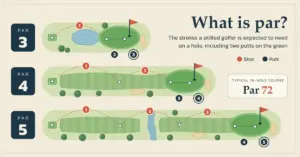
Almost every hole in one is made on a par-3 hole — the shortest holes on a course, where a strong player is expected to reach the green with the tee shot. Par 3s in New Zealand and worldwide typically run up to about 230 metres (250 yards), and many are far shorter, which is why they are the only holes most golfers can realistically reach in one. To understand how holes are rated, see our guide to what par in golf means.
Holes in one on par-4 and par-5 holes do exist, but they are extraordinarily rare and usually need a short, driveable par 4, a sharp dogleg that lets a player cut the corner, or thin high-altitude air that carries the ball further. They are the exception; the everyday hole in one is a tee shot on a par 3 that lands, releases and tumbles in.
The target itself is small. Under the Rules of Golf, the hole must measure 108 millimetres (4.25 inches) in diameter and be at least 101.6 millimetres (4 inches) deep — a little over two and a half golf balls wide. That tiny cup, often more than a hundred metres away, is what makes the feat so uncommon.
What does a hole in one score, and what is it called?
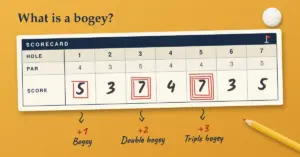
A hole in one always scores a 1 on the card, but the name for that score depends on the par of the hole, because golf names scores by how many strokes they sit under or over par.
- On a par 3, a 1 is two under par, which is an eagle — so the vast majority of aces are also eagles.
- On a par 4, a 1 is three under par, which is an albatross (also called a double eagle).
- On a par 5, a 1 is four under par, which is a condor — the rarest named score in the game.
For context, a score of one under par on a hole is a birdie, so a hole in one is always several rungs better than that. The table below lines up how a single stroke is scored and named on each type of hole.
Golf Scoring Terms Compared
| Type of hole | A hole in one scores | Strokes under par | Name for the score |
|---|---|---|---|
| Par 3 | 1 | 2 under | Eagle (and a hole in one / ace) |
| Par 4 | 1 | 3 under | Albatross (double eagle) |
| Par 5 | 1 | 4 under | Condor |
| Par 6 | 1 | 5 under | “Ostrich” (theoretical; none recorded) |
What are the odds of a hole in one?
The most widely quoted odds are about 1 in 12,500 for an average amateur to ace a par 3, and about 1 in 2,500 for a tour professional. These figures come from actuaries at hole-in-one insurance companies rather than from an official golf body, so treat them as careful estimates, not measured certainties — different sources quote different numbers.
The odds improve with ball-striking ability. A low-handicap player who hits more greens and controls distance better will ace a par 3 more often than a high-handicapper, which is why the professional figure is roughly five times shorter than the amateur one. Your golf handicap is a reasonable proxy for how likely you are to make one, although luck still decides the final roll. Sharpening your iron play with regular reps at a driving range will never guarantee an ace, but it does put more tee shots near the cup, which is the only part of the outcome you control.
Across a field, the odds shorten quickly. Insurers estimate that in a tournament of about 100 amateur players on a course with four par-3 holes, the chance that someone in the field makes an ace is roughly 1 in 32. That is why charity days and corporate events so often put a prize on a nominated par 3 — across a whole field over a whole day, an ace is genuinely possible.
What are the rules for a hole in one?
Under the Rules of Golf, a ball is “holed” only when it is at rest in the hole after your stroke and the entire ball is below the surface of the putting green. For a hole in one, that must happen on your first stroke of the hole, played from the teeing area, with no penalty strokes applied before it.
A few rules points decide the close calls:
- The ball must come to rest in the hole. A ball that drops in and bounces back out is not holed, because it did not stay at rest below the surface.
- A ball wedged in the side of the cup may not count. If part of the ball sits above the level of the putting surface, it is not holed — even if it is touching the flagstick.
- Against the flagstick is fine. If the ball rests against a flagstick left in the hole and any part of it is below the surface, the Rules treat it as holed.
There is a common belief that an ace must be witnessed to “count”. The Rules of Golf do not require a witness for the score to be valid — a hole in one is a legitimate score whether or not anyone saw it. Witnesses matter only in a practical sense: for bragging rights, for most prize and insurance schemes (which usually require an independent observer or an attested scorecard), and for record claims. In official play, a hole in one is scored and attested exactly like any other hole.
Famous holes in one and records
The only par-4 ace on the PGA Tour
Andrew Magee holed his tee shot on the 332-yard (about 304-metre) par-4 17th during the first round of the 2001 Phoenix Open at TPC of Scottsdale on 25 January 2001. His drive bounced along the fairway and struck the putter of Tom Byrum — who was lining up a putt in the group ahead — before rolling into the cup. According to Guinness World Records, it is, to date, the only par-4 hole in one made in a PGA Tour event, and also the longest hole in one recorded in a PGA Tour event.
The longest hole in one
The longest ace ever reported is a 517-yard (473-metre) hole in one credited to American golfer Mike Crean on the par-5 ninth at Green Valley Ranch in Denver in 2002, where the thin, mile-high air helped carry the ball. The claim is widely cited but also disputed, because no playing partner actually saw the ball drop; it was attested by affidavit afterwards. The best-known hole in one on a par 5 is a 496-yard condor by Shaun Lynch at Teign Valley Golf Club in Devon, England, in 1995, made by cutting across a horseshoe-shaped hole with a 3-iron.
Has Tiger Woods ever had a hole in one?
Yes. According to Golf Monthly, Tiger Woods has made 20 holes in one in his life, but — surprisingly — only three of them came in PGA Tour events, and all three fell in successive years in the 1990s, starting with his professional debut at the 1996 Greater Milwaukee Open and the following year’s 1997 Phoenix Open. He has not aced a hole in a Tour event since, although he made a widely shared hole in one during a casual round at the Madison Club in La Quinta, California, in 2018. His tally shows how luck-dependent the shot is: even one of the greatest ball-strikers in history managed only a handful of Tour aces across a long career.
Most holes in one by one golfer
The largest career tally most often quoted belongs to American Norman Manley, who, as Golf Monthly notes, was for years given as the record holder with 59 holes in one. That figure has since fallen out of favour because, like most amateur ace records, it is difficult to verify independently, so it is best treated as a reported total rather than an official record. It does, however, capture how a lifetime of golf and a run of good fortune can stack up.
Traditions, prizes and hole-in-one insurance
A long-standing tradition holds that a player who makes a hole in one buys a round of drinks for everyone in the clubhouse afterwards. It is a custom rather than a rule, and it is why many clubs and societies run their own informal hole-in-one funds so the lucky golfer is not left with a surprise bar bill.
At organised events, a hole in one on a nominated par 3 can win a major prize — a car, a holiday or a large cash sum. But an ace does not win you money automatically: it pays out only where an event is running a sponsored hole-in-one prize, and usually only on that one nominated hole and under set conditions. These prizes are almost always underwritten by a specialist insurer through a prize-indemnity policy: the event organiser pays a premium, and the insurer pays out the big prize in the rare event that a qualifying ace is made. This is also what people usually mean by “hole-in-one insurance”.
New Zealand has a well-known standing version of the challenge on the Taupō lakefront, where you hit at a floating green moored out on the water. Sinking the red flag — listed at about 104 metres (113 yards) from the tee — pays a NZ$10,000 prize, with rounds starting from around NZ$25. As with every price and prize on this page, confirm the current rate directly with the operator, as these figures change.
Sources
- The R&A — Rules of Golf: Definitions (Hole and Holed)
- The R&A — Rules of Golf: Rule 13 (ball resting against the flagstick, Rule 13.2c)
- Guinness World Records — Longest golf hole-in-one in a PGA Tour event
- Hole In One International — The Odds of a Hole In One
- Golf Monthly — Has There Ever Been A Hole-In-One On A Par 5?
- Golf Monthly — Which Golfers Have Had The Most Hole-In-Ones?
- Golf Monthly — How Many Holes-In-One Does Tiger Woods Have?
- Lake Taupō Hole in One Challenge
Frequently Asked Questions
What is a hole in 2 in golf?
A “hole in 2” simply means you took two strokes to complete the hole, and its name depends on the par. On a par 3 a 2 is a birdie; on a par 4 a 2 is an eagle; and on a par 5 a 2 is an albatross. There is no single special term for taking two shots the way “hole in one” names a single stroke.
Does a hole in one count towards your golf handicap?
Yes, but there is no special bonus. A hole in one is recorded as a score of 1 on that hole, just like any other number on your card. It lowers your total for the round, and a strong round feeds into your handicap index under the World Handicap System in the normal way — the ace is simply a very good hole score, not a separate adjustment.
Can you score a hole in one at a driving range or on a mini-golf course?
Not in the formal sense. A driving range has no hole to finish in, so an ace is not possible there, although some ranges run target or technology-based challenges instead. On a mini-golf course you can certainly sink a putt from the start in one stroke, and it is commonly called a hole in one, but it is an informal achievement rather than a regulation golf ace on a par 3.
Has anyone made more than one hole in one in a single round?
Yes, though it is exceptionally rare. There are documented cases of golfers acing two par 3s in the same round, and even rarer accounts of aces on consecutive holes. Given the odds of a single hole in one, two in one round is one of the longest shots in the sport.