The four golf majors are the sport’s most important tournaments: the Masters, the PGA Championship, the US Open and The Open Championship. They are played once a year each, between April and July, and — unlike almost everything else in professional golf — each one is run by a different, independent governing body rather than by a single tour. Winning any of the four is the achievement that defines a professional golfer’s career, which is why the majors get far more attention than a normal weekly event. This guide explains what each major is, how they work, how players qualify, and what records like the Grand Slam actually mean — with the New Zealand angle, including the country’s own major champions, built in.
Key Points
- The four men’s majors, in order: the Masters (April), the PGA Championship (May), the US Open (June) and The Open Championship (July).
- Each is run by a different, independent body — not owned by a single tour — which is why they survived the recent split in men’s golf unchanged.
- Format: 72 holes of stroke play over four days, with a cut after two rounds to roughly the top 70 and ties.
- Trophies: the Green Jacket (Masters), the Wanamaker Trophy (PGA), the US Open Trophy, and the Claret Jug (The Open).
- Records: six men have completed the career Grand Slam; Jack Nicklaus leads all-time with 18 major titles, ahead of Tiger Woods on 15.
- NZ link: Ryan Fox won the 2026 Open Championship — New Zealand’s third men’s major champion, after Bob Charles (1963) and Michael Campbell (2005).
What are the four golf majors?
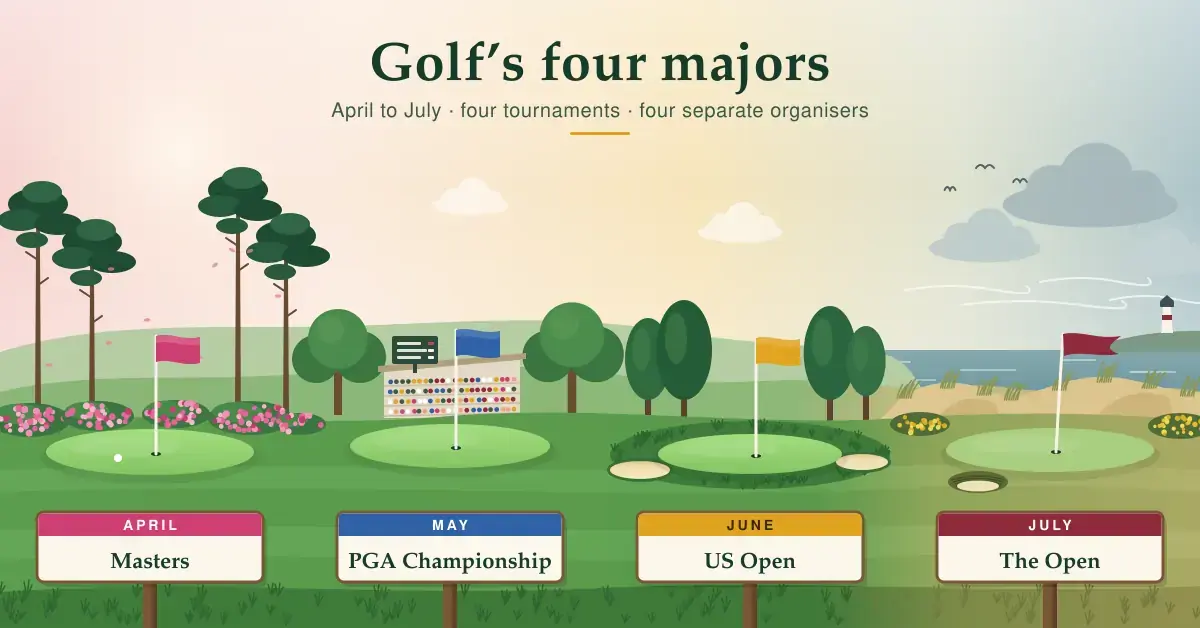
The four men’s majors, in the order they are played each year, are:
- The Masters — April, at Augusta National Golf Club in Georgia, USA. Winner receives the Green Jacket.
- The PGA Championship — May, on a rotating selection of US courses. Winner receives the Wanamaker Trophy.
- The US Open — June, on a rotating selection of US courses. Winner receives the US Open Trophy.
- The Open Championship — July, on a rotation of links courses in the United Kingdom. Winner receives the Claret Jug.
“Major” is not an official title handed out by one organisation. The four have simply come to be accepted, over many decades, as the championships that matter most, and they are the events that carry the heaviest weight in the Official World Golf Ranking. Because each is organised separately, they feel different from one another — different course styles, different traditions and even different rules for settling a tie.
The four majors compared
Here is how the four line up on the details that matter most to a new follower. Prize funds change every year, so treat the figures below as a guide and confirm the current purse with the event’s own website.
| Major | First played | Run by | When | Venue | Trophy |
|---|---|---|---|---|---|
| The Masters | 1934 | Augusta National Golf Club | April | Augusta National (fixed) | Green Jacket |
| PGA Championship | 1916 | PGA of America | May | Rotating US courses | Wanamaker Trophy |
| US Open | 1895 | USGA | June | Rotating US courses | US Open Trophy |
| The Open Championship | 1860 | The R&A | July | Rotating UK links courses | Claret Jug |
The Masters: golf’s invitation-only major
The Masters is the only major played on the same course every year — Augusta National Golf Club in Georgia — which is a large part of its identity. It was founded by the great amateur Bobby Jones and businessman Clifford Roberts, and first played in 1934 (originally as the Augusta National Invitation Tournament). The winner has been presented with the famous Green Jacket since 1949.
The Masters is also the only major that is invitation-only: there is no open qualifying. Players earn a place through a published set of criteria — past champions, recent major and Players Championship winners, top finishers at the previous year’s majors, leading players in the world ranking, and a small number of leading amateurs. That smaller, elite field and the unchanging course are why Augusta records and course knowledge count for so much.
The PGA Championship: the players’ major
The PGA Championship is run by the PGA of America and was first played in 1916, when Rodman Wanamaker put up the trophy that still carries his name. For its first four decades it was a match-play event; it became a 72-hole stroke-play tournament in 1958. The winner lifts the Wanamaker Trophy, one of the largest trophies in sport.
For most of its modern history the PGA Championship was played in August as the last major of the year. From 2019 it moved to May, slotting in as the second major of the season, a change tied partly to golf’s return to the Olympic programme. It is played on a rotation of strong US courses and is known for assembling one of the deepest fields of the year, including a number of club professionals who qualify through the PGA of America.
The US Open: the toughest test
The US Open is run by the United States Golf Association (USGA) and was first played in 1895, making it the second-oldest major. It has a reputation as the hardest major to win because the USGA deliberately sets courses up to be punishing: narrow fairways, thick rough and firm, fast greens that push the winning score close to par and sometimes above it.
It rotates around famous American venues — courses such as Pebble Beach, Oakmont, Shinnecock Hills and Pinehurst — and is one of the two majors with a genuinely open path in: a player with a low enough golf handicap can enter local and final qualifying and, in theory, play their way into the field. The 2026 edition was held at Shinnecock Hills in New York.
The Open Championship: the oldest major
The Open Championship — often called “The Open” or, informally, the British Open — is the oldest of the four, first played in 1860 at Prestwick in Scotland. It is run by The R&A and is the only major held outside the United States, moving around a rota of seaside “links” courses in the UK, such as St Andrews, Royal Birkdale and Royal Troon. A links course is a traditional coastal layout with firm turf, few trees and ever-present wind, so The Open rewards a different, lower, more creative style of play.
The winner receives the Claret Jug, golf’s oldest and most famous trophy, first awarded in 1872. Like the US Open, The Open runs open qualifying, so amateurs and lesser-known professionals can earn a spot. The 2026 Open was played at Royal Birkdale in England — and its result mattered a great deal in New Zealand, as we explain below.
How the majors work: format, the cut and playoffs
All four majors share the same basic shape but differ in the fine print, especially in how they break a tie.
72 holes of stroke play with a cut
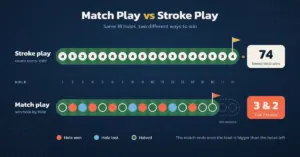
Each major is a four-round, 72-hole stroke-play event: players add up every shot over four days, and the lowest total wins. After the first two rounds (36 holes) there is a “cut” — roughly the top 70 players and ties play on over the weekend, while the rest are eliminated and go home. The exact cut rule varies slightly between events (the Masters, for example, keeps the top 50 and ties). Stroke play is the opposite of match play, where players compete hole-by-hole rather than on a running total.
How ties are settled: the playoff formats
If two or more players finish level after 72 holes, each major breaks the tie its own way — a detail that often decides a champion:
- The Masters: sudden death. Players replay the 18th hole, then the 10th, and keep repeating until one wins a hole outright. Rory McIlroy’s 2025 Masters was decided this way.
- The US Open: a two-hole aggregate playoff (the lower combined score over two holes wins), moving to sudden death if still level. The USGA adopted this in 2018, ending its old practice of an extra 18-hole round the next day.
- The PGA Championship: a three-hole aggregate playoff, then sudden death if needed.
- The Open Championship: a four-hole aggregate playoff, then sudden death if needed.
How players qualify
Entry into a major comes through a mix of exemptions and qualifying. Common routes include winning a recent major, ranking among the leaders in the world ranking, finishing high in official tour standings, or winning qualifying events. The Masters is invitation-only, as described above. The US Open and The Open are the most open, both offering qualifying rounds that give low-handicap amateurs and journeyman professionals a realistic chance to earn a place — one of the features that makes those two championships so widely followed.
The Grand Slam and the Career Grand Slam
Winning a major is hard; winning all four is the rarest feat in the game. Two terms get used, and they are not the same thing:
- The Grand Slam means winning all four majors in the same calendar year. No man has ever done it in the modern four-major era.
- The Career Grand Slam means winning all four at some point over a career. Only six men have managed it: Gene Sarazen, Ben Hogan, Gary Player, Jack Nicklaus, Tiger Woods and, most recently, Rory McIlroy, who completed the set — and his first European career Grand Slam — by winning the 2025 Masters at his eleventh attempt.
Tiger Woods came closest to a true Grand Slam with the “Tiger Slam”: he held all four trophies at once across 2000 and 2001, though not within a single calendar year. For the all-time record, Jack Nicklaus leads with 18 major titles, ahead of Woods on 15 — the benchmark that today’s players are measured against. These are also the numbers you will see cited whenever a leaderboard is compared to history, including when fans track the PGA Tour leaderboard during major weeks.
The New Zealand connection: Ryan Fox and the Claret Jug
New Zealand has a real stake in the majors. In July 2026, Ryan Fox won The Open Championship at Royal Birkdale, birdieing the 72nd hole to beat Cameron Young by a single shot and claim his first major at the age of 39. It was a landmark result: Fox became only the third New Zealander to win a men’s major, and he brought the Claret Jug back to New Zealand for the first time since Bob Charles lifted it in 1963.
Those three Kiwi men’s major champions are worth knowing:
- Bob Charles — won The Open in 1963, the first left-hander to win a major.
- Michael Campbell — won the US Open in 2005, holding off Tiger Woods at Pinehurst.
- Ryan Fox — won The Open in 2026.
New Zealand’s major pedigree is just as strong in the women’s game, where Lydia Ko has won multiple women’s majors alongside her Olympic medals. It is also worth not confusing The Open Championship with the New Zealand Open: the latter is a long-running, well-regarded national championship on the Asian and Australasian tours, but it is not one of the four majors.
Women’s majors and the “fifth major” debate
One common point of confusion is that the women’s professional game has five majors, not four: the Chevron Championship, the US Women’s Open, the KPMG Women’s PGA Championship, the Amundi Evian Championship and the AIG Women’s Open. So “four majors” is specifically a men’s figure.
On the men’s side, people regularly ask whether there is a “fifth major.” There is not — officially there are four — but The Players Championship, run by the PGA Tour, is often described as the game’s unofficial fifth major because of its strong field and prize fund. The arrival of LIV Golf and the split in the men’s professional game has added to the debate about what counts as elite, but it has not changed the status of the four majors, which remain run by their independent governing bodies.
How to follow the majors from New Zealand
The biggest practical challenge for New Zealand fans is the time difference. Because the majors are played in the United States and the UK, the key action usually unfolds in the small hours of the New Zealand morning or, for The Open, late evening New Zealand time. Final rounds are on the Sunday at the venue, which is Monday morning here.
To watch live, you will generally need a broadcaster or streaming service that holds the New Zealand rights, which can differ from one major to the next. If staying up is not an option, following the live scoring online and catching highlights afterwards is the common approach; our guide to how to follow The Open from New Zealand covers the viewing options in more detail. Checking the schedule in advance and converting the tee times to NZT is the simplest way to avoid missing the finish.
Common mistakes and misconceptions
A few things trip up newcomers to the majors:
- Thinking there are three majors. There are four men’s majors. The confusion usually comes from forgetting the PGA Championship, or from mixing up the men’s four with the women’s five.
- Calling The Open the “British Open.” Its official name is The Open Championship, or simply The Open. “British Open” is an informal nickname, mostly used outside the UK.
- Confusing the US Open and The Open. They are two separate majors: the US Open is run by the USGA on American courses in June; The Open is run by The R&A on UK links courses in July.
- Assuming the majors are owned by a single tour. They are not. Each is run by its own body — one reason they survived the recent upheaval in men’s professional golf largely unchanged.
- Treating prize money as fixed. Purses rise most years and differ between events; always check the current figure for the year you are looking at.
Sources
- The Masters — masters.com (official)
- PGA Championship (official)
- US Open — USGA (official)
- The Open Championship — The R&A (official)
- CBS Sports — Rory McIlroy completes the career Grand Slam (2025)
- CNN — Ryan Fox wins the 2026 Open Championship
- CBS Sports — PGA Championship moves to May from 2019
- MyGolfSpy — 2026 golf majors schedule and locations
- NBC Sports — women’s golf majors 2026
Frequently Asked Questions
Why are these four tournaments called “majors”?
Because they are, by long-standing consensus, the most prestigious and difficult championships to win, each run by an established governing body and carrying the most world ranking points. There is no single organisation that officially crowns an event a “major”; the status has built up over more than a century of history and tradition.
What is the difference between The Open and the US Open?
They are two different majors. The Open Championship is the oldest major, run by The R&A on seaside links courses in the United Kingdom, usually in July. The US Open is run by the USGA on courses in the United States, usually in June, and is known for extremely demanding course setups.
Can amateur golfers play in the majors?
Yes. The US Open and The Open both hold open qualifying, so a skilled amateur with a low handicap can earn a place by playing their way through qualifying rounds. The Masters and the PGA Championship also invite a limited number of leading amateurs, though their main fields are made up of professionals.
Does winning a major change a golfer’s ranking and earnings?
Significantly. Majors award the most Official World Golf Ranking points and some of the largest prize funds in the sport, so a win can move a player up the rankings and bring a major pay cheque. Just as important, it unlocks years of exemptions into future majors and other elite events, which shapes the rest of a player’s career.