
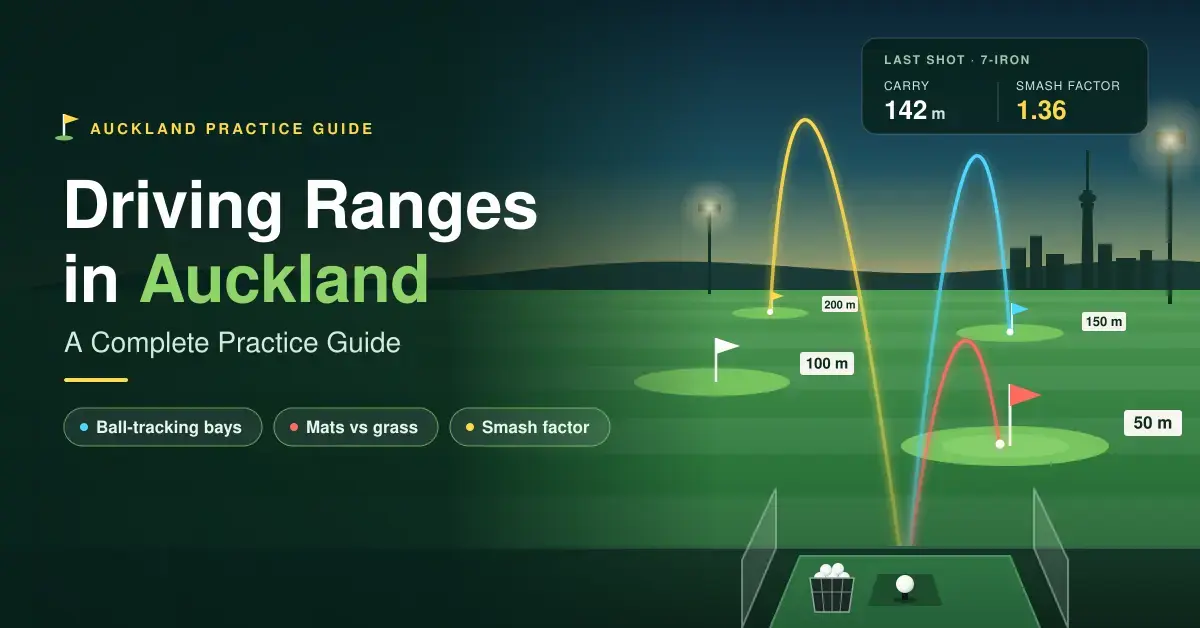
Auckland’s driving ranges have moved a long way from a single strip of worn matting and a wire basket of balls. The region now runs everything from 40-bay, ball-tracking mega-venues to quiet suburban ranges attached to a golf club, and choosing the right one depends on what you are actually trying to fix in your game. This guide explains how driving ranges in Auckland work, which venues offer what, and how to turn a practice session into measurable improvement rather than an hour of aimless swinging.
Key Points
- What it is: a driving range is a practice area where you hit supplied balls from lined-up bays, bought by the bucket or by time.
- Auckland options: big Toptracer venues (Golf Warehouse Ellerslie and Takapuna, Remuera’s Velocity Range) plus club and suburban ranges (Whitford Park, JK’s, The Range Warkworth).
- Use the data: smash factor and carry distance tell you more about your strike and yardages than raw distance.
- Mats vs grass: mats are consistent and weatherproof; grass tees give honest turf feedback for iron play.
- Where scores are made: spend up to half your time inside 50 metres — putting, chipping and pitching.
- Get a lesson: a PGA coach with video plus the range’s ball-tracking screen shortens the path to a repeatable swing.
What is a driving range, and why practise at one?
A driving range is a dedicated practice area where you hit balls from a lined-up row of bays into an open field or netted enclosure. Ranges supply their own marked practice balls, and you buy them by the bucket (small, medium or large) or by time in a technology-equipped bay. The point of a range is repetition in a controlled setting: on the course you get one shot with each club and then you move on, whereas a range lets you groove the same motion dozens of times in a row.
That repetition is why coaches treat the range as the workshop where a swing is built and the course as where it is tested. A golf swing is simply a repeatable athletic motion that delivers the clubface squarely into the ball, and building consistency in that motion is exactly what focused range time is for. At the range, your swing should be a motion you can repeat with confidence under pressure. If you are still refining the fundamentals, it pays to work on your golf swing mechanics before you start chasing extra distance.
Which driving ranges can you use around Auckland?
Auckland has both large commercial ranges built around ball-tracking technology and club-based ranges attached to golf courses. The commercial venues tend to be busiest and most family-friendly; the club ranges are often quieter and better for uninterrupted technical work. The comparison below sets out the main options across the wider region, from the central suburbs to the northern gateway at Warkworth.
Golf Warehouse Ellerslie is one of the country’s busiest practice destinations, with more than 40 fully automated bays running Toptracer Range technology, a nine-hole par-3 course (holes of roughly 80–125 metres) and indoor club-fitting bays; the site’s Golf Warehouse Ellerslie range page covers it in more detail. On the North Shore, Golf Warehouse Takapuna offers a 30-bay automated range, also Toptracer-equipped, plus an outdoor putting green and on-site PGA coaching — see the Takapuna driving range overview. In the central suburbs, Remuera Golf Club’s Velocity Range is a two-storey, 16-bay Toptracer facility with climate-controlled bays; Golf Warehouse Ellerslie and Remuera were, in fact, the first two venues in New Zealand to install Toptracer Range, back in December 2018.
For a more traditional, lower-cost experience, Whitford Park Golf Club runs a 20-bay range open to the public seven days a week, and JK’s Driving Range in Mangere is a long-standing, no-frills option handy to the airport. If you are heading north, The Range Warkworth is a covered 16-bay range with Toptracer, about 40 minutes from the city. For a fuller picture of the region’s practice options, the site’s driving-range overview is a useful starting point.
Auckland Driving Ranges Compared
| Venue | Area | Bays | Ball tracking | Notable extras |
|---|---|---|---|---|
| Golf Warehouse Ellerslie | Ellerslie (central) | 40+ automated | Toptracer Range | 9-hole par-3 course; indoor fitting bays |
| Golf Warehouse Takapuna | North Shore | 30 automated | Toptracer Range | Putting green; PGA coaching; late hours |
| Remuera Velocity Range | Remuera (central) | 16 (two-storey) | Toptracer | Climate-controlled bays; fitting studio |
| Whitford Park Golf Club | Whitford (south-east) | 20 | Standard | Public 7 days; club course on site |
| JK’s Driving Range | Mangere | Covered bays | Standard | No-frills; handy to the airport |
| The Range Warkworth | Warkworth (north) | 16 covered | Toptracer | Virtual games; ~40 min from the city |
Bay counts and features change — confirm current details and prices with each venue before you visit.
How does Toptracer and launch-monitor technology help your practice?
Ball-tracking technology turns a practice session from guesswork into data. Systems such as Toptracer Range use the same tracing technology seen in televised tournaments to display each shot’s flight, carry distance and ball speed on a screen in your bay. That matters most for “gapping” your clubs — knowing exactly how far each iron and wood carries in the air — so that on the course you can pick a club with confidence instead of hoping. It also exposes patterns: a consistent slice or a push shows up immediately, which lets you and a coach work on a fix with instant visual feedback.
Radar-based launch monitors, such as those used in professional club fitting, add even more precision by measuring the club and ball directly. If you want to practise indoors in poor weather, an indoor golf simulator uses the same category of technology in an enclosed bay. The key is not to drown in numbers: a handful of metrics tells you almost everything a club golfer needs to know.
Which numbers actually matter?
Total distance is the number everyone watches, but efficiency and consistency are what lower scores. Focus first on smash factor and carry distance; they reveal the quality of your strike and give you reliable yardages to trust on the course.
| Metric | What it means | Why it matters |
|---|---|---|
| Ball speed | Speed of the ball just after impact | The main driver of total distance |
| Carry distance | How far the ball flies in the air | The number you plan shots and gapping around |
| Launch angle | Initial angle of the ball off the face | Balances carry against roll for each club |
| Spin rate | Backspin on the ball | Affects height and how quickly the ball stops |
| Smash factor | Ball speed divided by clubhead speed | Measures how centred and efficient the strike is |
Should you practise off mats or grass tees?
Most Auckland ranges hit from synthetic mats, and for good reason: mats give a perfect lie every time, stay usable through wet Auckland winters, and modern cushioned versions are kinder to wrists and elbows over a long session. The trade-off is honesty. A mat can let the club bounce or skid into the ball, which quietly hides a “fat” strike where the club hits the ground first. Grass-tee practice, offered at some club ranges, shows exactly how your club interacts with the turf and produces real divots, which is invaluable for sharpening iron play.
A sensible approach is to use mats for high-volume, weather-proof repetition and technical drills, then get onto grass when you can to check that your strike stands up to real turf. If you tend to practise mostly on mats, spend a little extra time on your ball-first contact before an important round so the transition to the course is not a shock.
Why the short game deserves half your practice time
The fastest way to lower your scores is to practise inside 50 metres, not to add ten metres to your drive. Many of Auckland’s larger practice complexes include short-game areas — a chipping green with varied lies, a practice bunker with proper sand, and a putting green that mirrors course speeds. Yet most golfers spend nearly all their range time swinging a driver, which is the club used least often in a typical round. Splitting your time so that scoring clubs get real attention is one of the simplest ways to lower your handicap.
A sample short-game routine
A balanced hour spends the majority of its time on the shots that decide your score. The routine below allocates about an hour across putting, chipping, bunker play and pitching, so that no scoring skill is neglected.
| Activity | Focus | Suggested time |
|---|---|---|
| Putting | Pace control and start line | 20 minutes |
| Chipping | Landing spots and bump-and-run | 15 minutes |
| Pitching | Distance control with your wedges | 15 minutes |
| Bunker play | Splash shots and sand consistency | 10 minutes |
How do coaching and video analysis speed up improvement?
Practising the wrong move only makes a bad habit permanent, which is why lessons remain the best value in golf. Most Auckland ranges are staffed by PGA-qualified professionals who offer range-side lessons, often using video software that plays your swing back in slow motion beside a reference model. Seeing your own positions “down the line” and “face on” reveals faults — an over-the-top move, early extension, a slide — that are impossible to feel from inside the swing.
A single lesson to set a clear practice priority, followed by focused solo sessions, usually beats hours of unsupervised swinging. Many coaches now also offer remote check-ins, where you send a range video and receive feedback, which suits busy schedules. Pair coaching with the range’s ball-tracking screen and you get both the “why” of a fault and the numbers that confirm the fix is working.
Is floodlit night practice worth it?
For anyone who cannot reach a range in daylight, floodlit evening practice is genuinely useful, with a couple of caveats. Auckland’s wind often drops after dusk, so evenings can be good for checking your stock yardages, and the quieter atmosphere suits high-focus technical drills. The main limitation is depth perception: ball flight looks different under lights, so leaning on the launch-monitor data rather than your eyes stops you overswinging to compensate. Several ranges keep floodlit bays open late — Golf Warehouse Takapuna, for example, runs into the late evening — and some offer cheaper after-work bucket deals.
What does a driving range session cost in Auckland?
Costs vary by venue and by whether you use a standard bay or a technology bay, so check current prices with the range before you go. As a general guide, a bucket of balls is the cheapest option; time-based Toptracer bays are priced by the hour and are usually shared between a group, which spreads the cost. Loyalty cards, prepaid ball cards and off-peak specials are common and cut the price per session for regular practisers. If you value practising in any weather, factor covered and heated bays into the value, not just the sticker price of a bucket.
Common driving-range mistakes to avoid
The biggest mistake is treating the range as a place to hit a driver as hard as possible. Productive practice looks different, and avoiding a few common traps makes every session count.
- Hitting too fast: raking ball after ball with no routine trains a rushed rhythm; take your time and go through a full pre-shot routine on most swings.
- Only using the driver: the driver is one club in fourteen; give your irons, wedges and putter the time they deserve.
- Ignoring targets: aimless swinging builds no accuracy. Pick a specific target and an imaginary fairway for every shot.
- Trusting worn range balls: scuffed, flat-spotted practice balls can lose distance and fly erratically, so treat their distances as a rough guide, not gospel.
- Skipping the short game: the scoring clubs win rounds; leaving them out of practice is the fastest way to stall your progress.
Range etiquette and safety
A range is more relaxed than the course, but a short list of courtesies keeps everyone safe and comfortable. Safety comes first: never walk in front of the hitting line to fetch a ball, no matter how close it looks, because someone in an adjacent bay may already be mid-swing.
- Stay in your bay: keep your backswing and follow-through clear of the golfers on either side of you.
- Mind the noise: use headphones for music or podcasts, and keep any launch-monitor audio low.
- Respect the hitting line: never cross in front of the mats while others are hitting.
- Tidy up: return empty buckets to the collection points and leave the bay as you found it.
- Watch peak-time limits: on busy weekend mornings, be aware of any time caps so the queue keeps moving.
Sources
- Golf Warehouse NZ — Driving Ranges (Ellerslie & Takapuna facilities)
- Remuera Golf Club — Velocity Range (Toptracer)
- Golf Business News — Toptracer expansion into New Zealand
- NZ Golf Magazine — Remuera launches Toptracer Range
- Whitford Park Golf Club — Facilities
- The Range Warkworth — Golf driving range
- AucklandNZ — Auckland golf and practice facilities
Frequently Asked Questions (FAQ)
Can I use my own golf balls at an Auckland driving range?
No. Ranges require their own marked practice balls for safety and because the balls are collected and reused, so you cannot bring your own onto the range.
Do I need my own clubs to visit a driving range?
Not necessarily. Most Auckland ranges rent clubs for a small fee, which makes it easy for beginners or visitors to try the game before buying equipment.
Is Toptracer included in the price of a bucket?
It depends on the venue. Some ranges include ball-tracking in a standard bay, while others charge for a technology-enabled bay by the hour, so check the pricing at your chosen range.
How many balls are in a large bucket?
It varies by range, but a large bucket in Auckland typically holds somewhere in the region of 90 to 110 balls. Ask at reception, as sizes and counts differ between venues.
How often should I practise to see improvement?
Consistency matters more than marathon sessions. Two focused, structured sessions a week — with time given to the short game, not just the driver — will produce steadier progress than one long, unfocused visit.