
A sharp short game is the fastest way to shave strokes off your card, and the wedge is the club that makes it happen. Whether you are comparing golf wedges in New Zealand for the first time, hunting a clearance deal, or fine-tuning the bounce and grind that suit your home course, the best choice balances turf conditions, your own swing and honest loft gapping. This guide explains how wedges work, what the numbers stamped on the sole actually mean, which flagship 2026 models are sold locally, and how to match them to Kiwi turf — in plain language, with no sales pitch.
Key Points
- What wedges do: cover the scoring shots inside about 110 m — full approaches, pitches, chips and bunker escapes.
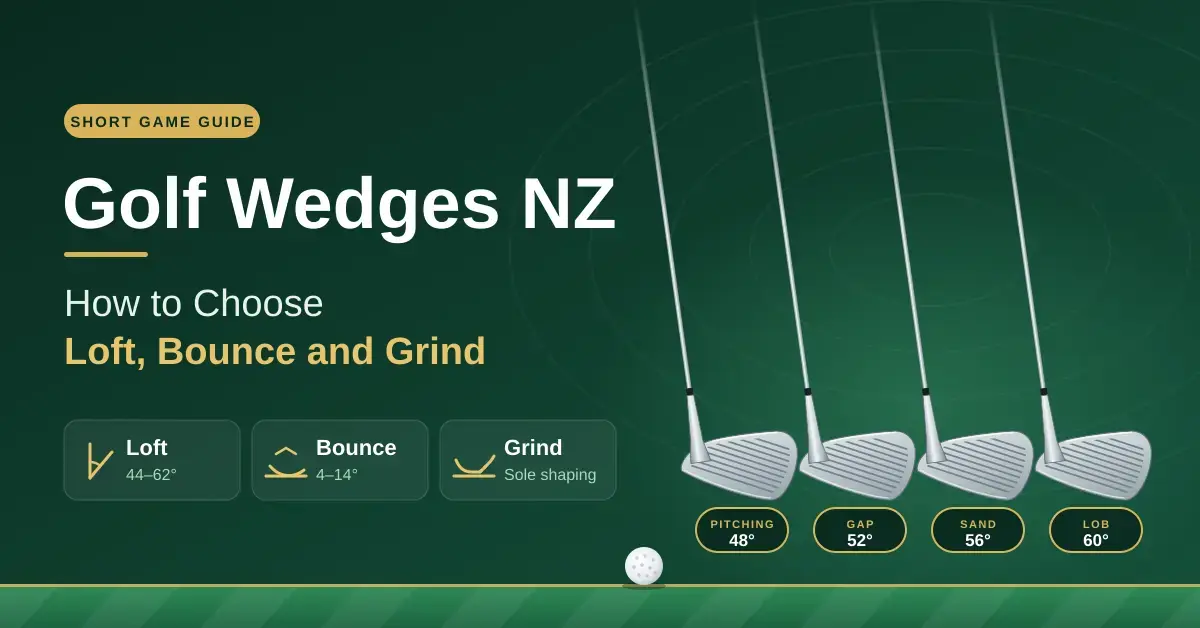
- Four types by loft: pitching (44–48°), gap (50–52°), sand (54–56°) and lob (58–62°).
- Bounce is your anti-dig safety: low 4–6° for firm turf and sweepers, mid 7–10° as an all-rounder, high 12–14° for soft turf and steep swings.
- Grind fine-tunes how the sole turns through the ground for open-face and greenside shots.
- Gap evenly: aim for 4–6° steps between wedges, and check your (often strong) pitching-wedge loft first.
- 2026 lines sold in NZ: Titleist Vokey SM11, Callaway Opus SP, Cleveland CBZ, TaylorMade MG5, PING s259, Mizuno Pro T-1.
- Typical NZ price: roughly NZD 200–400 per wedge depending on model, finish and condition.
What is a golf wedge, and what is it for?
A wedge is a short, high-lofted iron built for the scoring shots inside roughly 110 metres of the green. Where a driver and long irons are built for distance, wedges are built for height, spin and control: full approach shots into a green, pitches and chips around it, and escapes from bunkers or thick rough. Loft on a modern wedge typically runs from about 44° up to 62° or higher, and that loft — together with two less obvious numbers, bounce and grind — decides how the club behaves when it meets the turf.
Because these are the clubs you use most often near the hole, small differences in specification have an outsized effect on your score. Getting the setup right matters more than the brand name on the head.
Wedge anatomy: loft, bounce and sole grind explained
Three measurements define how a wedge performs: loft controls height and distance, bounce controls how the sole interacts with the ground, and grind fine-tunes that interaction for different shots and lies. Understanding all three is the difference between a club that glides through impact and one that digs or skids.
What does wedge loft mean?
Loft is the angle of the clubface relative to vertical, measured in degrees. Higher loft launches the ball higher and shorter with more backspin; lower loft flies it lower and further. Wedge loft is stamped on the sole or toe (for example “56″), and it is the single most important number when you build a set, because it determines the yardage gaps between your clubs.
What is bounce, and how much do you need?
Bounce is the angle between the leading edge of the face and the lowest point of the sole when the club sits flat — in effect a built-in skid plate that stops the head burying into the ground. The right amount depends on your angle of attack and the turf you usually play.
- Low bounce (4–6°): suits players with a shallow, sweeping swing and shots off firm, tight lies or thin, compacted sand. The leading edge sits close to the ground, which is ideal for opening the face on delicate lobs but less forgiving on soft turf.
- Mid bounce (7–10°): the versatile all-rounder that suits most club golfers and a wide range of conditions. If you are unsure, this is the safe default.
- High bounce (12–14°): suits steep swings that take deep divots, and soft turf, fluffy bunker sand and wet rough. The extra bounce keeps the sole from digging.
What is a sole grind?
A grind is metal removed from the heel, toe or trailing edge of the sole to change how the club sits and turns through the turf. A heel-and-toe grind (such as Vokey’s M grind or Callaway’s C grind) lets you lay the face wide open on a tight lie without lifting the leading edge off the grass, which is what makes flop shots and spinning greenside pitches possible. Wider, less-ground soles do the opposite: they add forgiveness and float for players who want simplicity over shot-making.
The four wedge types and how to gap them
Most golfers carry two to four wedges, spaced by loft so each covers a predictable distance. The four standard categories are:
- Pitching wedge (about 44–48°): usually the shortest club in an iron set, used for full approach shots.
- Gap (or approach) wedge (about 50–52°): bridges the yardage gap between the pitching and sand wedge.
- Sand wedge (about 54–56°): the most versatile club of the four — bunkers, chips, full shots and bump-and-runs.
- Lob wedge (about 58–62°): a specialist for high, soft shots that stop quickly and for escaping trouble near the green.
The key point is gapping: aim for an even 4–6° step between wedges so your distances rise in tidy increments. This matters more than it used to, because many modern iron sets have “strong” lofts — a pitching wedge can now be as low as 43–44°. Bolt a traditional 52° gap wedge onto a set like that and you leave an 8–9° hole that translates to a 20-metre distance gap you have to fudge with awkward half-swings. Check your pitching wedge loft first, then space the rest around it. Remember, too, that every wedge counts towards the 14-club rule, so an extra wedge means one fewer club elsewhere in the bag.
Best golf wedges in New Zealand for 2026
New Zealand retailers stock the same flagship families sold on the world’s tours, so local players have full access to current-generation hardware. Rather than ranking them — the right wedge depends on your swing, not a leaderboard — the table below compares the leading 2026 lines on the specifics that matter: who each suits, loft range, a standout feature and an indicative New Zealand price. Golf is one of the most widely played sports in the world (Wikipedia), and the wedge market reflects that scale, with each brand refining grooves, finishes and grinds every product cycle.
Wedge Family Comparison
| 2026 model | Best suited to | Loft range | Standout feature | Indicative NZ price |
|---|---|---|---|---|
| Titleist Vokey SM11 | Low to mid handicaps, shot-makers | 46–62° | Six tour grinds; CG consistent within each loft | ~NZD 369 |
| Callaway Opus SP | Players chasing greenside spin | 46–60° | Spin Gen 2.0 face with Spin Pocket construction | ~NZD 349 |
| Cleveland CBZ | Beginners and higher handicaps | 44–60° | Forgiving cavity-back; soft Z-Alloy, ZipCore weighting | ~NZD 249 |
| TaylorMade MG5 | All levels; wet-weather spin | 46–60° | Raw face with laser-etched Spin Tread grooves | ~NZD 349 |
| PING s259 | Better players wanting a compact head | 46–62° | New face-blast; larger elastomer insert for feel | ~NZD 349 |
| Mizuno Pro T-1 | Feel-focused players | 46–60° | Grain-flow forged; soft feel, copper or satin finish | ~NZD 329 |
A few practical distinctions between the families:
- Titleist Vokey SM11 is the tour benchmark, offered in six grinds and finishes including Tour Chrome, Nickel, a new Jet Black and a custom Raw. For 2026 Titleist redesigned the heads so the centre of gravity is consistent within each loft, which makes fitting more predictable.
- Callaway Opus SP / SP+ chases spin, using Spin Gen 2.0 face technology and a Spin Pocket (a larger “Spin Rocket” on the SP+) to lift launch and grab the green. Multiple grind options, including a returning X grind, cover most player types.
- Cleveland CBZ is the most forgiving option here: a cavity-back, game-improvement wedge using Cleveland’s Z-Alloy carbon steel, which the maker states is around 25% softer than the 431 stainless used in its previous CBX line, plus ZipCore weighting for stability on off-centre strikes.
- TaylorMade Milled Grind 5 (MG5) pairs a raw face with laser-etched Spin Tread grooves that channel water away, aimed at holding spin in damp conditions — useful through a New Zealand winter.
- PING s259 is a compact players’ wedge with new face-blast technology and a larger elastomer insert for feel, available in Chrome and Raw across six grinds.
- Mizuno Pro T-1 / T-3 are Mizuno’s current grain-flow forged wedges, known for soft feel and copper or satin finishes, with a broad range of sole profiles.
If you value spin and stopping power, look closely at groove technology and face coatings and at the golf balls you pair with them, since a soft, urethane-covered ball does more for greenside spin than any single club feature.
How to match wedges to New Zealand conditions
Bounce and grind that glide across a baked summer links behave very differently on a wet winter fairway, so New Zealand’s changeable maritime climate is a genuine factor in wedge selection. Matching your sole setup to the ground you usually play can save several shots a round.
- Wet Auckland winters: heavy, clay-based courses hold water and turn soft, so a low-bounce sole tends to dig and chunk. A higher-bounce sand or gap wedge (roughly 12–14°) skids through soft turf and gives you cleaner contact.
- Firm summer links: in summer, coastal fairways bake hard and lies get tight, and a high-bounce sole can catch the ground and skull the ball. A lower-bounce lob wedge (around 4–6°) lets the leading edge sit flush for crisp contact.
- West-coast iron-sand bunkers: many coastal courses have dense, dark iron-sand bunkers that play firmer than fluffy resort sand. A mid-to-low-bounce wedge with a heel grind lets you slide the sole under the ball instead of bouncing off the packed base.
You do not need a different wedge for every season — but if you play one course most of the time, choosing bounce to suit its turf is one of the cheapest ways to improve.
Common wedge-buying mistakes to avoid
Most wedge errors come from buying on brand or looks rather than fit. The frequent ones are:
- Ignoring loft gaps: adding a wedge without checking your iron-set lofts, and leaving a distance hole you have to guess your way through.
- Buying the wrong bounce for your turf and swing: a steep swinger on soft ground with a low-bounce lob wedge, or a sweeper on firm turf with a high-bounce sole, will fight the club all day.
- Copying a tour player’s specs: elite players use very low-bounce, heavily ground soles that punish anything less than a perfect strike; most amateurs score better with more bounce and forgiveness.
- Beginners choosing blades over game-improvement wedges: higher-handicap players are usually better served by a forgiving cavity-back such as the Cleveland CBZ than by a compact tour blade.
- Playing worn grooves: grooves flatten with use and lose spin; a tired wedge that looks fine can quietly cost you stopping power.
- Never getting fitted: a short session on a launch monitor removes the guesswork on loft, bounce and grind and is worth more than paying up for the newest finish.
How to care for your wedges
Clean grooves are the single biggest factor in maintaining spin, so a quick routine keeps a wedge performing far longer. Wedges take a beating from mud, sand, moisture and fairway chemicals, all of which dull the grooves and can corrode the finish if left unchecked.
- Clean the grooves after every shot and round: a soft brush and warm, soapy water clear packed sand and mud before they harden. Learn how to clean your golf clubs properly and the grooves stay sharp for longer.
- Avoid wire brushes on plated finishes: stiff metal bristles scratch chrome and satin coatings and can strip the micro-texture between grooves; use a nylon brush instead.
- Understand raw finishes: raw (unplated) wedges are designed to rust over time into a matte, glare-free patina — that is normal, not a fault.
- Dry clubs before storage: never leave a damp wedge sealed in a wet bag, which traps moisture against the metal and causes pitting and rust spots.
How much do golf wedges cost in NZ, and where to buy them?
Current-generation flagship wedges in New Zealand typically sell for around NZD 340–400 each, while forgiving game-improvement models often land nearer NZD 200–300. Prices vary by finish, shaft and retailer, and limited editions or graphite shafts push higher. You can buy from national golf superstores, on-course pro shops and reputable online retailers; comparing golf clubs for sale in NZ across a few outlets is the quickest way to gauge fair pricing.
To keep costs down, watch for stock-take clearances and ex-demo or ex-fleet clubs, and consider buying second-hand gear for wedges in good groove condition. When you are building or refreshing a bag, it also pays to budget for the golf accessories — brushes, towels and headcovers — that protect the investment.
Sources
Frequently Asked Questions (FAQ)
What is the difference between wedge bounce and a sole grind?
Bounce is a fixed angle — the angle between the leading edge and the lowest point of the sole — that stops the club digging into the ground. A grind is metal shaped away from the heel, toe or trailing edge to change how the sole sits and turns, especially when you open the face for greenside shots. Bounce is a number; grind is the shape around it.
How often should I replace my wedges?
It depends on how much you play and practise, since grooves wear with use rather than age. A wedge that sees heavy sand and range time may lose noticeable spin within a couple of seasons, while a lightly used one can last much longer. Rather than following a fixed round count, check whether the grooves still look sharp and whether your shots are stopping as quickly as they used to.
What wedges should a beginner buy?
Beginners and higher-handicap players are usually best served by forgiving, cavity-back game-improvement wedges such as the Cleveland CBZ rather than compact tour blades. A wider sole with more bounce and perimeter weighting is easier to strike cleanly, and a simple two-wedge setup — a sand wedge around 56° plus your pitching wedge — covers most situations before you add a gap or lob wedge.
How many wedges should I carry?
Most golfers carry two to four wedges, and the right number depends on your loft gaps and the other clubs you want to fit within the 14-club limit. A common setup is a pitching wedge, a gap wedge and a sand wedge, with many players adding a lob wedge for greenside height. Space them by 4–6° so each covers a distinct distance.
What loft should my sand wedge be?
A sand wedge is usually between 54° and 56°, which balances bunker performance with useful full-shot distance. If you also carry a 58–60° lob wedge, a 54° sand wedge gaps well; if the sand wedge is your highest-lofted club, 56° gives a little more height and stopping power around the green.