Buying second hand golf clubs in New Zealand has become one of the smartest ways to build a quality bag without paying full retail. Modern clubs are made from materials that hold up for years, several local specialists now grade and guarantee their used stock, and consumer law gives you real protection when you buy from a shop rather than a private seller. This guide explains how the NZ used-club market works in 2026 — where to buy, what things cost, how grading systems work, what to inspect, and the mistakes that catch first-time buyers out.
Key Points
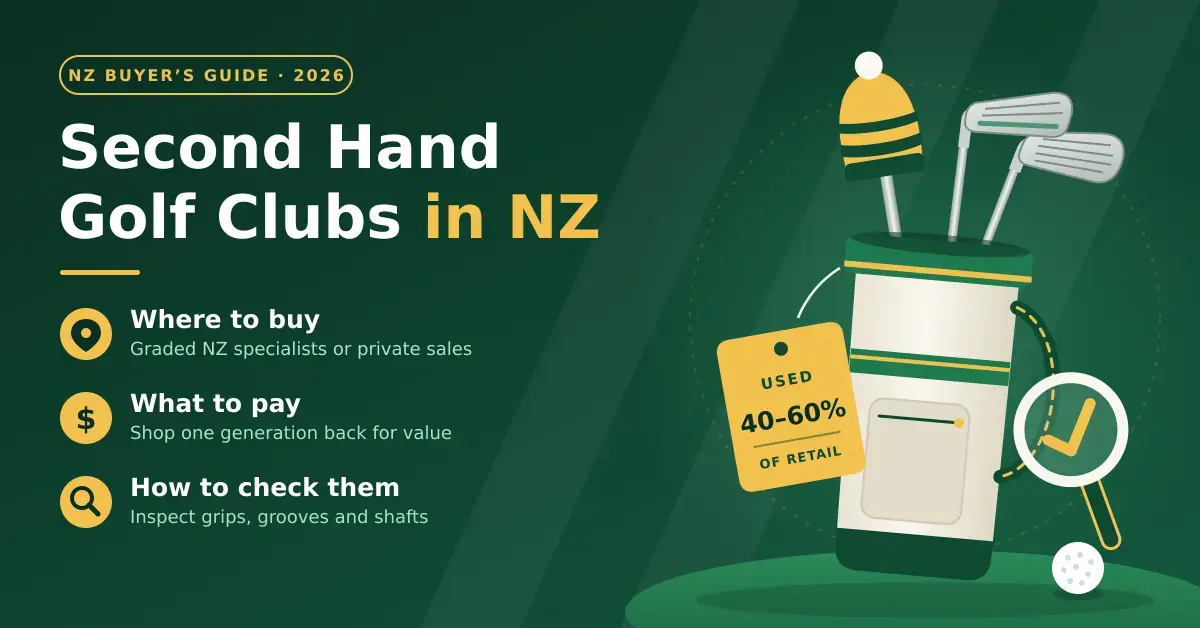
- Typical saving: used clubs run at roughly 40–60% of the original retail price.
- Biggest drop: clubs lose the most value in their first 12–18 months — shop one generation back.
- Where to buy: graded NZ specialists (Recreation Station, Wright Golf, Thrift Golf) or private sales via TradeMe.
- Key protection: the Consumer Guarantees Act covers used clubs bought in trade, but not private sales.
- What wears: grips and the grooves on wedges and short irons — inspect these hardest; titanium heads rarely lose spring.
- First upgrade: a fresh grip ($20–$40) makes most used clubs feel new.
Why buying used golf clubs makes financial sense in New Zealand
The main reason to buy used is simple: the performance gap between a current club and one that is two or three years old is usually small for the average amateur, while the price gap is large. New flagship drivers commonly sell for $900–$1,300 in New Zealand, yet a well-kept model from a couple of seasons earlier often costs around half of that. Manufacturers tend to make incremental changes year to year — small gains in aerodynamics, adjustability or sound — rather than leaps that translate into measurably lower scores for club golfers.
Modern clubs are also built to last. Driver and fairway-wood heads use titanium and carbon composites, putters are milled from stainless steel, and graphite and steel shafts tolerate thousands of impacts. For most club golfers a titanium driver head does not meaningfully lose its spring over normal use. The parts that genuinely wear are the grips and the grooves on wedges and short irons — all of which you can inspect and, in the case of grips, cheaply replace.
How much do used golf clubs depreciate?
Like cars, golf clubs lose the most value in their first 12 to 18 months. A driver can shed a large share of its retail price within a season or two of a new model launching, even in excellent condition. The practical takeaway is to shop one generation back: targeting “previous model” gear lets you buy near-current technology at a steep discount while someone else has absorbed the initial drop in value.
Where to buy second hand golf clubs in NZ
You have two broad options: dedicated used-golf retailers that inspect and grade their stock, or private sales through a marketplace such as TradeMe. Specialist shops cost a little more but take the guesswork out of condition, authenticity and shaft integrity; private sales can be cheaper but put all the checking on you. A good middle path for many buyers is to browse private listings for price context, then buy the actual club from a graded retailer that stands behind it.
New Zealand now has several genuine used-golf specialists. Recreation Station bills itself as the country’s largest used-club selection, hand-inspects every item against a “Recreation Station Certified” condition scale, and runs a trade-in service that returns most quotes within 24 hours. Wright Golf, based in Rolleston near Christchurch, pairs its used range with services such as shaft-length alterations and re-gripping. Thrift Golf also deals in pre-owned gear from the major brands. The table below compares the main places to look.
Retailer Comparison
| Where | Type | Based | Trade-in | Shipping note |
|---|---|---|---|---|
| Recreation Station | Used specialist (est. 2019) | Christchurch | Yes — online quote, often within 24h | Free NZ shipping over $200 |
| Wright Golf | Used specialist + club services | Rolleston, Christchurch | Buys used gear | Nationwide delivery |
| Thrift Golf | Pre-owned retailer | New Zealand | Buys used gear | Free shipping over $250 |
| TradeMe | Private + trade marketplace | New Zealand | N/A (direct sale) | Varies by seller; CGA only if seller is in trade |
Specialist retailers versus private TradeMe sales
Specialist retailers give you three things a private seller usually cannot: a consistent grading system, verification that the club is genuine and the shaft is sound, and a business that is legally accountable for what it sells. Private listings can undercut shop prices, but you carry the risk of counterfeits, hidden cracks near the hosel, or a shaft that has been replaced without disclosure. If you buy privately, insist on clear photos of the sole, face and shaft tip, and ask directly whether the club is original spec.
Your consumer rights when buying used clubs in NZ
The biggest practical advantage of buying from a shop is the Consumer Guarantees Act (CGA). Second-hand goods bought from a seller “in trade” — a business that sells regularly for profit — are covered by the CGA, which requires goods to be of acceptable quality for their age and price and free of undisclosed defects. That means a graded retailer has to make the club right if it turns out to be faulty or misdescribed. You can read the detail on the official Consumer Protection site.
The flip side matters just as much: the CGA does not apply to purchases from private sellers. A one-off TradeMe sale between two individuals carries no CGA guarantee, so “sold as is” really does mean it. This single distinction — in-trade versus private — is the most important thing a New Zealand buyer can understand before parting with money for used gear.
How used-club grading works
Grading is how an online retailer communicates condition to a buyer who can’t hold the club. Most NZ specialists rate gear on a numeric scale, judging the head, shaft and grip, and describe both cosmetic marks and any effect on performance. A 9/10 club has seen very light use with clean faces; a 7/10 will show honest wear such as sole scuffs or “bag chatter” (small dings from clubs knocking together in the bag) that look used but do not change how the ball flies.
| Grade | Condition | What to expect |
|---|---|---|
| Mint (9.5–10/10) | As new | Little or no use; wrapping may be just off |
| Excellent (8.5–9/10) | Very light use | A few minor cosmetic marks; clean faces |
| Very Good (7.5–8/10) | Regular play | Honest signs of use, nothing needing repair |
| Good (6.5–7/10) | Visible wear | Scuffed soles and light face wear; fully functional |
| Bargain (5–6/10) | Well used | Cosmetically rough but structurally sound |
Grading scales differ slightly between retailers, so read each shop’s own definitions rather than assuming a number means the same thing everywhere. Reputable sellers back the grade with high-resolution photos; if the images are vague or missing, treat the stated grade with caution.
What to check before you buy a used club
Inspect the wear items first, because they decide whether a “bargain” is actually a bargain. The grooves on wedges and scoring irons are what generate spin; if the face looks browned and the grooves are shallow or rounded, you will lose short-game control, and that club should be priced accordingly. On woods and the driver, check the crown and sole for cracks rather than mere paint chips, and look closely at the shaft tip near the hosel for hairline splits or heavy rub marks.
Common mistakes first-time buyers make include:
- Paying for cosmetics. Bag chatter and sole scuffs are cosmetic; do not pay a mint-condition price for a club graded lower purely on looks.
- Ignoring grooves on wedges. Worn grooves are the one wear issue that genuinely costs you performance — inspect them hardest.
- Overlooking loft and lie. Irons can be bent out of spec by a previous owner; have a professional check loft and lie if accuracy matters to you.
- Buying the wrong shaft. A current-year head on a flex or weight that doesn’t suit your swing will play worse than a well-matched older club.
- Skipping the grip. A tired grip makes any club feel old — but it is a cheap fix, not a reason to walk away.
How trade-in programmes work
Your current clubs are an asset. Most NZ used-golf specialists run trade-in schemes: you send photos, receive an online valuation (often within a day), and apply that credit toward your next purchase. Recreation Station, for example, says it has paid out hundreds of thousands of dollars to golfers through its programme. Trading in a two-year-old driver toward a one-year-old upgrade lets you refresh your bag for a small net cost and skips the hassle of fielding lowball offers on a marketplace.
To get the best valuation, present clubs clean, keep the grips in reasonable shape, and include the original headcovers and any adjustment tools. Complete sets and clubs with their accessories almost always command a higher trade-in figure than bare heads.
What used golf clubs cost in NZ in 2026
After the post-pandemic surge, used prices in New Zealand have steadied in 2026. The figures below are indicative market ranges rather than fixed prices — condition, model year and brand move them considerably — but they give a realistic sense of what to budget. Across the board, used gear tends to run at roughly 40–60% of the original recommended retail price.These price swings are largely driven by ordinary supply and demand, as each new retail launch pushes more last-season equipment into the used market.
| Category | Typical used price (NZD) | Notes |
|---|---|---|
| Drivers | $300–$650 | Depends heavily on age and condition |
| Iron sets (5–PW) | $500–$1,300 | Premium forged sets sit at the top |
| Hybrids & utility irons | $120–$300 | Often the best value in the used market |
| Wedges | $90–$180 | Check groove wear carefully |
| Putters | $150–$400 | Milled premium models hold value best |
Timing helps. Deals tend to cluster in late autumn (May–June), when players trade in after the summer season, and again in early spring (September), when new retail launches trigger a wave of last-generation trade-ins.
Which clubs are smart to buy used — and which to approach with care
Some clubs are near-ideal used buys, while others need a closer look. Drivers, fairway woods and putters are generally excellent used purchases because their key parts wear slowly and adjustable hosels let you fine-tune loft and lie to your swing. Hybrid golf clubs and utility irons are especially good value, as they often see deeper discounts than high-demand drivers.
Be more careful with wedges and scoring irons, where grooves wear fastest and directly affect spin — our guide to golf wedges covers what loft and bounce to look for. Forged irons made from softer carbon steel show bag chatter more readily, but that is cosmetic; the groove condition is what counts. If you are buying a first set or kitting out a junior, the same value logic applies — see our guide to kids golf clubs in NZ for sizing. For a broader view of the local market, including new as well as used options, our overview of golf clubs for sale in NZ is a useful companion.
Caring for second-hand clubs in NZ’s climate
A little maintenance protects your investment, and it matters more here than in drier climates. Auckland’s humidity and coastal salt air are hard on equipment, so dry clubs after a wet or seaside round and store them out of a hot car boot. The first upgrade on most used clubs is the grip: a fresh grip for around $20–$40 instantly makes an older club feel new and lets you hold the club with lighter, more consistent pressure — our guide to golf grips and re-gripping explains the options.
Beyond grips, clean the grooves after each round, keep headcovers on your woods to prevent further bag chatter, and have the loft and lie of used irons checked if your strike feels inconsistent. For more on matching gear to local course and weather conditions, see our guide to choosing equipment for New Zealand conditions, and if you specifically want an Auckland-focused walkthrough of buying, grading and maintaining used gear, read our guide to pre-owned golf clubs in Auckland.
Sources
- Recreation Station — NZ used-golf specialists (grading, trade-in, shipping)
- Wright Golf — used clubs and club services (Rolleston, Christchurch)
- Thrift Golf — pre-owned golf equipment, New Zealand
- Consumer Protection (NZ Government) — Consumer Guarantees Act
- Consumer NZ — Consumer Guarantees Act and second-hand goods
- TradeMe — New Zealand online marketplace
Frequently Asked Questions (FAQ)
Is it safe to buy second-hand golf clubs online in NZ?
Yes, provided you buy from an established in-trade specialist such as Recreation Station, Wright Golf or Thrift Golf. These retailers grade and inspect their stock, verify authenticity, and are covered by the Consumer Guarantees Act, which does not apply to private sales.
How much can I save buying used instead of new?
Used clubs typically cost around 40–60% of the original retail price. A club that is one or two years old usually delivers performance very close to the current model for roughly half the price.
What should I check before buying a used wedge or iron?
Check the grooves first. If the face looks browned or the grooves are shallow and rounded, the club will not generate the spin needed for short-game control. On irons, also confirm the loft and lie have not been bent out of spec by a previous owner.
Do used golf clubs come with a warranty in NZ?
They usually do not carry the full manufacturer’s warranty, but clubs bought from a business in trade are protected by the Consumer Guarantees Act, and many NZ specialists add their own short satisfaction guarantee. Private-sale clubs come with no such protection.
Can I trade in my old clubs toward used ones?
Yes. Most NZ used-golf specialists run trade-in programmes where you submit photos, receive an online valuation (often within 24 hours) and apply the credit to another purchase. Clean clubs with their original headcovers and tools attract the best offers.