The best golf driver is the one that matches your swing, not the one at the top of an overseas ranking. A driver that a low-handicap tour player loves can be the hardest club in the bag for a weekend golfer, because the two swings produce very different clubhead speed, launch and spin. This guide explains the handful of things that actually decide whether a driver suits you — loft, forgiveness, adjustability and shaft fit — and frames what that means for buyers here in New Zealand, including price bands in NZD and where to get fitted.
It is written for golfers choosing a new or replacement driver: beginners buying their first “big stick”, improving club players chasing more fairways, and anyone weighing a brand-new model against last season’s or a used one. Prices and model details change often, so treat every figure here as a starting point to confirm against the retailer’s own website.
Key Points
- Fit beats brand. Modern drivers are all close on raw speed; the best one for you is decided by loft, forgiveness and shaft fit, ideally on a launch monitor.
- Loft: most golfers are easier served by 10.5° (or more) than 9.5°; higher loft launches the ball higher and suits slower swings.
- Forgiveness: a high-MOI “max” head (near the 460cc size and 5,900 g·cm² MOI limits) loses less on off-centre hits — the trait that helps most players.
- Adjustability: hosels change loft by about ±1.5° and movable weights bias the ball toward a draw or fade.
- Price in NZ: a new current-season driver is typically a four-figure purchase (e.g. the PING G440 Max recently on sale at NZ$944 from NZ$1,049 at Golf HQ NZ); last season’s or pre-owned drivers often cost far less for near-identical performance.
- Confirm before buying: prices, models and stock change constantly — check the retailer’s own site and get fitted.
What makes a driver “the best” for you?
There is no single best driver, and that is the honest answer to the most common question golfers ask. Modern drivers from the major brands all sit close to the same legal limits on ball speed, so the real differences are in how consistent they are across the face and how well a given model’s loft, weighting and shaft match your swing. Club fitters describe the current market as a range of specialised heads — one tuned for maximum forgiveness, one for low spin, one to fight a slice — sitting alongside each brand’s core model, rather than one club that wins for everyone.
That is why “best” on this site is framed by measurable traits and who a club suits, not by marketing. For most recreational players in New Zealand, the driver that produces the straightest, most repeatable tee shot — even on strikes off the centre of the face — will lower scores more than the one that is longest on a perfect hit.
How much do golf drivers cost in New Zealand?
New current-model drivers from the major brands are not cheap in New Zealand. As a concrete reference point, Golf HQ NZ recently listed the PING G440 Max on sale at NZ$944 from a regular price of NZ$1,049. Flagship and tour-spec models from the other brands sit in broadly the same territory, so a current-season driver is typically a four-figure purchase, with premium builds pushing higher. Because sale prices and new releases move these figures constantly, confirm the current price on the retailer’s own website before you buy.
You do not have to spend that much. The main price routes are:
- Current flagship (new): a four-figure price for the newest technology and full fitting options.
- Last season’s model (new, discounted): noticeably cheaper once the next release lands, with performance usually very close.
- Pre-owned / ex-demo: the lowest-cost route for a head that is only a year or two old, if you check it carefully.
- Value and slower-swing lines (e.g. XXIO): priced across a wide range; some lightweight models sit at a premium despite being aimed at gentler swings.
If budget is the main constraint, a lightly used driver or a discounted prior-year model is usually better value than a cheap, generic new club. Our guide to golf clubs for sale in NZ covers where to look, and the section on buying used below explains what to check.
Driver loft: is 9.5 or 10.5 degrees right for you?
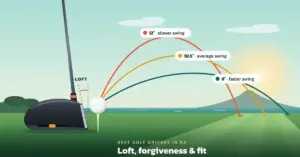
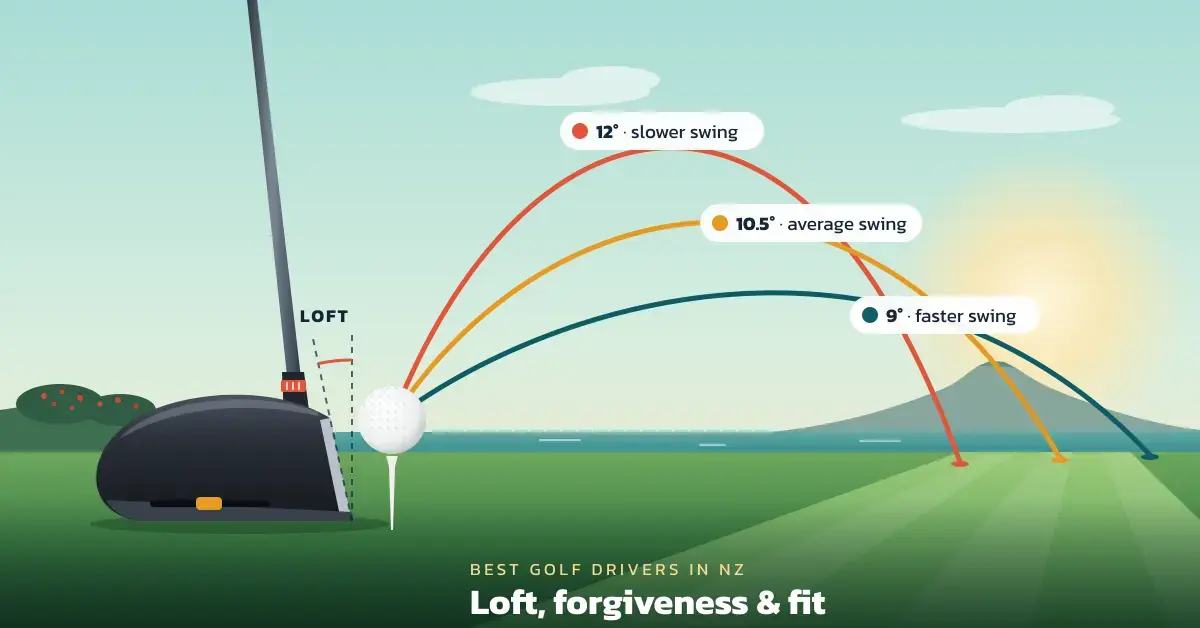
Loft is the angle of the clubface, and for most golfers a 10.5-degree driver is easier to hit than a 9.5-degree one. Loft controls how high the ball launches and how much backspin it carries. More loft helps the ball get airborne and stay there, which is why it generally suits slower swings, beginners and anyone who hits the ball too low.
- 10.5 degrees (or more): the safer default for most recreational and higher-handicap players. It adds launch and carry, and many such drivers are offered up to 12 degrees for very gentle swings.
- 9.5 degrees (or less): suits faster, more consistent swings. A low-lofted driver spins less, but a slower swing can leave the ball launching too low and losing carry.
The catch is that launch depends on more than loft alone — your attack angle (whether the clubhead is moving up or down at impact) and ball speed matter just as much. Hitting up on the ball lets you play less loft and still launch it high. Because of this, the loft number on the sole is only a starting point: a launch monitor, which measures your actual launch angle and spin, is the reliable way to settle 9.5 versus 10.5. Most adjustable drivers also let you fine-tune loft by around a degree either way, so you are rarely locked in.
Forgiveness explained: MOI, head size and off-centre hits
Forgiveness is how little distance and accuracy you lose when you miss the centre of the face, and it is the single most useful trait for the average golfer. The engineering term behind it is MOI, or moment of inertia — a measure of how much the clubhead resists twisting when the ball strikes off-centre. A higher-MOI head twists less on a heel or toe strike, so the ball holds its line better and keeps more of its speed.
Two design factors drive forgiveness:
- Head size: under the Rules of Golf a driver head may be up to 460 cubic centimetres (cc), plus a small tolerance of about 10cc. Almost every modern driver is built right at this 460cc maximum because a bigger head allows a larger sweet spot and higher MOI.
- Weight placement: designers save weight with lightweight carbon crowns and push it low and to the back of the head. That lowers the centre of gravity and raises MOI, which lifts launch and stability at the same time.
The rules also cap MOI at 5,900 g·cm² (with a 100 g·cm² tolerance), and the most forgiving “max” models are built close to that ceiling. In practical terms, if you miss the centre of the face regularly — which describes most golfers — a high-MOI “max” driver will keep more tee shots in play than a smaller, lower-spinning tour head. If a persistent curve rather than off-centre contact is your problem, see our advice on how to fix a slice in golf, because no driver can fully cure a swing fault.
Adjustability: hosels and movable weights
Most current drivers let you change their behaviour without buying a new club, which makes a single head suit a wider range of swings. There are two common adjustable features:
- Adjustable hosel: a sleeve where the shaft meets the head, turned with a supplied wrench, that changes loft (commonly by about ±1.5 degrees) and can make the face sit more open or closed. The PING G440 Max, for instance, uses an eight-position hosel offering roughly ±1.5 degrees of loft and up to three degrees of lie adjustment.
- Movable weight: a weight on the sole or at the back of the head that can be set toward the heel, toe or centre. Moving it toward the heel encourages a draw (a shot that curves right-to-left for a right-hander); toward the toe encourages a fade. The G440 Max, as an example, uses a 29-gram back weight with draw, neutral and fade settings.
Adjustability is genuinely useful for players still developing a consistent swing, because it lets a fitter dial in launch and shot shape, and lets you re-tune as your swing changes. It is not magic, though — a draw-bias setting nudges the ball, it does not rebuild your technique. Brands keep refining these systems; recent examples include finer hosel adjustment such as Cobra’s FutureFit, aimed at smaller, more precise changes.
Shaft flex and weight: matching the engine of the club
The shaft is where many drivers are mismatched to their owner, and it matters as much as the head. Two properties count: flex (how much the shaft bends) and weight.
Flex should match your clubhead speed. A shaft that is too stiff for your swing can rob you of launch and feel; one that is too soft for a powerful swing can send shots left and spin too much. The common flex ratings, from softest to stiffest, are Ladies (L), Senior/Amateur (A), Regular (R), Stiff (S) and Extra Stiff (X). Softer, lighter shafts help slower swings launch the ball more easily; stiffer shafts suit faster, well-timed swings.
Weight is measured in grams. As a rough guide from Golf Warehouse NZ: shafts under 50g are ideal for slower swing speeds, 50–60g suits most players who hit it a bit harder but keep a smooth rhythm, and 60g and above suits those with fast, powerful swings while maintaining a steady tempo. Lighter shafts tend to launch higher and add distance, while heavier shafts help with control. Because the heads are already near the legal speed limit, fitters increasingly say the shaft and the fit are where most golfers find their gains.
Driver model families available in New Zealand
The major brands refresh their driver lines roughly once a year, usually with several versions of each family aimed at different players: a forgiving “Max” head, a lower-spin tour head, and often a draw-biased anti-slice head. The table below compares the main families NZ retailers stock and who each one tends to suit. It is a map of the market, not a ranking — the right pick still depends on a fitting. We have left prices out of the table because they change constantly with sales and new releases — check the current price on NZ retailers’ own sites before you buy.
Driver Families Compared
| Brand / family | Typical versions | Best suited to | Standout trait |
|---|---|---|---|
| PING G440 | Max, LST, SFT, K | Forgiveness-seekers to faster swings (LST) | High stability; adjustable hosel and back weight |
| TaylorMade Qi4D | Qi4D, Qi4D LS | Wide range of players; LS for low spin | Consistent ball speed across the face |
| Callaway Quantum | Core, Max, Triple Diamond | All levels; Max for forgiveness | Multi-material face and body |
| Titleist GT / GTS | GT2, GT3, GT4 (GTS successor) | Better ball-strikers wanting balance | Blend of speed, forgiveness and adjustability |
| Cobra DS-Adapt / OPTM | Core, Max, LS | Players who want fine adjustability | FutureFit finer hosel adjustment |
| XXIO | Standard and lightweight lines | Slower swings and seniors | Very light build for easy launch (non-adjustable) |
A few patterns are worth knowing. Within most families, a “Max” or “K” model is the most forgiving and the safest choice for mid-to-high handicappers, an “LS”/”LST” or “Triple Diamond” model is lower-spinning and aimed at faster swings, and an “SFT”/draw model is built to fight a slice. If you find a full-size driver too hard to launch or keep straight, a lofted hybrid golf club or a fairway wood off the tee can be a more reliable option while you build confidence.
Where to try and get fitted in Auckland
Getting fitted is the step that turns a good driver into the right driver, and in New Zealand it is widely available and often free with a purchase. A fitting puts you on a launch monitor so a fitter can see your real clubhead speed, launch angle, spin and strike pattern, then match the head, loft and shaft to them. Several Auckland retailers offer complimentary driver fittings and let you bring your current club along to compare.
- Book a fitting rather than guessing. A short session can reveal that you need more loft, a lighter shaft, or a draw setting you would never have chosen from the spec sheet.
- Test on a monitor or range. You can hit shots on a simulator or practice bay before committing — for example, Toptracer-equipped ranges such as the Ellerslie driving range let you see carry and dispersion, and dedicated fitting studios like custom fitting at Golf Warehouse Ellerslie measure full launch data.
- Bring the ball you play. Launch and spin change with the golf ball, so test with the ball you actually use on the course.
Remember that a new driver still only replaces one slot in the bag — you are allowed a maximum of 14 clubs, as explained in our guide to how many clubs you can carry in your golf bag, so choosing the driver that best complements the rest of your set matters.
Should you buy used or last season’s driver?
A pre-owned or prior-year driver is often the smartest-value choice, because driver technology moves in small annual steps rather than leaps. A head that is one or two seasons old usually performs within a few metres of the latest release for a fraction of the price. The trade-off is that you give up the newest fitting options and may inherit someone else’s wear.
If you go used, check the following before you pay:
- Face and crown: look for deep scratches, dents or cracks, especially a hairline crack near the face — a cracked face is a reject, not a bargain.
- Hosel and shaft: make sure the adjustable sleeve turns and locks, and that the shaft is the correct flex for you and has no rattles.
- Completeness: confirm it includes the adjustment wrench and a headcover; every new driver ships with a headcover, and a missing one is a small red flag on a used club.
- Authenticity and returns: buy from a reputable retailer or platform with a return path rather than an unverified private seller.
Our guide to buying second hand golf clubs in NZ goes deeper on grading, pricing and where to shop safely. Under New Zealand’s Consumer Guarantees Act, clubs bought from a business in trade must still be of acceptable quality, which is one reason a trusted retailer beats an unknown private sale for peace of mind.
Common mistakes when buying a driver
Most driver regrets come from a short list of avoidable errors, and knowing them saves money and strokes.
- Playing too little loft. Copying a tour pro’s 9-degree setting is the classic mistake; most amateurs launch the ball too low and would carry it farther with more loft.
- Buying on brand or looks alone. The head that suits your swing may not be the one you had in mind — let launch data, not the paint job, decide.
- Ignoring the shaft. A flagship head on the wrong shaft is a mismatch; the wrong flex or weight undoes the head’s benefits.
- Chasing distance over dispersion. A few extra metres on a pure strike mean little if the misses sail out of bounds; forgiveness wins for most players.
- Skipping the fitting. Guessing specs off a website, when a free fitting is available, is the easiest mistake to avoid.
- Overlooking left-handed availability. Left-handed golfers have fewer models in stock in NZ; check availability early rather than assuming every head comes in a left-hand version.
Sources
- Golf Warehouse NZ — How to choose a new driver
- Golf HQ NZ — PING G440 Max driver (specs and NZ price)
- Golf360 NZ — Best golf drivers in 2026
- GolfWorks — How moment of inertia (MOI) affects driver playability
- Haggin Oaks — What does a 460cc driver mean in golf?
- Plugged In Golf — The biggest trends in 2026 drivers
- Consumer Protection NZ — Consumer Guarantees Act
Frequently Asked Questions
What is the best driver right now?
There is no single best driver for every golfer. The major 2026 families — such as the PING G440, TaylorMade Qi4D, Callaway Quantum, Titleist GT and Cobra lines — are all excellent, and which one is best for you depends on your swing speed, your typical miss and the shaft that fits you. The most reliable way to find “your” best driver is a launch-monitor fitting, not a ranking.
Is a 9.5 or 10.5 degree driver easier to hit?
A 10.5-degree driver is easier to hit for most golfers. The extra loft helps the ball launch higher and carry farther, which suits slower and less consistent swings. A 9.5-degree driver spins less and suits faster, well-struck swings. If you are unsure, start at 10.5 degrees or get fitted, and note that most adjustable drivers let you fine-tune loft by about a degree either way.
How much should I spend on a driver in NZ?
A current-season driver from a major brand is generally a four-figure purchase new in New Zealand — for example, Golf HQ NZ recently listed the PING G440 Max on sale at NZ$944 from a regular NZ$1,049. You can spend considerably less on last season’s model or a quality pre-owned head, usually with only a small performance difference. Spend according to how often you play; a careful used buy is strong value for most club golfers.
Are left-handed drivers available in New Zealand?
Yes, but the choice is narrower. Most major brands make left-handed versions of their main driver families, yet NZ retailers stock fewer left-handed heads and shaft options than right-handed ones. If you play left-handed, check stock and fitting availability early, and be prepared to order a specific loft or shaft rather than buy off the shelf.
Do I really need a fitting, or can I buy off the shelf?
You can buy off the shelf, but a fitting usually gets you a better result for little or no cost. A fitter uses a launch monitor to match loft, head and shaft to your actual swing, which often changes which model you would have picked. Many NZ stores offer free driver fittings, so it is worth booking one before you commit.
Will a new driver fix my slice?
A new driver can reduce a slice but will not cure it. Draw-biased heads and heel weight settings help by nudging the ball away from the curve, and a correctly fitted shaft can help too. The lasting fix is in the swing path and face angle at impact, so pair the right driver with practice or a lesson rather than expecting the club to do all the work.