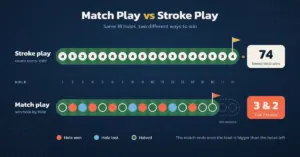
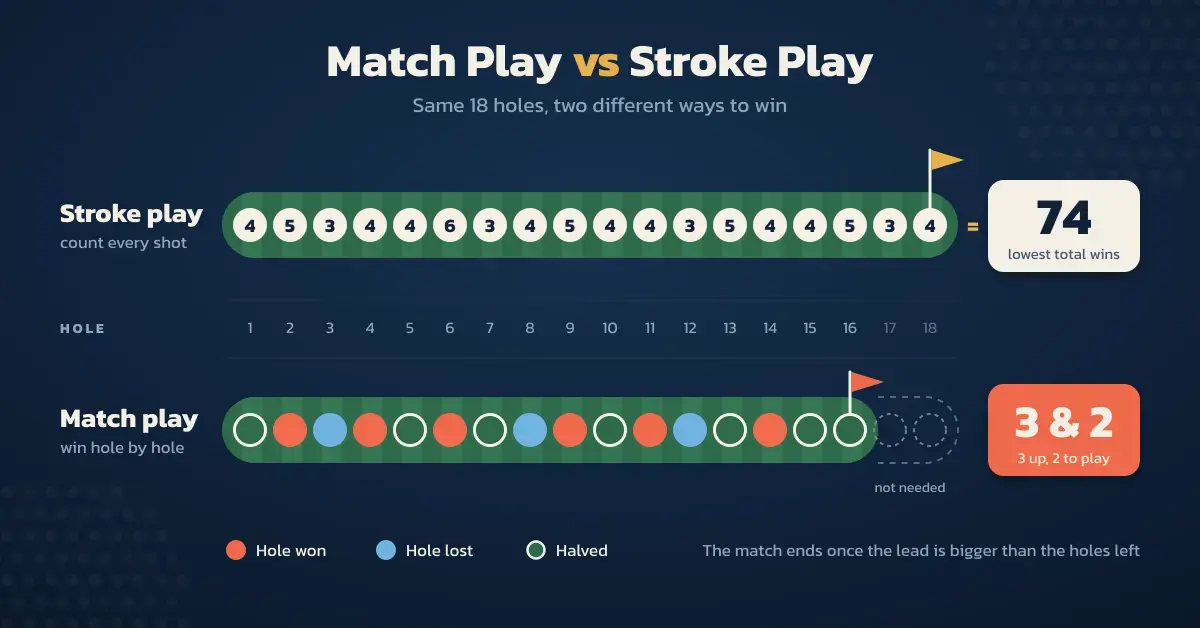
The core difference is simple: in stroke play you count every shot over the whole round and the lowest total wins, while in match play you play hole by hole against one opponent and the winner is whoever is ahead by more holes than are left to play. Everything else – how penalties work, whether you can concede a putt, how you should think your way around the course, and how handicaps are applied – follows from that one distinction.
Key Points
- Stroke play: count every shot over 18 holes; lowest total wins; you must hole out on every hole.
- Match play: win, lose or halve each hole; the player ahead by more holes than remain wins the match, often before the 18th.
- Penalties: two penalty strokes in stroke play versus loss of hole in match play (Rule 1.3c).
- Concessions: only in match play – you can give an opponent a putt, a hole or the match, and it is final.
- Handicaps (WHS, recommended): 100% of the difference in singles match play; 95% of Course Handicap in individual stroke play.
- Where you see them: stroke play for the NZ Open and the majors; match play for the Ryder Cup and the NZ Amateur knockout.
What is stroke play?
Stroke play is the format where your score for the round is the total number of strokes you take, including any penalty strokes, added across all 18 holes. The player (or team) with the lowest total wins. You are effectively competing against the entire field at once, not against one person, so a single disastrous hole still counts in full and can sink an otherwise good round.
Because every shot matters, stroke play has two non-negotiable habits. First, you must hole out on every hole – there is no picking up your ball or being given a short putt. If you fail to hole out and do not correct the mistake before making a stroke to begin the next hole, you are disqualified from the competition (Rule 3.3c). The main exception is stableford, a form of stroke play scored on points, where an unplayable hole simply scores zero points and you may pick up. Second, your scorecard has to be accurate: in a formal competition you keep a marker’s card, check it, and sign it. Returning a score lower than you actually took means disqualification, and returning one higher means the higher score stands.
Stroke play is the format behind almost all professional tournaments, including every men’s major and the NZ Open, and it is what most club medal and stableford days use. If you want the full vocabulary of how individual-hole scores are named – from a par to a bogey or a birdie – those terms apply in both formats, but they decide your total only in stroke play.
What is match play?
Match play is a head-to-head format in which each hole is its own small contest. Whoever takes fewer strokes on a hole wins that hole; if you tie, the hole is “halved”. You are not adding up a total for the round – you are counting holes won and lost. The match is over the moment one player is ahead by more holes than there are left to play, which means a match can finish well before the 18th green.
This changes the feel of the game completely. A quadruple bogey is no worse than a single bogey if your opponent also fails to make par – you simply lose that one hole and start level again on the next tee. There is no cumulative scorecard to sign for the round’s total; you just agree the result of each hole as you go and confirm the final margin at the end.
Match play is the format used in team events such as the Ryder Cup, the Presidents Cup and the Solheim Cup, and in most club knockout competitions and interclub pennants. New Zealand’s national amateur title is decided this way too: the New Zealand Amateur Championship runs 36 holes of stroke play as qualifying, then sends the leading players into a knockout match-play bracket to find the champion.
Match Play vs Stroke Play Compared
| Feature | Match play | Stroke play |
|---|---|---|
| Who you play | One opponent (or pair), head to head | The whole field at once |
| How you win | Ahead by more holes than remain | Lowest total strokes |
| Unit of scoring | Holes won, lost or halved | Total strokes for the round |
| Must you hole out? | No – putts can be conceded | Yes, every hole |
| General penalty | Loss of the hole | Two strokes |
| When it ends | Can finish before the 18th (e.g. 3&2) | After all 18 holes |
| Best strategy | Reactive, can be aggressive | Conservative, avoid big numbers |
| WHS allowance (singles) | 100% of handicap difference | 95% of Course Handicap |
| Typical use | Ryder Cup, NZ Amateur knockout, club matchplay | NZ Open, majors, club medal days |
How is scoring different between the two formats?
Scoring is where the two formats look most different, because match play has its own running vocabulary that stroke play does not use.
How do you read a match play score?
In match play the score is always stated from the leader’s point of view and in terms of holes, not strokes:
- All square (AS): the match is level – neither player is ahead.
- 1 up, 2 up, 3 up: how many holes the leader is ahead by at that moment.
- Dormie: the leader is ahead by exactly the number of holes remaining (for example, 3 up with 3 to play). The leader cannot now lose, but the trailing player can still force a tie by winning every remaining hole.
- A final score like 3&2: the winner was 3 holes up with 2 holes left to play, so the match ended on the 16th green because the result could no longer change. The first number is the lead; the second is the holes that were left.
- 1 up or 2 up: a match that goes the full distance and is won on the 18th by one or two holes.
If the match is level after 18 holes it is halved (tied). In knockout competitions a tie is usually broken by playing extra “sudden-death” holes until someone wins a hole.
How do you read a stroke play score?
Stroke play scoring is just arithmetic. You record the strokes taken on each hole, add penalty strokes, and total them for the round. Scores are often shown relative to par – “level par”, “+4”, “-2” – but the number that decides the competition is the raw total. In a net competition your handicap is then subtracted from that gross total to give your net score.
How do penalties differ?
The penalty systems are built around each format’s scoring, so the same mistake is punished in two very different ways. This is one of the biggest practical differences on the course.
- Stroke play: the general penalty is two strokes added to your score for the hole. Smaller breaches carry one stroke, and serious or uncorrected errors can mean disqualification.
- Match play: the general penalty is loss of the hole. Rather than adding strokes, a breach simply hands that hole to your opponent.
Under the Rules of Golf, administered by The R&A and the USGA, the “general penalty” is defined as loss of hole in match play or two penalty strokes in stroke play (Rule 1.3c). There are smaller procedural differences too. Only in stroke play may you complete a hole with a second ball when you are genuinely uncertain of the right procedure; that second ball is not a provisional ball, and match play has no equivalent (Rule 20.1c). In the same spirit, “ready golf” – playing when you are ready rather than strictly in turn – is a stroke-play convention (Rule 6.4b), while in match play the order of play matters: if you play out of turn, your opponent may cancel the stroke and make you replay it (Rule 6.4a).
What are concessions, and why do they only exist in match play?
A concession is when you give your opponent something without them having to play it out, and it is unique to match play. You can concede:
- A stroke – most often a short putt, so your opponent picks up and is counted as holed.
- A hole – you give up a hole you are unlikely to win.
- The entire match – usually done when a result is beyond doubt.
A concession is final once made: it cannot be declined or withdrawn. This is why, in match play, you often see players tap the ground near an opponent’s ball to signal “that’s good” on a short putt. In stroke play there is no such thing – every putt must be holed, because every stroke counts towards the field.
How does strategy change between match play and stroke play?
Stroke play rewards caution. Because one blow-up hole can ruin an entire round and you are measured against a whole field, the smart approach is to minimise big numbers: aim for the fat of the green, take the safe side of a hazard, and accept a bogey rather than risk a double or worse. Consistency beats heroics.
Match play rewards reactive, sometimes aggressive, play. Since the worst that can happen on any hole is losing that one hole, the risk-and-reward maths changes. You can take on a tucked pin or try to drive a short par 4, and if it goes wrong you have lost only a single hole. You also play the opponent as much as the course: if they are in trouble, you play safe to win the hole; if they have hit it close, you may need to attack. Reading whether you are ahead, level or behind – and how many holes remain – should shape every decision.
How are handicaps applied in each format?
Handicaps let players of different standards compete fairly, but the two formats apply them differently, and the percentages catch a lot of people out. New Zealand uses the World Handicap System (WHS), and the recommended handicap allowances are set out in Appendix C of the Rules of Handicapping. If you are still getting to grips with the number itself, our explainer on NZ golf handicaps covers how a Course Handicap is worked out.
Singles match play
In individual match play the recommended allowance is 100% of the difference between the two players’ Course Handicaps. The lower-handicapped player plays off scratch for the match and gives the higher-handicapped player the full difference in strokes, applied on the hardest-rated holes according to the stroke index on the card.
Individual stroke play
In individual stroke play the recommended allowance is 95% of your Course Handicap. Appendix C sets this figure for medium-sized fields of roughly 30 to 100 players, where a 95% allowance is designed to give all players a similar chance of finishing in the top 10% when they play well.
Four-ball and other formats
Team formats use their own figures – for example, four-ball match play is commonly played off 90% of each player’s Course Handicap, and four-ball stroke play off 85%. Allowances are recommendations that a club’s committee can adjust, so always confirm the exact figure with the competition organiser or your club before you start.
Where will you see each format?
- Stroke play: virtually all professional tour events and majors, the NZ Open, and most club medal, stableford and championship-qualifying rounds.
- Match play: the Ryder Cup, Presidents Cup and Solheim Cup; the knockout stages of the New Zealand Amateur; club matchplay championships, interclub and pennants; and most casual games between two players or two pairs.
The formats also combine. Many amateur championships, including the NZ Amateur, start with stroke-play qualifying to seed a field and then switch to match play for the knockout. Team events like the Ryder Cup sit entirely in match play but mix formats within it – foursomes (alternate shot) and four-ball (better ball) – before finishing with singles.
Whatever the format, the equipment rules are the same – for instance, the 14-club limit applies in both, with the penalty expressed as strokes in stroke play and holes in match play.
Sources
- The R&A – Rule 3: The Competition (match play and stroke play)
- The R&A – Rule 1.3c: Levels of Penalties (the general penalty)
- The R&A – Rule 20.1c: Playing two balls in stroke play
- The R&A – Rule 6.4: Order of play and ‘ready golf’
- The R&A – Rules of Handicapping, Appendix C: Handicap Allowances
- Wikipedia – Match play (all square, dormie and winning margins)
- amateurgolf.com – New Zealand Amateur Championship overview
Frequently Asked Questions
Which format is better for beginners?
Match play is usually friendlier for newer golfers. Because each hole stands alone, a blow-up hole is quickly forgotten and you can still enjoy a close contest, and in a casual match a generous opponent can concede short putts to keep things moving. Stroke play, where every shot counts and you must hole out, can feel punishing until your scoring is more consistent.
What does 3&2 mean in match play?
The winner was three holes up with only two to play, so the match ended early on the 16th green – the first number is the winning margin, the second the holes that were left.
What are the different types of match play?
The main variations are singles (one player against another), foursomes or alternate shot (two players sharing one ball), and four-ball or better ball (two pairs, each player using their own ball and the better score of the pair counting). Each can be played with or without handicaps, and team events like the Ryder Cup use several of these within one competition.
Why do most professional tournaments use stroke play?
Stroke play ranks an entire field on one objective figure – total strokes – and rewards consistency across 72 holes, which suits large professional fields, prize-money ladders and televised leaderboards far better than a series of one-on-one matches would.
Is stableford match play or stroke play?
Stableford is a form of stroke play, not match play. Instead of counting total strokes you earn points against a target on each hole (for example, two points for a par), and because a bad hole just scores zero you are allowed to pick up rather than hole out.