
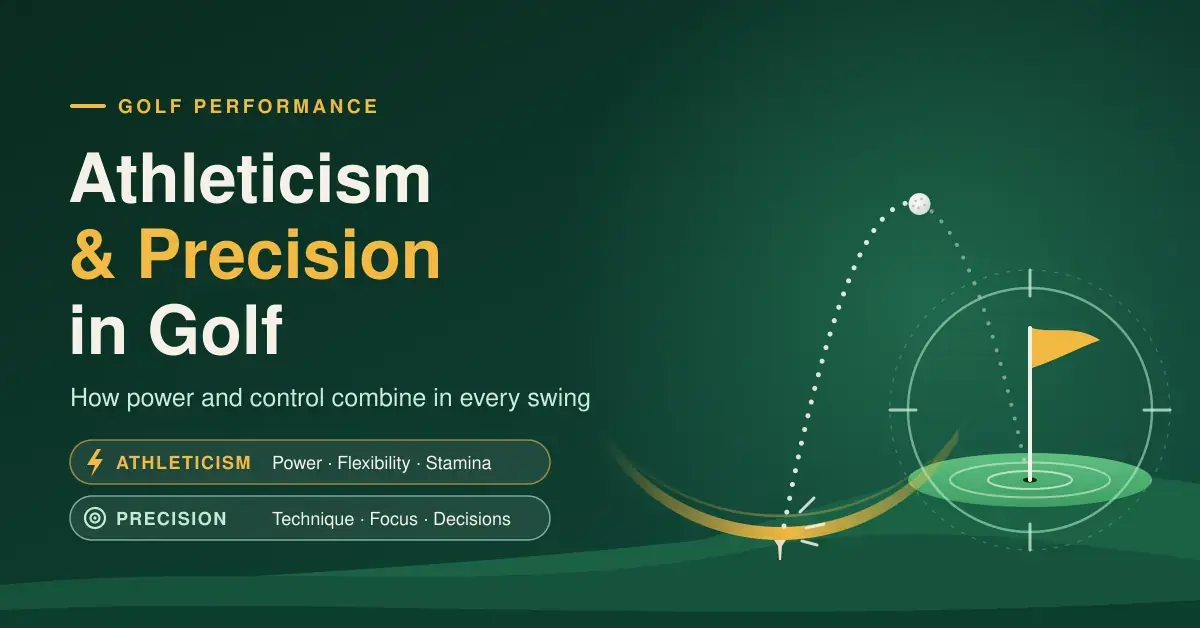
Golf combines two demands that look like opposites: the athleticism to move a clubhead at high speed, and the precision to send a ball exactly where you intend. Because the game is slow-paced and has no physical contact, people often ask whether it is really a sport at all. The honest answer is that golf asks for a different kind of athleticism from a rugby player’s, paired with a level of fine motor control and decision-making that few sports match. This guide explains what each side actually involves, how the two combine in a single swing, and the training that develops both — with the numbers that research has attached to each claim.
Key Points
- Golf is a sport that fuses athleticism (power, flexibility, stamina) with precision (technique, focus, decisions).
- Strength adds distance: resistance training lifts clubhead speed ~1.6–4.1% and carry ~4.8–5.2% in reviews.
- Flexibility feeds the X-factor — shoulder-hip separation that stores power and protects the back.
- Walking 18 holes covers ~6–8 km and 10,000–15,000 steps, burning ~1,400–1,800 calories if you carry.
- Precision wins scores: fundamentals, a pre-shot routine, positive imagery and course management.
- Train both: golf-specific strength, mobility, mental skills and deliberate, game-like practice.
Is golf really a sport?
Yes — golf meets the standard definition of a sport: a physical activity, governed by rules, in which players compete. What confuses the question is that golf hides its physical demands. A round is low-intensity but long: walking 18 holes covers roughly 6–8 km and 10,000–15,000 steps, and a player who walks and carries their own bag burns in the region of 1,400–1,800 calories. The swing itself is an explosive, whole-body movement repeated dozens of times. So golf is not about sustained exertion like running — it is about producing short bursts of power with extreme accuracy, again and again, while staying mentally composed. That combination is what the rest of this article unpacks.
Athleticism in golf: the physical demands
Athleticism in golf means the strength, flexibility and stamina that let you swing fast, swing freely and keep swinging well late in a round. It is golf-specific rather than general fitness — a golfer trains to rotate powerfully and repeatably, not to bench a heavy weight or run a fast 10 km.
Strength and power for clubhead speed
Strength and power drive clubhead speed, and clubhead speed drives distance. The evidence here is unusually clear: a systematic review of resistance-training studies found that strength programmes produced increases in clubhead speed of roughly 1.6–4.1% and carry-distance gains of about 4.8–5.2%. The largest effects came from programmes that combined general resistance work with golf-specific, high-velocity movements over about eight weeks. Grip strength and lower-body power also correlate with swing speed, which is why gym work for golf leans on rotational and explosive exercises rather than slow, heavy lifting alone.
Flexibility, mobility and the X-factor
Flexibility lets you make a bigger, safer turn — and a bigger turn stores more power. The key mechanism has a name: the X-factor, the separation between the rotation of the shoulders and the hips at the top of the backswing. More recent work points to the “X-factor stretch” — the moment the hips start turning toward the target while the shoulders are still turning away — as correlating even more strongly with clubhead speed. Skilled golfers tend to be more flexible than less-skilled ones, which helps them create that separation. Good hip and thoracic (upper-back) mobility also protects the lower back, the most common site of golf injury.
Endurance and stamina over a full round
Golf rewards stamina even though it is not aerobically intense. A four-hour round, often over hilly ground, asks you to repeat a precise athletic movement when your legs and concentration are tired — the quality of your 70th shot matters as much as your first. Maintaining focus and physical stamina from the first tee to the final putt calls for the same blend of athleticism and precision that endurance athletes rely on, scaled to golf’s stop-start rhythm. Walking rather than riding a cart, and basic cardiovascular fitness, both help a score hold up over the back nine.
Precision in golf: the accuracy side
Precision is golf’s signature demand: the ball does not move until you hit it, so every error is yours. Precision covers the mechanics that make contact repeatable, the mental routine that holds under pressure, and the course-management decisions that keep you out of trouble.
Technique and fundamentals
Accurate ball-striking is built on sound fundamentals — grip, stance, posture and swing path. These unglamorous basics set the clubface angle and the point of contact, which together decide direction and curve. A player who grooves the fundamentals can repeat the same strike under pressure; one who relies on timing and compensations tends to lose accuracy exactly when a round gets tense. This is why coaching and structured practice at a driving range start with positions, not power.
Mental focus and visualisation
Golf is as much a mental game as a physical one, and the mental side is measurable. Studies on golf putting show that imagery and visualisation affect results: facilitative, positive imagery improves putting outcomes, while negative outcome imagery measurably harms both confidence and performance. Elite players use a consistent pre-shot routine, pictured target lines and positive self-talk to keep attention on the shot in front of them rather than the last mistake or the scorecard. Precision on the greens, in particular, is where composure pays off — our guide to reading greens and putting covers the mechanics behind that.
Shot selection and course management
Precision extends beyond the swing to the decisions around it. Choosing the right club, aiming at the fat side of the green, laying up short of a hazard and playing to your own strengths can lower scores without changing your swing at all. Good course management means reading distance, wind and lie, then picking the shot with the best balance of reward and risk — often the conservative one. Knowing the layout of the course you are playing is part of that planning.
How athleticism and precision work together
Elite golf is not athleticism OR precision — it is the two fused in the same motion. Raw power with no control sprays the ball; perfect mechanics with no speed leaves distance on the table. The following three links show where the two meet.
Kinematic sequencing: the swing chain
Kinematic sequencing is the order in which the body unwinds — hips, then torso, then arms, then club — so that energy transfers up the chain and peaks at impact. Athleticism supplies the strength and flexibility to generate that energy; precision is the timing that releases it in the right order. When the sequence is correct, a golfer gets maximum clubhead speed and a square face at the same time. When it is off, the player either loses speed or has to make last-moment compensations that cost accuracy.
Conditioning that protects focus
Physical conditioning supports the mental game late in a round. Fatigue degrades concentration and fine motor control, so a fitter golfer holds their routine and decision-making together over four-plus hours better than an unfit one. In this sense, strength and stamina are not just about longer drives — they buy you clearer thinking on the closing holes, where many rounds are won or lost.
Consistency through repeatable mechanics
Consistency is what the marriage of athleticism and precision produces. Developing golf-specific strength and mobility lets you repeat the same powerful swing, and refined technique makes each repetition land close to the last. The goal is not one perfect shot but a narrow range of outcomes you can plan around — predictable distances and shapes that make the whole game easier to score.
Athleticism vs Precision
| Aspect | Athleticism | Precision |
|---|---|---|
| Main role | Generates clubhead speed and distance | Controls direction, contact and scoring |
| Key qualities | Strength, power, flexibility, stamina | Technique, focus, imagery, course management |
| Typical measure | Clubhead/ball speed, carry distance | Fairways and greens hit, putts per round |
| How to build it | Rotational strength, plyometrics, mobility work | Fundamentals, pre-shot routine, deliberate practice |
| Most useful for | Low-handicap and competitive players | Beginners and improving players |
Training strategies that build both
A balanced golf programme trains the body and the skill together. The four pillars below cover the physical and the precise sides; most improving players under-do one of them.
Strength and power training
Build rotational strength and explosive power with the swing in mind. Medicine-ball throws, cable or band rotations, squats and hinges, and light plyometrics develop the speed that resistance-training research links to measurable distance gains. The pattern that works best in studies pairs general lifting with golf-specific, fast movements, trained a few times a week rather than occasional heavy sessions.
Flexibility and mobility work
A mobility routine targeting the hips, thoracic spine and shoulders widens your turn and protects your back. Dynamic stretches before a round and longer mobility or yoga sessions between rounds improve the range of motion that feeds the X-factor and reduces injury risk. Mobility, not just strength, is often the limiting factor for amateurs who cannot make a full shoulder turn.
Mental skills training
Train focus and imagery the way you train the body. A repeatable pre-shot routine, positive visualisation of the target and the ball flight, and simple breathing or mindfulness cues all have research support for steadying performance. Practising these deliberately — not just hoping to feel calm on the day — is what separates players who perform in competition from those who only do it on the range.
Deliberate practice: quality over quantity
Structured practice beats mindless ball-beating. Sessions that mix technical work, pressure drills, varied targets and some on-course play transfer to real scoring far better than hitting the same club at the same flag. Blocked repetition grooves a feel; randomised, game-like practice builds the decision-making and adaptability precision golf requires. If you are serious about lowering your handicap, our broader guide to improving at golf maps out how to structure it.
Common mistakes golfers make
Most players hold themselves back by over-indexing on one half of the equation. The frequent errors below are worth checking yourself against.
- Chasing distance at the cost of contact. Swinging out of your shoes adds a few miles per hour but scatters the ball; distance only helps when it is paired with control.
- Ignoring mobility. Lifting for strength while neglecting hip and upper-back mobility caps your turn and raises injury risk.
- No pre-shot routine. Skipping a consistent routine leaves the mental side to chance and shows up most under pressure.
- Aggressive course management. Firing at every pin and taking on every hazard turns small misses into big numbers; smarter targets save more shots than a new swing.
- Grinding reps with no plan. Hitting hundreds of balls at one target builds comfort, not transferable skill.
- Letting the golf cart carry your fitness. Riding every round and skipping any conditioning leaves stamina and focus to fade over the back nine.
Who the athleticism-precision balance suits
Every golfer benefits, but the emphasis shifts with your goals. Beginners get the fastest returns from precision — fundamentals, a routine and sensible decisions — because solid contact and course management lower scores before power matters. Competitive and low-handicap players, who already strike it well, gain most from the athletic side, where small clubhead-speed gains stretch the gaps on long holes. Older players and those returning from injury should lead with mobility and stamina to keep playing comfortably. For the many Kiwis who cross-train, our look at sports that transfer skills into golf shows how other activities feed both sides.
Disclaimer: This article is general information about golf performance and training, not personalised coaching or medical advice. Exercise and injury risk vary by individual; consult a qualified coach, physiotherapist or doctor before starting a new training programme.
Sources
- Ehlert, A. (2021). The correlations between physical attributes and golf clubhead speed: a systematic review. European Journal of Sport Science
- Journal of Strength & Conditioning Research: Effects of Resistance Training Methods on Golf Clubhead Speed and Hitting Distance
- Titleist Performance Institute: The Best Exercises to Increase Clubhead Speed
- Journal of Sports Sciences: The effects of outcome imagery on golf-putting performance
- Golf Monthly: How Many Calories Does a Round of Golf Burn?
Frequently Asked Questions (FAQ)
Is golf a real sport or just a game?
Golf is a sport. It is a rule-governed physical activity in which players compete, and it demands explosive power, flexibility, stamina and fine motor control. Its demands are just spread over four hours of low-intensity walking rather than concentrated into a fast, continuous effort, which is why it can look less athletic than it is.
Does getting stronger actually add distance?
Yes, within limits. Reviews of resistance-training studies report clubhead-speed gains of around 1.6–4.1% and carry-distance gains of roughly 4.8–5.2%, with the best results from programmes that mix general strength work with fast, golf-specific movements. Strength only helps, though, if you keep the contact and sequencing that turn speed into accurate distance.
What is the X-factor in the golf swing?
The X-factor is the separation between how far the shoulders and hips have rotated at the top of the backswing. A larger separation stores more elastic energy for the downswing. Research also highlights the “X-factor stretch” — the hips beginning to turn toward the target while the shoulders are still turning back — as a strong contributor to clubhead speed.
How much of golf is mental?
A large part of scoring is mental, especially around the greens. Studies on putting show that positive, facilitative imagery improves outcomes while negative outcome imagery harms both confidence and performance. A consistent pre-shot routine, clear target visualisation and composure under pressure are trainable skills that protect your technique when it matters most.
Should beginners focus on power or accuracy first?
Accuracy and fundamentals first. Solid contact, a repeatable swing and smart course management lower scores faster than extra distance, and they reduce the big numbers that wreck a card. Once you strike the ball consistently, adding athletic power through strength and mobility work gives you more to work with on longer holes.