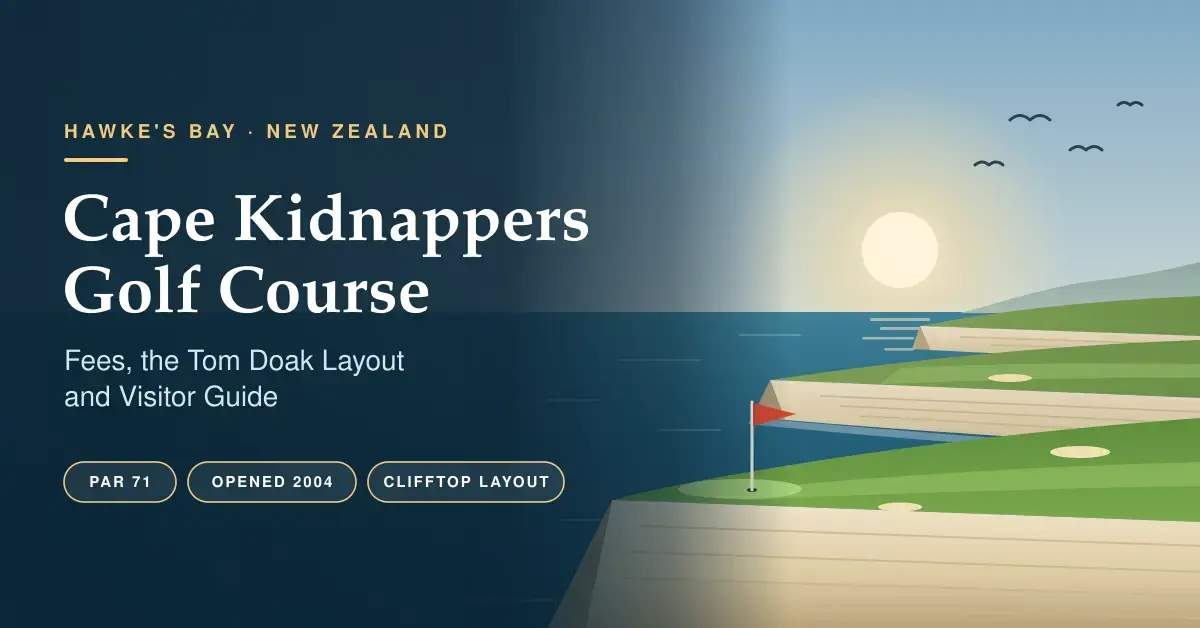
Cape Kidnappers is a par-71 clifftop course near Te Awanga in Hawke’s Bay, on New Zealand’s North Island, designed by American architect Tom Doak and opened in 2004. It is laid out across narrow ridges of farmland that run out towards the Pacific Ocean, with fairways finishing above steep cliffs. The course is part of a roughly 6,000-acre (about 2,400-hectare) working sheep and cattle station that also hosts the Rosewood Cape Kidnappers lodge and the Cape Sanctuary wildlife reserve. This guide sets out the verified facts a visitor actually needs: who built it, how it plays, what a round costs, whether you need a cart or caddie, how to get there, and how it compares with other courses you might play on a New Zealand trip.
Quick Facts
| Course | Cape Kidnappers, Te Awanga, Hawke’s Bay, New Zealand |
| Address | 446 Clifton Road, Te Awanga |
| Designer | Tom Doak / Renaissance Golf Design |
| Opened | 2004 (Tom Doak restoration completed December 2024) |
| Layout | 18 holes, par 71, about 7,147 yards (6,533 m) from the back tees |
| Style | Clifftop ridge-and-valley; firm, fast, wind-exposed |
| Signature hole | Par-5 15th, ‘Pirate’s Plank’ |
| Indicative green fee | From ~NZ$391 (NZ) / ~NZ$565 (AU) / ~NZ$739 (overseas), high season |
| Carts | Optional (hire available); walking permitted; caddies available |
| Booking | Advance booking required; soft-spike (non-metal) facility |
| World ranking | #65 in Golf’s 2025–26 Top 100; previously #17 in Golf Digest’s World’s 100 Greatest |
A clifftop course built on a working station
Cape Kidnappers sits at 446 Clifton Road, Te Awanga, about 20 kilometres south-east of Napier. The golf course occupies the headland of the same name, a long, fingered peninsula whose ridges are separated by deep ravines that fall away to the sea. The land is part of a large pastoral station, and the entrance gate on Clifton Road is still several kilometres from the clubhouse – the private access road climbs through paddocks and plantation for roughly 15 to 20 minutes before you reach the pro shop, so visitors should allow extra time on top of their drive to the gate.
The wider estate is owned by the family of the late Julian Robertson, the American investor who founded the Tiger Management hedge fund and who also developed Kauri Cliffs in Northland and Matakauri near Queenstown. The on-site accommodation, formerly branded ‘The Farm at Cape Kidnappers’, now operates as Rosewood Cape Kidnappers under Robertson Lodges. You do not have to be a lodge guest to play, but the golf course remains a low-volume, booking-only operation rather than a busy public club.
Who designed Cape Kidnappers and when did it open?
Tom Doak and his firm Renaissance Golf Design were commissioned by Julian Robertson in the early 2000s, and the course opened for play in 2004. Doak is known for minimalist, ground-following designs that move very little earth, and at Cape Kidnappers the fairways largely follow the natural shape of the ridges rather than being carved into them. The result is a layout that looks dramatic from the tee but is more playable than it first appears.
What changed in the 2024 renovation?
Tom Doak returned to carry out a restoration for the course’s 20th anniversary, with the work completed in time for the December 2024 summer season. The project re-grassed fairways and greens to bring back the firm, fast ‘bounce and roll’ the design was built for, trimmed mānuka and kānuka in the ravines to reopen cliff-edge sightlines, removed non-native cypress and pines around several holes, added a grass bunker at the 9th, and laid new, more discreet cart paths. The par and routing were unchanged, so most published descriptions of the holes still apply.
What the Tom Doak layout plays like
The course is a par 71 measuring about 7,147 yards (roughly 6,533 metres) from the back tees, with forward sets down to around 4,700 metres. Rather than hugging the shoreline like a traditional links, the holes run out and back along elevated fingers of land, so several fairways have a ravine or a cliff on one or both sides. From the tee the landing areas can look alarmingly narrow, but the fairways are generally wide, which is a deliberate concession to the coastal wind.
The turf is kept firm and fast, so the ball runs a long way and approach shots are often played low and allowed to release. The greens are large, with strong internal contours and run-off areas that feed missed shots into collection hollows. Deep bunkers and native rough frame the fairways. Because the headland is exposed, wind is the defining variable: on a calm day the course is a fair test for mid-handicap players, while a strong sea breeze makes club selection and ball-flight control the main challenge.
Pirate’s Plank: the par-5 15th
The best-known hole is the 15th, nicknamed ‘Pirate’s Plank’. It is a par 5 of roughly 550 metres that plays out along a progressively narrowing ridge high above the sea, with ground falling away on both sides towards the end. The fairway is wider than it looks from the tee, but a shot pushed or pulled near the green can be lost down the cliff, so most players treat it as a three-shot hole and aim for the centre of the putting surface. The par-3 and par-4 holes on the back nine (including the 8th, ‘Backstop’) share the same out-and-back, cliff-edge character.
Cape Kidnappers green fees and what a round includes
Green fees at Cape Kidnappers are premium and vary by residency and season. The figures below are indicative high-season (roughly October to May) rates for 18 holes and should be confirmed with the course at the time of booking, as published prices change and shoulder-season and winter rates are lower.
| Player category | Indicative 18-hole green fee (NZD, high season) | Notes |
|---|---|---|
| Overseas visitor | Around $739 | Advance booking required; welcome on weekdays and weekends |
| Australian golfer | Around $565 | Reduced trans-Tasman rate; proof of residency |
| New Zealand golfer | Around $391 | Lowest rate; NZ residency applies |
| Cart hire | Additional, on request | Optional – not compulsory (see below) |
| Caddie / club hire | Additional, on request | Book ahead through the pro shop |
The green fee covers the round plus use of the practice facilities and locker rooms. Carts, caddies and rental clubs are charged separately. Rates are best treated as a guide only; the course can also offer stay-and-play packages for Rosewood Cape Kidnappers lodge guests, which bundle golf with accommodation.
Do you have to take a cart or a caddie?
No – a cart is not compulsory at Cape Kidnappers. Carts are available for hire and many visitors use one because of the walking distances and elevation between some greens and the next tee, but walking is permitted and caddies can be booked. This corrects a common misconception: the course is not a ‘carts-only’ facility. If you want the full experience and are reasonably fit, walking with a caddie is a popular choice.
Booking, handicaps and dress code
Tee times must be booked in advance; the course does not take casual walk-ups. A recognised golf background is sensible given the exposure and pace expectations, and keeping an official golf handicap through New Zealand’s DotGolf system is useful if you plan to play several clubs on a trip. Standard golf-course dress applies: a collared shirt with tailored trousers or shorts, and golf shoes. Metal spikes are not permitted – the course is a soft-spike (non-metal) facility – so bring spikeless or soft-spiked shoes.
Practice facilities and the pro shop
The practice area sits a short distance from the clubhouse and includes a driving range, a putting green prepared to match the pace of the course, and a short-game area with a practice bunker. Warming up here is worthwhile because the firm greens and run-offs reward a calibrated short game. The pro shop handles check-in, cart and caddie bookings, and rental-club hire, and stocks apparel, weatherproofs and course-branded items – useful if a sudden squall rolls in off the sea.
Getting there: location and drive times
Cape Kidnappers is one of the more remote top courses to reach, but it is still within easy range of the main Hawke’s Bay centres. The region is better known to many visitors for its Art Deco architecture in Napier, its wineries and its gannet colony, so a round pairs naturally with a wider Hawke’s Bay itinerary.
- From Napier: approximately 40 minutes by road to the Clifton Road entrance gate.
- From Hastings: approximately 25 to 30 minutes via Havelock North, Haumoana and Te Awanga.
- From the gate to the clubhouse: allow a further 15 to 20 minutes up the private station road.
- Parking is on site at the clubhouse; helicopter transfers can be arranged for lodge guests.
If you are building a North Island golf trip, the nearest comparable club is the Hawke’s Bay Golf Club at Bridge Pa near Hastings, which is far more affordable for an everyday round.
How Cape Kidnappers compares with other New Zealand courses
Cape Kidnappers belongs to a small group of destination courses in New Zealand where scenery and architecture, rather than club membership, are the draw. Its distinguishing feature is the clifftop, ridge-and-valley routing: other famous Kiwi courses offer dunes, parkland or mountain backdrops, but none has quite the same leap-across-the-chasms character. The table below sets it beside other courses New Zealand visitors often consider.
Course Comparison
| Course | Region | Style | Par | Visitor access |
|---|---|---|---|---|
| Cape Kidnappers | Hawke’s Bay | Clifftop ridge-and-valley | 71 | Premium, booking-only |
| Hawke’s Bay Golf Club | Hawke’s Bay | Parkland | 72 | Affordable, visitors welcome |
| Millbrook Resort | Queenstown / Arrowtown | Resort / mountain | 72 (each 18) | Resort, booking-only |
| Formosa Golf Resort | Auckland (Beachlands) | Clifftop / parkland | 72 | Public, visitors welcome |
| Royal Auckland & Grange | Auckland | Parkland (27 holes) | 72 | Private, limited visitor access |
For a resort-style alternative, Millbrook Resort near Arrowtown offers 36 holes with mountain views and hosts the New Zealand Open. Closer to Auckland, the Formosa Golf Resort at Beachlands has its own clifftop holes designed by Sir Bob Charles. A broader overview of the options is in our guide to golf in New Zealand.
Cape Sanctuary and the estate’s conservation work
Much of the headland beyond the fairways is part of Cape Sanctuary, a privately funded conservation project that uses predator control and pest-exclusion fencing to protect native birds, reptiles and coastal seabirds. Players are asked not to climb fences or enter nesting areas to look for stray balls; a ball hit into these zones should be treated as lost. Cape Kidnappers is also well known for its large Australasian gannet colony at the tip of the headland, which can be visited on guided tours separately from golf. Predator-free sanctuaries and protected coastal reserves have become an important part of conservation efforts across New Zealand, helping native species recover in areas where introduced predators are controlled. The golf operation works within regional environmental rules on irrigation and buffer planting so that the course can coexist with the surrounding sanctuary.
Common mistakes visitors make
A few avoidable errors trip up first-time visitors to Cape Kidnappers. Knowing them in advance makes for a smoother day.
- Underestimating the drive in. The entrance gate is not the clubhouse; the station road adds 15 to 20 minutes, and arriving late can cost your tee time.
- Assuming a cart is required. It is not – but if you want to walk with a caddie, or hire a cart, arrange it when you book rather than on the day.
- Aiming at the cliff edges. The fairways are wider than they look; playing to the centre of fairways and greens is almost always the percentage choice, especially on the 15th.
- Ignoring the wind forecast. A calm booking and a windy booking are effectively two different courses; a few extra clubs and a lower ball flight help enormously.
- Packing the wrong shoes. Metal spikes are banned; bring spikeless or soft-spiked footwear and a windproof layer.
Sources
- Where2Golf – Cape Kidnappers (par, length, green fees, access)
- Golf Business News – Cape Kidnappers 20th-anniversary renovation
- GOLF.com – Top 100 Courses in the World ranking
- Top 100 Golf Courses – Cape Kidnappers profile
- Robertson Lodges – Rosewood Cape Kidnappers (estate and golf)
- Hawke’s Bay Tourism – golf in the region
Frequently Asked Questions
How much does it cost to play Cape Kidnappers?
Indicative high-season (about October to May) 18-hole green fees are around NZ$739 for overseas visitors, NZ$565 for Australian golfers and NZ$391 for New Zealand golfers. Carts, caddies and rental clubs cost extra, and shoulder-season and winter rates are lower. Prices change, so confirm the current fee with the course when you book.
Do you have to use a golf cart at Cape Kidnappers?
No. A cart is optional, not compulsory. Carts are available for hire and many visitors use one because of the distances and elevation between holes, but walking is permitted and caddies can be booked in advance through the pro shop.
Who designed Cape Kidnappers and when did it open?
The course was designed by American architect Tom Doak and his firm Renaissance Golf Design for owner Julian Robertson, and it opened in 2004. Tom Doak returned to carry out a restoration for the course’s 20th anniversary, completed for the December 2024 summer season.
Where is Cape Kidnappers and how do you get there?
It is at 446 Clifton Road, Te Awanga, in Hawke’s Bay on the North Island – roughly 40 minutes from Napier and 25 to 30 minutes from Hastings to the entrance gate, then a further 15 to 20 minutes up a private station road to the clubhouse. Tee times must be booked in advance.
What is the signature hole at Cape Kidnappers?
The signature hole is the par-5 15th, nicknamed ‘Pirate’s Plank’. It runs out along a narrowing clifftop ridge high above the sea, with the ground falling away on both sides near the green, making accuracy more important than distance.