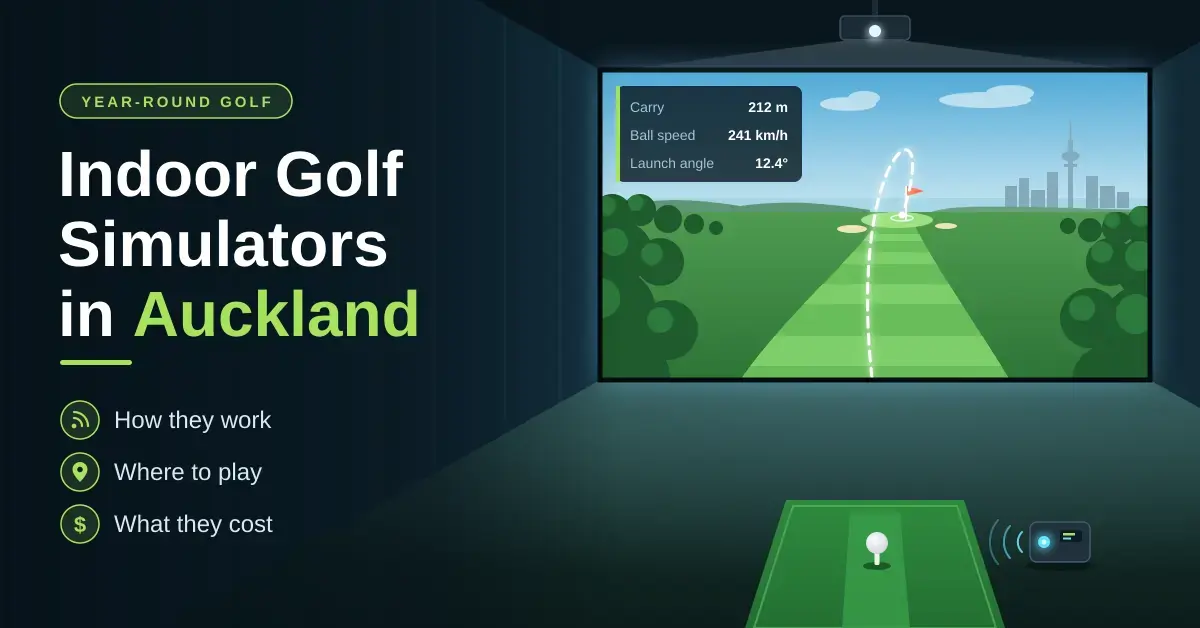
An indoor golf simulator lets you hit real golf shots into a large screen while a launch monitor measures the ball and club, then projects the resulting flight onto a virtual course. Auckland now has a cluster of commercial simulator venues spread across the CBD, the central suburbs and the North Shore, alongside a fast-growing market for home installations. This guide explains how the technology works, where you can play across the city, what a session costs, what it takes to build a setup at home, and how simulator practice compares with a traditional driving range — so you can decide which option fits your game and budget.
Key Points
- What it is: a hitting bay where you play real shots into a screen while a launch monitor measures the ball and club and renders a virtual course.
- Where to play: established Auckland venues include The Golf Lounge (Newmarket), The Green Pinnacle (Grey Lynn), Flush Golf (Britomart), GOLFixx (Wairau Valley) and Neverland (Takapuna).
- Technology: TrackMan (radar) is strong on club-delivery data; Foresight (camera) excels at spin for fitting; Toptracer favours simple, social play.
- Cost: roughly – per hour for a standard bay, charged per bay, with private suites up to about 5 per hour.
- Home setups: allow about 3.0 m of ceiling, 3.0–3.6 m width and 4.5 m+ depth, plus a durable impact screen, software and a launch monitor.
- Handicaps: casual rounds usually do not count, but Golf NZ affiliated venues can provide an official handicap.
What an indoor golf simulator is and how it works
An indoor golf simulator is a hitting bay where you play real shots with your own clubs into an impact screen, while sensors track the ball and club and software renders the shot on a virtual hole. You swing normally; the system measures what happens and shows where the ball would have finished outdoors. Because the whole session is indoors, it runs the same in July rain as it does on a still summer evening.
Two things make the modern experience convincing. The first is the launch monitor — the radar or camera unit that reads the strike. The second is the course software, which converts those numbers into a 3D ball flight across a laser-mapped rendering of a real course. Together they let a player work on technique with hard data, or a group play a famous layout such as St Andrews or Pebble Beach in a single evening.
The data a launch monitor captures
A launch monitor records the shot in the milliseconds around impact and reports it as a set of numbers. Depending on the unit, a premium bay can track more than 20 parameters, and the most useful ones are consistent across systems:
- Ball speed — how fast the ball leaves the face, the main driver of distance.
- Launch angle — the vertical angle the ball starts on, which shapes carry and roll.
- Spin rate — backspin and side spin, which explain why a shot climbs, holds a green or curves.
- Club speed and smash factor — how efficiently club speed is transferred to the ball.
- Club path and face angle — the delivery numbers that explain a draw, fade, push or pull.
These readings are what a traditional range cannot give you: outdoors you watch the general direction of the ball and guess, whereas a simulator quantifies exactly why a shot behaved the way it did. That feedback is why competitive players use bays to confirm carry distances and coaches use them to isolate a fault on the spot.
The main launch-monitor technologies
The venue you choose largely comes down to the launch-monitor technology it runs, because that determines what the system measures and how it reads your swing. Three approaches dominate Auckland’s commercial bays, and each suits a slightly different purpose.
| Technology | How it tracks the shot | Strength | Best suited to |
|---|---|---|---|
| TrackMan (radar) | Doppler radar paired with cameras to follow club and ball | Detailed club-delivery data — path, face and smash factor | Lower-handicap players, coaching and competition tracking |
| Foresight Sports (camera) | High-speed cameras photographing the ball at impact | Precise spin and launch measurement indoors | Club fitting and ball-flight optimisation |
| Toptracer (camera) | Camera-based ball-flight tracing with game layers | Simple, visual tracing and arcade-style games | Social groups, casual practice and family sessions |
Radar systems such as TrackMan sit behind the player and are strong on club-delivery numbers, which is why coaching-focused venues favour them. Camera-based systems such as Foresight photograph the ball directly and are prized for spin accuracy in club fitting. Toptracer, familiar from televised tour coverage, prioritises an easy, visual experience over deep diagnostics. None is universally “best” — the right choice depends on whether you are chasing data or entertainment.
Where to play: indoor golf simulator venues in Auckland
Auckland’s simulator venues range from polished CBD hospitality rooms to large suburban performance centres, so the right one depends on whether you want coaching, competition or a social night out. The venues below are established operators with confirmed locations and technology; rates and features change, so check each venue’s own booking page before you visit.
- The Golf Lounge (Newmarket) — At 1 Broadway, this venue runs TrackMan across premier bays and private suites, with access to more than 460 international courses. It suits corporate hosting and small-group play.
- The Green Pinnacle (Grey Lynn) — On Great North Road, this is a Golf New Zealand affiliated venue with 11 TrackMan bays and roughly 300 virtual courses. Memberships include an official Golf NZ affiliation number and handicap, and the club carries a testimonial from New Zealand tour player Ryan Fox.
- Flush Golf (Britomart) — At 48 Customs Street East, this Savor Group venue pairs five TrackMan bays with a full food-and-drink menu, social leagues and event nights; full venue hire suits groups of up to about 50.
- GOLFixx (Wairau Valley) — On Archers Road on the North Shore, this large facility markets itself as one of New Zealand’s biggest indoor golf centres, with casual bays, concessions and NZ PGA coaching from around $35 an hour.
- Neverland Indoor Golf (Takapuna) — An eight-bay venue positioned as an affordable option, with casual bays from $20 an hour before 6pm and $30 after, plus low-cost club hire.
- Urban Fairway (Newmarket) — A simulator bar on Melrose Street combining hitting bays with a relaxed food-and-drink setting for social sessions.
Auckland Simulator Venues Compared
| Venue | Area | Technology | Bays | Indicative price | Notable feature |
|---|---|---|---|---|---|
| The Golf Lounge | Newmarket (1 Broadway) | TrackMan | Premier bays and private suites | ~/hr premier; ~5/hr suite | 460+ international courses |
| The Green Pinnacle | Grey Lynn (Great North Rd) | TrackMan | 11 | Membership and casual play | Golf NZ affiliation and official handicap |
| Flush Golf | Britomart (48 Customs St E) | TrackMan | 5 | Hourly; venue hire for groups | Full Savor Group food and bar; leagues |
| GOLFixx | Wairau Valley (Archers Rd) | Simulator bays with coaching | Large multi-bay | From ~/hr; concession cards | One of NZ’s largest indoor centres |
| Neverland Indoor Golf | Takapuna | Launch-monitor bays | 8 | /hr pre-6pm; /hr after | Low-cost club hire; up to 4 per bay |
| Urban Fairway | Newmarket (Melrose St) | Simulator bar | Multi-bay | Hourly | Relaxed bar-and-bay social setting |
What it costs to hire a simulator bay in Auckland
Casual bay hire in Auckland generally runs from about $20 to $90 an hour, with premium private suites priced higher. Where a venue sits in that band depends on the technology, the location and the time of day rather than any single “market rate”.
- Entry level — Value-focused venues such as Neverland start around $20 an hour off-peak, with a shared bay taking up to four players.
- Mid-range — North Shore and suburban centres such as GOLFixx sit around $35 an hour, often with multi-session concession cards that lower the effective rate.
- Premium bays — Central TrackMan venues such as The Golf Lounge charge about $75 an hour for a premier bay.
- Private suites — Larger private rooms for corporate or group play can run to roughly $175 an hour, reflecting the extra space, seating and catering.
Rates are usually charged per bay rather than per person, so splitting a booking across a group brings the per-head cost down quickly. Peak weekend evenings and winter demand push prices toward the top of each range, which is why booking ahead is worthwhile in the wetter months.
Building a home golf simulator in New Zealand
A growing number of New Zealand players are installing simulators at home, usually in a garage, spare room or purpose-built shed, to remove travel and booking queues entirely. A workable home setup comes down to space, a durable screen, the right software and a launch monitor that matches your budget.
- Room dimensions — As a practical minimum, aim for a ceiling of about 3.0 metres, a width of roughly 3.0–3.6 metres and a depth of at least 4.5 metres so a driver swings freely; more space is better, and a centred hitting position lets both right- and left-handers use the bay. Measure before you buy anything, as ceiling height is the most common constraint.
- Impact screen — Commercial screens use tightly woven, multi-layer polyester designed to absorb fast-moving balls, stay flat for a sharp image and dampen noise. A quality screen and enclosure is what protects the room and keeps the picture clean.
- Software — Home users commonly run subscription platforms such as GSPro, E6 Connect or TrackMan Performance Studio, which offer detailed course libraries and practice modes. Check that your chosen launch monitor is compatible with the software before committing.
- Hardware — Portable launch monitors such as the Bushnell Launch Pro (Foresight) or similar consumer units make a home bay realistic without commercial pricing. Buying through a local New Zealand distributor secures warranty cover and setup support.
If you are matching gear to your own swing rather than a fixed room, a professional custom fitting is a useful first step; local specialists such as the Golf Warehouse in Ellerslie use launch monitors for exactly this. The same measurement approach that improves your home bay also improves the clubs you put in it.
Why golfers use simulators
The main reason players use simulators is measurement: every shot produces numbers you can act on, which turns vague practice into targeted work. Beyond the data, simulators solve several practical problems that outdoor practice cannot.
- Precise feedback — Instead of guessing, you see launch angle, spin and face-to-path on every swing, so you understand why a shot curved or came up short.
- Weather-proof practice — Auckland’s maritime climate disrupts outdoor plans often; an indoor bay runs in any conditions, all year.
- Time efficiency — A solo player can complete 18 virtual holes in under an hour, against four to five hours for an outdoor round plus travel.
- Distance calibration — Hitting several balls with each club builds an accurate average carry for your whole bag, which helps you close the gaps between clubs.
Simulators are not a full replacement for outdoor golf — they cannot replicate every lie, wind read or putting surface — but as a controlled practice tool they let you work on mechanics and gapping far faster than a range does. Pairing that data with work on your golf swing is where most players see the quickest improvement.
Simulators versus a traditional driving range
A simulator and a driving range serve overlapping but different needs: the range offers real ball flight and a low entry cost, while the simulator offers data, comfort and course play. Neither is strictly better, and many Auckland golfers use both.
- Data — A range shows rough direction; a simulator reports spin, launch, path and smash factor on every shot.
- Conditions — Ranges are exposed to rain, wind and light; a bay is climate-controlled year-round.
- Equipment — Indoor mats and fresh balls are kinder to club faces than worn range balls off abrasive tees.
- Cost and realism — A bucket of range balls is cheaper per session and gives you real ball flight and open air, which some players prefer for feel.
- Social setting — Ranges are line-based and solitary; simulator bays have lounge seating so a group can play together.
If your goal is volume repetition and real ball flight at low cost, an outdoor range such as the Takapuna driving range does the job. If you want measured feedback, course play and shelter from the weather, a simulator earns its higher hourly rate. Interestingly, the technology has spread well beyond dedicated venues — some cruise operators such as Royal Caribbean, covered on Wikipedia, now install golf simulators onboard as an all-weather activity.
Social play, leagues and corporate events
Simulators have become a mainstream option for group entertainment because arcade-style game modes let players of very different abilities compete on level terms. Most Auckland venues combine bays with a licensed bar and catering, and many run structured mid-week leagues in team formats. The table below outlines how venues typically match different events to bay setups.
| Event type | Typical group size | Suggested format | Catering match |
|---|---|---|---|
| Corporate function | 30–50+ guests | Venue buyout with longest-drive or closest-to-pin contests | Shared platters with beer and wine on tap |
| Client entertaining | 4–12 guests | Private suite playing an iconic tour course | Sliders, small plates and cocktails |
| Mid-week league | Two-player teams | Rotating 9-hole team formats over several weeks | Pizza, chips and casual drinks |
| Birthday or family | 4–6 players per bay | Arcade game modes over strict scoring | Snack bundles and non-alcoholic options |
Because a bay is charged per hour rather than per head, group events scale well, and a shared booking is often cheaper per person than a round at a club. For teams that want a competitive edge, some venues track results across a season, giving casual leagues a genuine ladder to climb.
Common mistakes and simple etiquette
Most problems in a simulator bay come from treating it like an outdoor range, when the confined space and sensitive equipment call for a little care. Avoiding a handful of common mistakes keeps the session accurate and the venue happy.
- Hitting with dirty clubs — Grit and sand on a club face can tear or stain the impact screen; wipe faces clean before you start.
- Using marked balls — Sharpie alignment lines can transfer ink onto the screen at speed, so use the balls the venue provides or clean, unmarked ones.
- Standing too close — Keep well clear of the hitting zone while another player swings; heavy clubs at speed leave no room for error indoors.
- Trusting raw numbers blindly — Indoor spin and carry can differ slightly from outdoors; use the data for trends and gapping rather than treating a single reading as gospel.
- Over-booking the time — A four-player group takes three to four hours for 18 holes, so choose 9-hole or target modes for a shorter session and finish on time for the next booking.
Beginners are welcome at every commercial venue, and the arcade modes make a first visit approachable even if you have never played outdoors. Following the venue’s check-in guidance and handling touchscreens and alignment gear gently keeps the sensors calibrated for everyone.
Who indoor golf suits
Indoor simulators suit a wide range of players, which is why the venues themselves vary so much. Serious golfers use them as a data lab to calibrate distances and rehearse mechanics; casual groups use them as weather-proof entertainment with food and drink; and coaches use them to show a fault and a fix in the same session. Home users value the convenience of practising without travel, while visitors and beginners appreciate playing a famous course without needing a handicap. If you compete, a venue with Golf New Zealand affiliation can also feed an official golf handicap, and simulator practice complements rather than replaces time on Auckland’s outdoor golf courses.
Sources
Frequently Asked Questions (FAQ)
How much does it cost to hire a golf simulator in Auckland?
Casual bay hire generally runs from about $20 an hour at value venues such as Neverland in Takapuna to around $75 an hour for a premier TrackMan bay at central venues like The Golf Lounge, with larger private suites priced higher, up to roughly $175 an hour. Rates are usually charged per bay rather than per person, so splitting a booking across a group lowers the cost per head. Peak weekend evenings and winter demand sit at the top of each range.
Can I bring my own clubs and count on the data?
Yes, bringing your own clubs gives the most realistic and useful distance data, and it is encouraged. Make sure the faces are clean and free of grit or sand first, because abrasive debris can damage the impact screen. Treat the readings as accurate for trends and club gapping; indoor spin and carry can differ slightly from outdoor conditions, so use the data to guide practice rather than as an exact outdoor prediction.
Do simulator rounds count toward an official New Zealand handicap?
Casual simulator rounds generally do not count toward an outdoor Golf New Zealand handicap. The exception is at affiliated venues: The Green Pinnacle in Grey Lynn is a Golf New Zealand affiliated club, and its memberships include an official affiliation number and recognised handicap. If maintaining a handicap matters to you, check whether a venue is affiliated before joining.
How long does it take to play a virtual round?
A solo player practising efficiently can finish 18 virtual holes in about 45 to 50 minutes, far quicker than an outdoor round. A twosome typically takes around one and a half to two hours, while a full four-player group needs a three-to-four-hour booking. For shorter sessions, most venues offer 9-hole play or target-based game modes that fit comfortably into an hour.
What space do I need for a home golf simulator?
As a practical minimum, aim for a ceiling of about 3.0 metres, a width of roughly 3.0 to 3.6 metres and a depth of at least 4.5 metres so you can swing a driver freely. More space is always better, and a centred hitting position lets both right- and left-handed players use the bay. Ceiling height is the most common limiting factor, so measure carefully before buying a screen, enclosure or launch monitor.