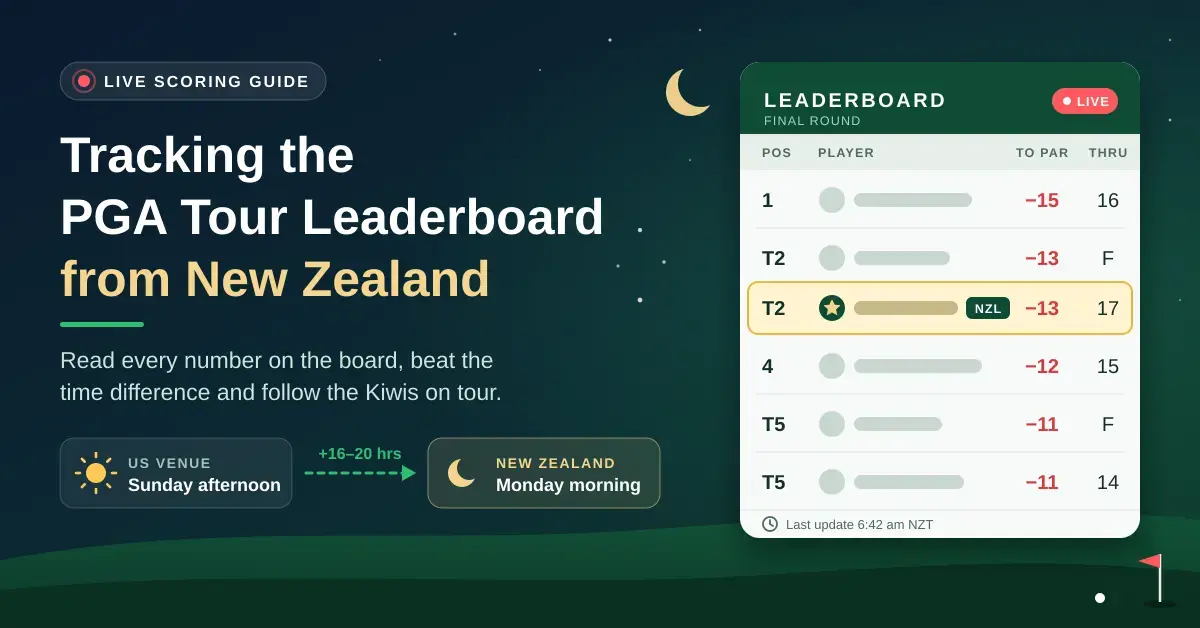
Following the PGA Tour from New Zealand means reading a live leaderboard that usually updates while most of the country is asleep. This guide explains what each number on a PGA Tour leaderboard means, how the live-scoring technology behind it works, and the most reliable ways for Kiwi fans to keep up despite a time difference of roughly 16 to 20 hours. It also walks through the parts of the season that decide where players sit on the board — the cut, the FedExCup, the signature events and the playoffs — and points out the New Zealanders worth tracking. For the general mechanics of reading any scoreboard, our companion guide on how to read and track a golf leaderboard covers the basics; here the focus is squarely on the PGA Tour and the New Zealand viewing experience.
Key Points
- A PGA Tour leaderboard ranks players by their score to par; the ‘Thru’ column tells you how many holes they have left to play.
- New Zealand is roughly 16 to 20 hours ahead of US venues, so the final round usually reaches its climax during our Monday.
- Sky New Zealand holds the exclusive PGA Tour broadcast rights here; the official PGA Tour app and website give free live scores.
- The 36-hole cut in a standard event keeps the top 65 players and ties for the weekend.
- Finishing position feeds the FedExCup points race, which decides the playoffs, signature-event spots and tour cards.
- Ryan Fox is the New Zealander to track — a multiple PGA Tour winner and the 2026 Open Championship winner.
What the PGA Tour Leaderboard Actually Shows
A PGA Tour leaderboard ranks players by their score relative to par, from lowest (best) to highest. ‘Par’ is the number of strokes a skilled golfer is expected to need for a hole or a course, so a score of −5 means a player is five strokes better than that benchmark across the holes they have completed. Everything else on the board exists to add context to that single ranking number.
Most official boards show the same core columns. Reading them in order tells you not just who is leading, but whether that lead is real or about to change as more players finish.
- Pos — the player’s current position; a ‘T’ (as in ‘T3’) means they are tied with others.
- To Par / Total — the overall score against par for the whole tournament so far.
- Today — the score against par for the round currently being played.
- Thru — how many of the 18 holes the player has completed in that round; ‘F’ means finished, and a number such as ’12’ means they are still out on the course.
- R1–R4 — the individual round totals once each round is complete.
Why ‘Thru’ Matters More Than Position
The ‘Thru’ column is the single most important thing to read before trusting the leaderboard. A player shown at the top but only ‘Thru 9’ has another nine holes to play, while someone two shots back but ‘F’ (finished) has no more chances to improve. During live play the board constantly reshuffles, so a mid-round leader is a provisional picture, not a result. Learning to weigh position against holes remaining is what separates a casual glance from genuinely understanding the state of play.
The Cut Line Explained
The cut is the halfway checkpoint that trims the field for the weekend. After the first two rounds (36 holes) of a standard full-field event, only the top 65 players and ties continue to Saturday and Sunday; everyone else misses the cut, earns no prize money and goes home. From a New Zealand perspective, the cut is usually decided during our Saturday morning, and it is the first real drama of the week — especially when a favourite is hovering right on the projected line. Note that major championships can use a slightly different cut (the PGA Championship, for example, cuts to the top 70 and ties).
How to Follow the PGA Tour from New Zealand
The main obstacle for Kiwi fans is simple geography: New Zealand sits roughly 16 to 20 hours ahead of the American venues where most PGA Tour events are played. A Sunday final round that finishes in the late afternoon on the US East Coast lands in the early-to-middle of our Monday morning, which is why Kiwis so often say the tournament ‘finishes on Monday.’ The practical answer is to pick one trusted live source and let it do the refreshing for you rather than chasing updates across half a dozen tabs.
For live video, following overseas golf from New Zealand almost always runs through Sky. Sky New Zealand holds the exclusive PGA Tour broadcast rights here through 2030, covering the full schedule — regular season, the FedExCup Playoffs and the Fall events — across its Sky Sport channels and the Sky Sport Now streaming service. For scores without the television subscription, the official PGA Tour app and website give the same ShotLink-fed leaderboard that the broadcasters use.
Where to Follow the PGA Tour from New Zealand
| Platform | Best for | Cost in NZ |
|---|---|---|
| PGA Tour (official app & site) | The full ShotLink-fed live leaderboard, scorecards and player alerts | Free |
| Sky Sport NZ | Live television coverage of the full schedule and the majors | Sky subscription |
| Sky Sport Now | Streaming the same live coverage without a satellite box | Streaming pass |
| ESPN Golf | A clean alternative live leaderboard and news | Free |
| Data Golf | Strokes-gained analysis and live win-probability models | Free / paid tiers |
Managing the Time Difference
The time difference is manageable once you know the rhythm of a tournament week. The first two rounds (Thursday and Friday in the US) play out across our Friday and Saturday, the cut is decided around our Saturday morning, and the all-important final round unfolds through our Monday. If you want to watch live, the leaders tee off last, so the climax of a US East Coast event typically reaches New Zealand between about 8am and noon on Monday. Many fans record the final round overnight and avoid social media until they can watch it — a sensible habit given how fast results spread.
Setting Up Player Alerts
Custom alerts are the most useful feature for anyone who cannot watch every hole. In the official PGA Tour app you can ‘favourite’ individual players and receive a notification each time they make a birdie, drop a shot or move on the board. For a New Zealand fan this means you can keep an eye on a Kiwi in contention without refreshing the leaderboard through the work day — the phone simply tells you when something happens.
How Live Scoring Works: ShotLink and Strokes Gained
Every number you see updates almost instantly because of ShotLink, the PGA Tour’s shot-tracking system. Using a network of lasers, cameras and volunteers, ShotLink records the start and end position of essentially every shot hit by every player, then feeds that data straight to the digital leaderboard. This is why the board can refresh within seconds of a putt dropping, and why fans in Auckland can see a shot’s distance and the resulting score almost as quickly as spectators standing on the course in Florida or California.
What ShotLink Measures
ShotLink captures far more than the final score. Because it logs the coordinates of each shot, it can report driving distance, how far an approach finished from the hole, and exactly where a ball came to rest. That raw location data is the foundation for the deeper statistics that explain why a player is leading, not just that they are.
Strokes Gained in Plain English
Strokes gained is the single most useful statistic for interpreting a leaderboard, and it is simpler than it sounds. Developed by Columbia University professor Mark Broadie using ShotLink data, it compares a player’s performance on each shot against the tour average from the same spot. If the field needs 2.9 shots on average to hole out from 150 metres in the fairway and a player does it in two, they have ‘gained’ strokes on the field. The tour breaks this into six categories: off-the-tee, approach, around-the-green, putting, tee-to-green and total.
The value of strokes gained is that it shows the engine behind a score. A player can sit near the top of the board because of an outlier week with the putter, while another is there through sheer ball-striking. The approach-play category tends to explain the largest share of scoring differences between the best players, so a leader dominating ‘strokes gained: approach’ is often more likely to hold on than one relying on a hot putter. If you want to apply the same thinking to your own game, our guide to green reading and putting is a good next step.
The FedExCup and Why Finishing Position Matters
Every stroke counts toward more than the weekly trophy because of the FedExCup, the PGA Tour’s season-long points race. Players earn points based on where they finish each week, and those points decide who qualifies for the lucrative events, who keeps their playing privileges and who ultimately wins the season title. This is why you will often see a ‘Projected FedExCup Points’ column beside the score, and why a Sunday battle for 20th place can still carry real stakes.
| Standing | What it unlocks |
|---|---|
| Top 30 (after the second playoff event) | A place in the Tour Championship and a shot at the FedExCup title and its US$10 million bonus |
| Top 50 (season-long) | Entry into the following year’s eight signature events, which carry elevated purses and no cut |
| Top 70 (end of regular season) | Qualification for the FedExCup Playoffs |
| Top 100 (after the FedExCup Fall) | Fully exempt status for the next season |
| 101–125 | Conditional status only — limited starts, from the 2026 season onward |
Signature Events and The Players
Not every event on the leaderboard carries the same weight. The signature events are a small group of limited-field, no-cut tournaments with much larger purses and points, open mainly to the previous season’s top performers. The Players Championship, held each March at TPC Sawgrass, sits in a category of its own — it is the tour’s flagship event with the deepest field and its own famous island green at the 17th. Cameron Young won the 2026 edition by a single shot; you can read more about that tournament on Wikipedia.
The Playoffs and the Tour Championship
The FedExCup Playoffs are a three-event sprint that closes the season. The top 70 reach the FedEx St. Jude Championship, the field narrows to the top 50 for the BMW Championship, and the top 30 advance to the Tour Championship. Since 2025 the Tour Championship has been a straightforward 72-hole stroke-play event in which all 30 players start level at even par — replacing the older ‘starting strokes’ format — so the leaderboard you read at East Lake is a true reflection of that week’s golf, with the winner taking the season title.
Majors and Regular Events Read Differently
The four major championships produce the highest-pressure leaderboards of the year, and they tend to look different from a regular tour stop. Courses are set up to be far harder — longer, with thicker rough and firmer greens — so winning scores sit much closer to par. On a board where the leader is only a few under, a single birdie can move a player several places, which makes majors uniquely volatile to watch from New Zealand, late at night or in the early morning.
| Major | Usual leaderboard character | Main defence |
|---|---|---|
| The Masters | Volatile back nine on Sunday | Fast, undulating greens and pressure |
| U.S. Open | High scores; par is a good score | Thick rough and narrow fairways |
| The Open Championship | Swings with the wind and weather | Links turf, pot bunkers and the elements |
| PGA Championship | Varies from birdie-fests to brutal | Long yardages and modern layouts |
The majors also feed the Official World Golf Ranking (OWGR), a separate measure from the FedExCup that tracks performance over a rolling two-year window. A strong run in the majors can lift a player’s world ranking even in a quiet FedExCup season, which is why the two numbers rarely match.
New Zealand Players to Track
For Kiwi fans the obvious name to follow is Ryan Fox, who has turned into a genuine PGA Tour winner. Fox claimed his first tour title at the 2025 Myrtle Beach Classic in a playoff, won the RBC Canadian Open less than a month later, and then captured the 2026 Open Championship — his first major, and the first by a New Zealander at The Open since Sir Bob Charles in 1963. Setting a favourite-player alert for Fox is the simplest way to catch his moves on the board without watching every group. A full look at his career, technique and equipment is available on the site.
Beyond the headline names, the PGA Tour app also hosts leaderboards for its feeder and senior circuits — the Korn Ferry Tour and PGA Tour Champions — where emerging and veteran players compete. Keeping an eye on the Korn Ferry Tour is a good way to spot the next New Zealander working toward a full tour card. If you are newer to the sport, our explainer on scoring terms such as what a birdie is will make every leaderboard easier to read.
Common Mistakes When Reading a PGA Tour Leaderboard
Most misreadings come from trusting the numbers without their context. Knowing the common traps makes the board far more reliable, especially when you are catching up after the fact rather than watching live.
- Ignoring the ‘Thru’ column. A leader with holes still to play has not won anything; always check how much golf remains before reading too much into a position.
- Confusing ‘Today’ with ‘Total’. A player can be shooting a brilliant round today yet still sit mid-table on their tournament total, or vice versa.
- Forgetting the draw. In the first two rounds, one half of the field may play in calm morning conditions while the other faces strong afternoon wind, so similar skill can produce very different scores.
- Assuming a frozen board is final. Lightning, rain or heavy wind can suspend play, locking the leaderboard mid-round and sometimes pushing the finish to a Monday (or, for us, even later).
- Reading betting odds as the standings. Win-probability figures reflect what a model expects to happen, not the current order of play — they are a prediction, not the result.
Responsible Gambling Note
Some leaderboards and golf apps now display live betting odds and win probabilities alongside the scores. These are informational features and are included here only to explain what the numbers mean, not as encouragement to bet. In New Zealand, the only legal provider of sports betting is the TAB, operated by TAB NZ; betting with offshore operators is not regulated here. Betting carries risk and no statistic, demo or tip improves the odds of winning. If gambling is causing harm to you or someone you know, free and confidential support is available in New Zealand through the Gambling Helpline on 0800 654 655 or by texting 8006.
Sources
- PGA Tour — FedExCup and playoffs format
- The Golf News Net — 2026 FedExCup Playoffs format
- ESPN — PGA Tour eligibility changes (top 125 to top 100)
- Sportcal — Sky NZ extends PGA Tour rights through 2030
- The Action Network — Strokes Gained explained (Mark Broadie / ShotLink)
- PGA Tour — Ryan Fox’s first tour title
- Golf Channel — 2026 Players Championship results
Frequently Asked Questions
How often does the PGA Tour leaderboard update?
The official leaderboard updates within seconds of a shot being recorded by ShotLink, the tour’s shot-tracking system. For live play this is effectively real time, which is why the online board and the television coverage stay closely in step.
What time do PGA Tour events finish in New Zealand?
Because New Zealand is roughly 16 to 20 hours ahead of the American venues, a Sunday final round in the United States reaches its climax during our Monday. For a US East Coast event the leaders usually finish between about 8am and noon on Monday New Zealand time.
What does ‘Thru’ mean on a golf leaderboard?
‘Thru’ shows how many of the 18 holes a player has completed in the current round. An ‘F’ means they have finished, while a number such as ’12’ means they are still out on the course with holes to play, so their score can still change.
What does MDF mean on a leaderboard?
MDF stands for ‘Made Cut, Did Not Finish.’ It applied when a secondary cut was used after the third round to limit a very large weekend field. This rule was effectively retired when the standard 36-hole cut moved to the top 65 and ties for the 2019–20 season, so it is now rarely seen.
Where can I watch the PGA Tour live in New Zealand?
Sky New Zealand holds the exclusive PGA Tour broadcast rights in New Zealand, shown on its Sky Sport channels and the Sky Sport Now streaming service. For live scores without a subscription, the official PGA Tour app and website carry the same leaderboard used by the broadcasters.