LIV Golf is a professional men’s golf league, launched in 2022 and financed by Saudi Arabia’s sovereign wealth fund, that set out to challenge the established order of the sport with team competition, huge prize money and a faster, shotgun-start format. In only a few seasons it signed many of the world’s leading players, triggered lawsuits and bans, and split professional golf in two — before running into a severe funding crisis in 2026. This guide explains what LIV Golf is, how it works, why it has been so divisive, and where it stands today.
Key Facts
| League | LIV Golf (originally the LIV Golf Invitational Series; now the LIV Golf League) |
|---|---|
| Announced | 29 October 2021 (as LIV Golf Investments) |
| First event | 9–11 June 2022, Centurion Club, near St Albans, England |
| Founder / first CEO | Greg Norman (2021 – January 2025) |
| Current CEO | Scott O’Neil (from January 2025) |
| Main backer | Saudi Arabia’s Public Investment Fund (PIF), chaired by Yasir Al-Rumayyan |
| Name meaning | “LIV” = 54 in Roman numerals (original 54-hole events; 54 also = a “perfect round”) |
| Format (2026) | 72 holes over four days, shotgun start, no cut |
| Field | 57 players in 13 four-player teams (48 players / 12 teams in 2022–2025) |
| 2026 purses (as announced) | About US0 million league-wide |
| Status (September 2026) | Filed for Chapter 11 bankruptcy; PIF funding ending after 2026; relaunch planned for 2027 |
What is LIV Golf, in simple terms?
LIV Golf is a breakaway professional golf circuit that competes with the traditional tours, most notably the PGA Tour in the United States and the DP World Tour in Europe. It stages its own tournaments, runs its own points race and pays its players directly, operating outside the historic tour system rather than as part of it.
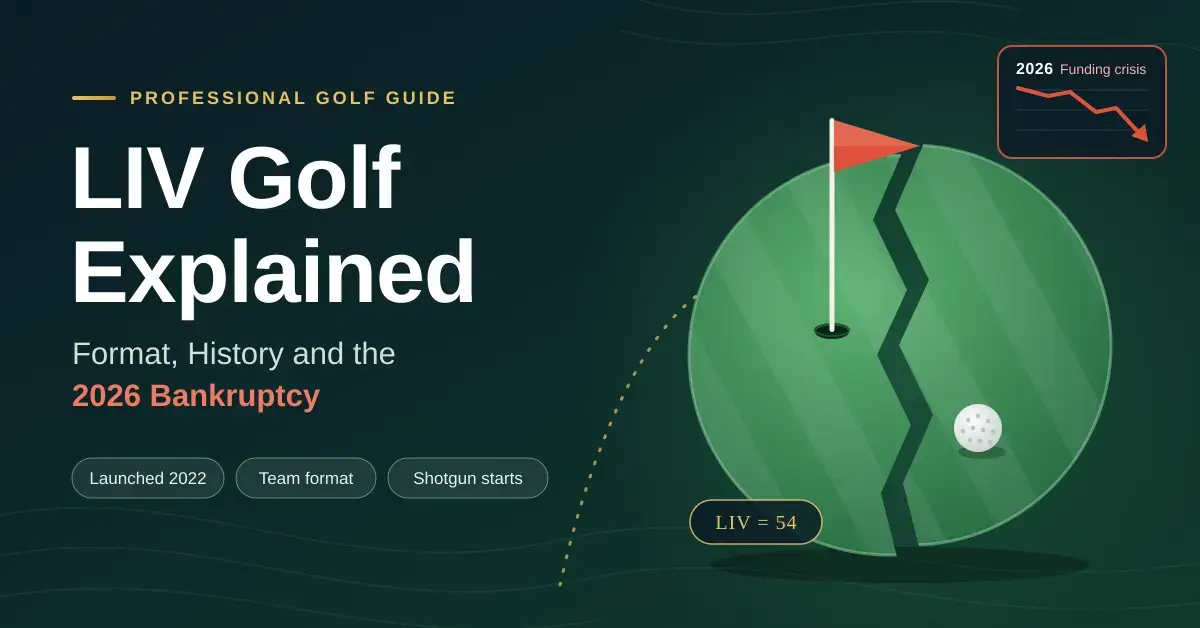
The name “LIV” is the Roman numeral for 54. It points to two things at once: each regular tournament was originally played over 54 holes (three rounds of 18) rather than the usual 72, and 54 is also the score a golfer would card by making a birdie on every hole of a par-72 course — golf’s notional “perfect round”. A birdie means finishing a hole one stroke under par, the score an expert is expected to take.
Unlike a normal tour event, LIV combines two competitions at once: an individual tournament and a team tournament played over the same rounds. That team element, alongside on-course music, relaxed dress codes and a party atmosphere, is central to how LIV markets itself as a more modern, entertainment-driven version of the game.
Who created LIV Golf and who funds it?
LIV Golf was fronted by Australian great Greg Norman and financed by Saudi Arabia’s Public Investment Fund. Norman, a two-time Open champion and former world number one, became the league’s first chief executive when LIV Golf Investments was announced on 29 October 2021.
Greg Norman and the launch
Greg Norman was the public face of LIV from the outset. The first tournament — the LIV Golf Invitational London — ran from 9 to 11 June 2022 at the Centurion Club near St Albans in England, not in Dubai and not in 2021 as is sometimes claimed. Norman remained chief executive until January 2025, when the former sports executive Scott O’Neil took over; Norman then stepped away from the organisation entirely later in 2025.
Saudi Arabia’s Public Investment Fund
The money behind LIV Golf comes from the Public Investment Fund (PIF), Saudi Arabia’s sovereign wealth fund — a state-owned investment vehicle chaired by Yasir Al-Rumayyan. A sovereign wealth fund is a pool of national wealth, in this case built largely on oil revenue, that a government invests around the world. PIF is reported to have poured well over US$5 billion into LIV Golf, funding player contracts, prize purses and day-to-day operations.
That backing is also the source of much of the controversy around LIV, which critics have described as “sportswashing” — using sport to improve a country’s international image. Supporters counter that PIF is a mainstream global investor with stakes in many major companies and sporting bodies.
How does the LIV Golf format work?
LIV Golf’s signature format is a no-cut, shotgun-start event that runs faster than a traditional tournament. “No cut” means every player who tees off on day one plays all the way to the end — nobody is eliminated partway through, as happens on most tours after 36 holes. A “shotgun start” means all groups begin at the same time from different holes across the course, so the whole field finishes together.
The 2022–2025 format (54 holes)
For its first four seasons LIV events were played over 54 holes across three days, with 48 players competing as individuals and in 12 four-player teams. Play was stroke play — every shot counted toward a running total and the lowest score wins — and the same rounds decided both the individual leaderboard and the team standings. Regular events carried purses of around US$25 million, among the richest in golf, with additional team prize money and a lucrative season-ending Team Championship.
The 2026 format changes (72 holes)
From the 2026 season LIV Golf expanded its regular events to 72 holes over four days, matching the length of a standard tour tournament. The field grew to 57 players — 13 teams of four plus five unattached “wild card” players — and the change was made partly to strengthen the league’s case for official world ranking points. LIV originally announced combined individual and team purses of around US$470 million for 2026, though those figures were cut sharply during the season’s financial troubles.
Individual and team competition
Every LIV event produces two sets of results from the same golf. Individually, the lowest total score wins. For the team competition, a set number of the best scores from each four-player franchise are combined each day. Teams have their own names, captains and branding — such as Legion XIII, Crushers GC and Ripper GC — plus separate season-long standings and their own Team Championship.
LIV Golf vs PGA Tour
| Feature | LIV Golf | PGA Tour |
|---|---|---|
| Started | 2022 | Independent tour since 1968 |
| Rounds per event | 72 holes (54 in 2022–2025) | 72 holes |
| Field size | 48–57 contracted players | Roughly 120–156 (varies) |
| 36-hole cut | No | Yes, in most events |
| Team competition | Yes — 13 franchise teams | Mainly individual |
| Start | Shotgun (all groups start together) | Traditional tee times |
| Events per season | About 14 | 35-plus |
| Ownership / funding | Backed by Saudi Arabia’s PIF | Run by its members; for-profit commercial arm |
| World ranking points | Limited or none for most of its history | Full OWGR points |
How is LIV Golf different from the PGA Tour?
The clearest differences are field size, cuts, team play and ownership. LIV fields are small and fixed — roughly 48 to 57 contracted players with no cut, guaranteed appearance money and a team element — whereas the PGA Tour runs large, open-entry fields, a 36-hole cut in most events and pays players purely on results. LIV is bankrolled by a single sovereign backer; the PGA Tour is run by its players as a member organisation with its own commercial arm. The comparison table above sets out the main contrasts side by side.
Which players joined LIV Golf?
LIV Golf attracted a string of major champions and top-ranked players, largely through very large guaranteed contracts. Early signings for the 2022 season included Dustin Johnson, Phil Mickelson, Sergio García, Louis Oosthuizen, Ian Poulter and Lee Westwood. They were later joined by names such as Cameron Smith (the 2022 Open champion), Brooks Koepka, Bryson DeChambeau and Patrick Reed.
The most eye-catching move came in December 2023, when the reigning Masters champion Jon Rahm switched to LIV in a deal widely reported to be worth hundreds of millions of dollars. Not everyone was tempted, though: Rory McIlroy became one of LIV’s most vocal opponents and stayed on the PGA Tour, and Tiger Woods publicly confirmed he had turned down an approach reported to be worth several hundred million dollars.
Why has LIV Golf been so controversial?
LIV Golf divided the sport over money, politics and the very structure of professional golf. Three issues stand out.
Bans and lawsuits
The PGA Tour suspended players who competed in the first LIV event in June 2022 and barred them from its tournaments, arguing they had broken tour regulations. That led to a bitter legal battle, with LIV and several players filing antitrust claims and the PGA Tour countersuing, before the litigation was paused by the 2023 framework agreement described below.
World ranking points
For most of its existence LIV Golf’s events did not earn Official World Golf Ranking (OWGR) points. The OWGR is the global system used to rank players and to help decide who qualifies for the four majors. Because LIV’s small, no-cut fields did not meet the criteria, LIV golfers saw their rankings slide, which threatened their access to the majors. The move from 54 to 72 holes and the larger fields were partly an effort to satisfy those criteria.
“Sportswashing” criticism
Human-rights groups and some players criticised LIV as an attempt by Saudi Arabia to use golf to soften its international image, a practice often called sportswashing. LIV and its players generally rejected that framing, pointing to investment, jobs and the growth of the game. You can read more about LIV Golf’s impact on the wider game in our related guide.
What was the 2023 framework agreement?
On 6 June 2023 the PGA Tour, the DP World Tour and PIF announced a surprise “framework agreement” to combine their commercial businesses into a single for-profit entity and end their lawsuits. The deal stunned the golf world — not least the LIV players who had been at the centre of the dispute.
The framework was only an outline, however, and a binding deal was never completed. Talks dragged on for years without a final agreement, and by 2025 senior PGA Tour figures indicated that active negotiations with PIF had stalled. The two sides of professional golf therefore remained separate.
Why did LIV Golf file for bankruptcy in 2026?
LIV Golf filed for bankruptcy protection in September 2026 after its Saudi backer decided to stop funding the league. On 29 April 2026 PIF announced it would end its financial support at the close of the 2026 season, saying the investment was “no longer consistent” with its strategy after reported losses of around US$5 billion and spending of more than US$100 million a month.
The 2026 season then unravelled: events were cancelled, including the season-ending Team Championship in Indianapolis; prize purses were slashed from about US$30 million to roughly US$10 million per event; and the majority of LIV’s 300-plus staff were laid off. On 8 September 2026 the company filed for Chapter 11 bankruptcy protection in the US Bankruptcy Court for the District of New Jersey.
Chapter 11 is a US legal process that lets a company keep operating while it reorganises its debts rather than shutting down. In its filing LIV reported liabilities estimated at between US$500 million and US$1 billion, and court papers showed it owed millions of dollars to leading players, including Jon Rahm and Bryson DeChambeau. PIF agreed to provide US$49.6 million in “debtor-in-possession” financing — emergency funding that keeps a bankrupt business running during the process.
What happens to LIV Golf next?
LIV Golf says it intends to emerge from bankruptcy and relaunch for the 2027 season under new ownership. As part of the filing the league entered a restructuring agreement with the private-equity firm BC Partners and has been seeking a new lead investor, with executives suggesting the long-term value lies in its franchise teams and floating a more player-owned model. Nothing about the 2027 season was guaranteed at the time of writing, so the league’s future remained uncertain.
Common misconceptions about LIV Golf
Several myths about LIV Golf are worth clearing up.
- “LIV started in 2021 in Dubai.” The company was announced in 2021, but the first tournament was held in June 2022 near London, not in Dubai.
- “It’s played as short six-hole matches.” LIV uses full stroke play over 54 holes (2022–2025) or 72 holes (from 2026), not short match-play skins.
- “Rory McIlroy and Tiger Woods joined LIV.” Both stayed away; McIlroy has been one of LIV’s strongest critics and Woods turned down a reported nine-figure offer.
- “LIV and the PGA Tour have merged.” They signed a framework agreement in 2023, but a binding merger was never completed.
- “Team golf improves your handicap or scores.” LIV’s format is about entertainment and prize money; it does not change how the game is played for amateurs.
Who is LIV Golf for, and how do you follow it?
LIV Golf is aimed at fans who want a faster, team-based, entertainment-led take on professional golf, and it has drawn a younger, more casual audience alongside traditional supporters. For most of its run, events were streamed free on LIV Golf’s own YouTube channel and app and carried by various international broadcasters, making it easy to watch a live leaderboard from almost anywhere, including New Zealand.
If you are new to the sport and want to understand the traditional game behind these debates, our guide to how to play golf is a good starting point, while our page on following a live leaderboard explains how scoring works across tours. New Zealand fans can also follow home-grown events such as the New Zealand Open. Because of the 2026 restructuring, exact broadcast and streaming arrangements for future seasons were still being decided, so it is worth checking current listings before an event.
Sources
- LIV Golf – Format, rules, teams and scoring
- LIV Golf – Expanded 72-hole format for the 2026 season
- LIV Golf – Takes strategic action to secure its next era
- CNBC – LIV Golf files for Chapter 11 bankruptcy protection
- CNN – LIV Golf files for bankruptcy in latest fallout for breakaway tour
- Golf Digest – LIV Golf files for bankruptcy, with players owed millions
- Golf.com – PIF statement: LIV Golf ‘no longer consistent’ with strategy
- The Spokesman-Review – The decline of LIV Golf: from April’s funding loss to bankruptcy
- Golf Channel – LIV Golf timeline: from the beginning to where things stand
- PGA Tour – Framework agreement explained
Frequently Asked Questions (FAQ)
What does LIV stand for in LIV Golf?
LIV is the Roman numeral for 54. It refers to the league’s original 54-hole event length and to 54 as the score of a “perfect round” of 18 birdies on a par-72 course. It is pronounced “liv”, as in the number 54, rather than as a word.
Who owns and funds LIV Golf?
LIV Golf has been financed by Saudi Arabia’s Public Investment Fund (PIF), the country’s state-owned sovereign wealth fund, chaired by Yasir Al-Rumayyan. PIF invested more than US$5 billion before announcing in April 2026 that it would end its funding, which prompted the league to seek new investors.
How is LIV Golf different from the PGA Tour?
LIV uses small, fixed fields with no cut, guaranteed contracts, shotgun starts and a team competition, and is backed by a single sovereign investor. The PGA Tour runs larger open fields with a 36-hole cut, pays players on results and is run by its members. LIV events also moved from 54 to 72 holes in 2026.
Did LIV Golf really file for bankruptcy?
Yes. LIV Golf filed for Chapter 11 bankruptcy protection in the United States in September 2026 after PIF decided to stop funding the league. Chapter 11 allows it to keep operating while it restructures its debts, and LIV has said it hopes to relaunch in 2027 under new ownership.
Can I watch LIV Golf in New Zealand?
LIV Golf events have generally been available to New Zealand viewers through free streams on LIV’s official YouTube channel and app, as well as via international broadcast partners. Because of the league’s 2026 restructuring, arrangements for future seasons were still being confirmed, so check current listings close to each event.