
Padel is one of the fastest-growing racket sports in New Zealand, yet buying the right gear here is still harder than it is in Europe or Australia. Local stock is thin, prices vary sharply between retailers, and many leading brands ship only from overseas. Online comparison platforms exist to close that gap, gathering rackets, balls, shoes and accessories from local and international sellers into one place with prices shown in New Zealand dollars. This guide explains how those platforms work, what actually matters when you choose each piece of equipment, and how to avoid the most common buying mistakes — whether you are picking up your first racket or shopping for padel shoes NZ from abroad.
Key Points
- Racket shape drives feel: round for control and beginners, teardrop for all-round play, diamond for power and advanced players.
- Weight matters: adult rackets run 350–385 g — lighter is easier on the wrist and elbow.
- Padel balls are not tennis balls: lower pressure (about 11 psi vs 14 psi) makes them softer and slower.
- Padel shoes prioritise lateral support and use herringbone or omni soles for grip on sand-filled turf.
- Buying overseas: 15% GST is added at checkout on orders up to NZ$1,000; always factor in shipping time.
- Comparison platforms show NZD prices and dispatch origin so local and international sellers can be weighed side by side.
What a padel equipment comparison platform actually does
A padel equipment comparison platform gathers the same product from several retailers and lists it side by side, so you can see the real New Zealand price before you buy. Instead of opening a dozen browser tabs, you see one racket, ball or pair of shoes with each seller’s price, stock status and shipping origin in a single view.
The practical value is highest in a small market. Many well-known padel brands — Bullpadel, Siux, Nox, Adidas, Head, Babolat, Wilson and Osaka among them — have limited or no local distribution, so identical rackets can appear at very different prices depending on whether they ship from within New Zealand, from Australia or from Europe. A good comparison tool shows prices in NZD, flags where an item dispatches from, and estimates delivery time, which lets you weigh a slightly cheaper European price against a two-to-three-week wait.
These platforms are reference tools, not coaches. They will not tell you which racket you should play with, but they remove the guesswork about where to buy once you know what you want. That makes them most useful when paired with a clear understanding of the equipment itself — which is what the rest of this guide covers.
How to choose a padel racket
The single most important choice is the racket, and it comes down to three things: shape, weight and balance. Padel rackets are solid and stringless, made from a foam core wrapped in composite layers, and small differences in these three factors change how the racket feels far more than the brand name on it.
Racket shape
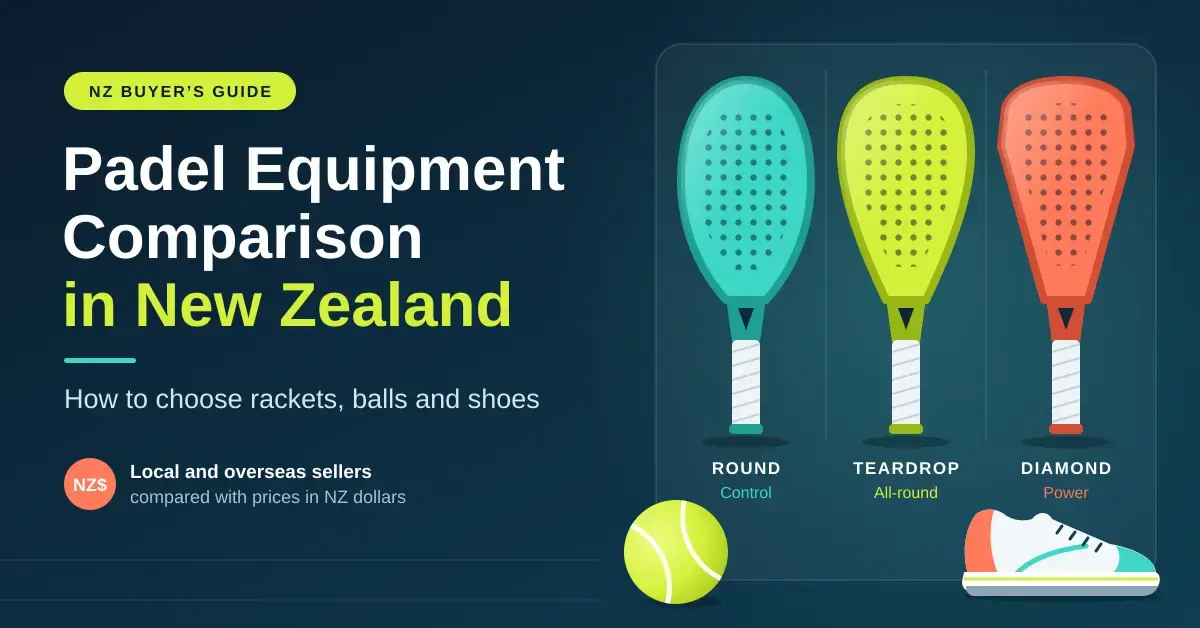
Racket shape controls where the sweet spot sits and how forgiving the racket is. There are three shapes, and each suits a different level of player:
- Round: the sweet spot sits near the centre of the face and is the largest of the three, giving the most control and the most forgiveness on off-centre hits. Round rackets have a low balance point (weight towards the handle) and are the standard recommendation for beginners and defensive players.
- Teardrop: a middle ground with a medium balance and a slightly higher sweet spot. It blends control and power, which makes it the popular all-round choice for improving and intermediate players.
- Diamond: the sweet spot sits high on the face and the balance is towards the head, producing the most power but the least forgiveness. Diamond rackets reward advanced, attacking players who consistently middle the ball, and punish beginners who do not.
Weight and balance
Adult padel rackets weigh roughly 350–385 grams, and that small range matters more than it looks. Heavier rackets deliver more power on smashes but tire the wrist and elbow faster, which raises the risk of overuse injury for newer players. As a rough guide:
- 355–365 g suits beginners, many women, and anyone with arm or elbow sensitivity.
- 365–375 g is the sweet spot for most intermediate club players.
- 375–385 g suits advanced and tournament players who swing fast and want maximum momentum.
Balance point works alongside shape: a head-heavy racket adds power but reduces manoeuvrability, while a handle-heavy racket is easier to whip into position for volleys near the net. Just as golfers benefit from matching gear to their swing through custom club fitting, padel players get the best results when racket shape, weight and balance are matched to their level rather than chosen on looks alone.
Padel Racket Comparison
| Racket shape | Balance | Sweet spot | Typical weight | Best suited to |
|---|---|---|---|---|
| Round | Low (towards the handle) | Large, central | 355–365 g | Beginners and defensive players wanting control and forgiveness |
| Teardrop | Medium | Medium, slightly higher | 365–375 g | Intermediate players wanting a balance of control and power |
| Diamond | High (towards the head) | Small, near the top | 375–385 g | Advanced, attacking players chasing maximum power |
Why padel balls are not tennis balls
Padel balls look almost identical to tennis balls but are made to a different specification, and using the wrong one changes how the game plays. The key difference is internal pressure: a new padel ball sits at around 11 psi, compared with roughly 14 psi for a tennis ball. That lower pressure makes a padel ball slightly softer and slower, which suits the shorter, enclosed court and the frequent rebounds off the glass walls.
Under the sport’s rules, a competition padel ball must measure between 6.35 cm and 6.77 cm in diameter, weigh between 56.0 g and 59.4 g, and bounce between 135 cm and 145 cm when dropped from 2.54 metres onto a hard surface. Balls approved by the International Padel Federation (FIP) meet these standards, which is why club and tournament play uses approved models rather than repurposed tennis balls.
In practice, balls lose pressure with use and start to feel dead after a few sessions, so most regular players buy them in three-ball tubes and rotate through them. When comparing prices, check the number of tubes in a listing rather than the headline figure — a cheap single tube can work out dearer per ball than a multi-tube pack.
Padel shoes: why standard trainers fall short
Padel shoes are built for constant sideways movement, which is exactly what running shoes and most general trainers are not designed for. Padel is played in a small, enclosed court with quick pivots, sudden stops and lateral lunges, so a proper padel shoe reinforces the sides of the foot and the midsole to keep you stable when you change direction fast.
The clearest visible difference is the sole. Most NZ courts use a sand-filled artificial turf, and padel shoes use one of two outsole patterns to grip it:
- Herringbone: a zigzag tread that grips well and still allows a controlled slide when you need it — the most common all-round choice.
- Omni (multi-stud): smaller, densely packed studs designed specifically for sand-filled surfaces, which shed trapped sand while holding traction.
Compared with tennis shoes, which emphasise heel stability for baseline running, padel shoes focus on midsole stability and reinforced sidewalls with a protective toe bumper for the rolling forces of quick turns. The same logic applies across racket and club sports — the reasoning behind choosing the right golf shoes for grip and stability carries directly over to why padel needs its own footwear rather than borrowed trainers.
Bags, grips and accessories
Beyond the big three, a handful of accessories round out a padel kit, and comparison platforms usually list them alongside rackets. A padel bag (a padelero) is longer and shallower than a tennis bag and often insulated to protect rackets from heat. Overgrips are inexpensive, wear out quickly and are worth buying in multipacks; they change how the handle feels and help absorb sweat. Wrist bands, a protective wrist cord for the racket, and spare balls complete most bags.
None of this is expensive individually, but it adds up, so it pays to compare bundles. The same habit that helps golfers build a sensible kit from a golf accessories guide applies to padel: buy the accessories you will actually use, and treat consumables like grips and balls as ongoing costs rather than one-off purchases.
Buying padel gear from overseas: GST, shipping and timing
Because local stock is limited, many New Zealand padel players buy from Australian or European retailers, and the total landed cost is what matters — not the sticker price. Since 1 December 2019, overseas suppliers selling low-value goods to New Zealand consumers must charge 15% GST at checkout on orders with a customs value up to NZ$1,000, so tax is usually already included in the price you pay online rather than collected at the border.
For orders above NZ$1,000, GST and any duty are generally collected by Customs or the courier before delivery, which can add unexpected cost and a short delay. Shipping time is the other variable: a European racket might be cheaper than a locally stocked one but arrive in two to three weeks, while an Australian seller may cost slightly more but land in days. A comparison platform that shows dispatch origin lets you make that trade-off deliberately.
If you would rather not wait or risk sizing, buying locally — or checking the second-hand equipment market for lightly used rackets — can be the better value once you factor in shipping and the hassle of returning gear that does not suit you.
Common mistakes when buying padel equipment
Most first-time buyers make the same handful of avoidable mistakes. Knowing them in advance saves money and prevents injury:
- Starting with a diamond racket: beginners drawn to “power” rackets often get less control and a higher error rate. A round racket teaches cleaner contact first.
- Buying too heavy: a racket a few grams too heavy is a common cause of wrist and elbow strain in new players.
- Using tennis balls or shoes: tennis balls play too fast and lively, and running shoes offer no lateral support on turf — a real ankle-roll risk.
- Ignoring the grip size and overgrip: a handle that is too thin or too worn hurts control; an inexpensive overgrip fixes it.
- Judging only on headline price: shipping, GST above the threshold, and the number of balls per pack all change the true cost.
- Skipping a demo: where a club offers loan rackets, trying two or three shapes before buying is the fastest way to learn what suits you.
Who each type of gear suits
The right kit depends on how often you play and how you play. A newcomer playing socially is best served by a round racket around 360 g, FIP-approved balls in a multi-tube pack, and entry-level padel shoes with a herringbone sole — a setup that maximises control and comfort while you learn. An improving club player who trains weekly benefits from stepping up to a teardrop racket in the 365–375 g range for more attacking options without losing much control. Committed and competitive players who consistently middle the ball are the audience for diamond rackets and heavier weights, matched with omni-sole shoes if their home court is sand-filled turf.
Padel’s growth in New Zealand makes this easier than it used to be. Pacific Padel and other operators are rolling out courts across Auckland — including indoor courts on the North Shore and clubs in Takapuna, St Johns and Remuera — with more nationwide, and the national body, Padel New Zealand, maintains a public directory of clubs where many offer loan rackets so you can try before you commit.
Sources
- International Padel Federation (FIP) — Padel Balls Approval
- LTA — Padel FAQs
- Playtomic — Padel Racket Shapes
- Tennis Warehouse — How to Choose a Padel Racket
- Wilson — Comparing Padel Shoes and Tennis Shoes
- Padel New Zealand — Find a Club
- Newstalk ZB — Padel Gains Traction in NZ
- DHL — New Zealand GST Regulations on Low-Value Imported Goods
Frequently Asked Questions
Do I need a padel-specific racket to start?
Yes. Padel rackets are solid, stringless and shaped to the sport’s rules, and no other racket — including a tennis or squash racket — is legal or practical for padel. You do not need an expensive one to begin; a well-chosen round, entry-level racket around 360 grams is ideal for learning control.
Can I use tennis balls for padel?
Not for proper play. Tennis balls run at a higher internal pressure, so they play faster and bounce livelier than padel balls, which throws off timing on a padel court. Use balls approved by the International Padel Federation, which are made to padel’s lower-pressure specification.
Are padel shoes really necessary, or will running shoes do?
Padel shoes are strongly recommended. Running shoes are built for forward motion and lack the lateral support and turf-specific grip that padel’s constant sideways movement demands, which raises the risk of slipping or rolling an ankle. Herringbone or omni soles are designed for the sand-filled surfaces most courts use.
Is it cheaper to buy padel gear locally or from overseas?
It depends on the item and the total landed cost. Overseas sellers can be cheaper on the sticker price, but you should add shipping and, on orders over NZ$1,000, any GST or duty collected at the border. Comparison platforms that show NZD prices and dispatch origin make it easier to judge the real cost against delivery time.
What should a beginner’s padel kit cost in New Zealand?
A sensible starter setup — an entry-level round racket, a tube or two of approved balls, a pair of padel shoes and a few overgrips — typically lands in the low-to-mid hundreds of dollars. Rackets span roughly NZ$60 to over NZ$500, so most of the variation comes from how much you spend on the racket itself.