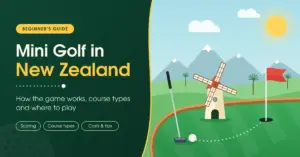
Mini golf is one of the easiest ways to enjoy the putting side of golf in New Zealand, and it asks for no experience, no membership and barely any equipment. This guide explains what mini golf is, where it came from, how scoring works, the main types of course you will meet here, what a round usually costs and how to play a little better. It is written for first-time players, families and casual groups rather than tournament competitors, and it links to more detailed city and venue guides wherever you want to dig deeper.
What mini golf actually is
Mini golf is a scaled-down form of golf that uses only the putter and only the putting stroke. Instead of long fairways, you play a short, obstacle-filled hole where the goal is simply to roll the ball into the cup in as few shots as possible. Because every hole is a putt, anyone who can tap a ball can play, which is exactly why it has such broad appeal.
You will see the activity under several names. “Minigolf” is the term the international sport body uses, while “miniature golf”, “putt-putt”, “crazy golf” and “adventure golf” are common commercial labels. They all describe the same core idea: putting through a creative course. The differences are in scale and theme rather than in the basic game.
What makes mini golf distinctive is the obstacle. Each hole is a small puzzle built from ramps, tunnels, windmills, water and banked walls, so success depends on reading angles and judging speed rather than on hitting the ball a long way. That shift from power to precision is why a nine-year-old and an adult can share a scorecard and both have a real chance of winning.
The contrast with the full sport is stark. A round of 18 holes on a championship layout such as Augusta National (Wikipedia) can take most of a day and a bag of fourteen clubs. Mini golf strips all of that away and keeps only the part most beginners enjoy first. If you later want to try the long game, our overview of golf in New Zealand is a good next step.
Key Points
- What it is: golf reduced to the putting stroke only — no long clubs, no experience needed.
- Scoring: count every stroke; lowest total wins, with most holes set at par two.
- Stroke limit: a six-stroke maximum per hole is standard, keeping play moving.
- Course styles: indoor bar, glow-in-the-dark, outdoor adventure and formal competition courses.
- Typical cost: about NZD 15–25 per adult for a round in New Zealand.
- Best skill to practise: pace control — most dropped shots come from hitting too hard.
A short history of mini golf
Mini golf is older than most people assume, and its roots are firmly in “proper” golf. In 1867 Old Tom Morris laid out a dedicated putting course, the Himalayas, for the St Andrews Ladies’ Golf Club in Scotland. It is widely regarded as the first course built purely for putting, and it is still played today.
The recognisably modern game took shape in the early twentieth century. The earliest documented miniature course, the “Gofstacle”, appeared in The Illustrated London News in June 1912. In the United States the idea accelerated: Thistle Dhu opened in Pinehurst, North Carolina, in 1916, and in 1922 Thomas McCullough Fairbairn developed a workable artificial green from cottonseed hulls, sand, oil and dye.
That artificial surface made courses cheap to build almost anywhere. In 1927 Garnet Carter patented his “Tom Thumb” course in Tennessee, and a nationwide craze followed, with rooftop courses appearing across New York City by the late 1920s. The boom collapsed during the Great Depression, but the game never disappeared, and today it spans everything from seaside holiday courses to serious competition circuits.
How a round of mini golf works
A round of mini golf follows a few simple rules that keep play fair and moving. You putt from a marked tee area, play the ball where it lies, and count every stroke until the ball drops into the cup. Lowest total score after all the holes wins.
Par and the stroke limit
Most mini golf holes carry a par of two, meaning a reasonably skilled player should hole out in two putts; longer or trickier holes may be set at par three or four. The single most important rule to know is the stroke limit. Under the rules of the World Minigolf Sport Federation, the global governing body, the maximum is six strokes per hole, after which you pick up and record the limit as your score. Many casual venues use a six or seven-stroke cap for exactly the same reason: it stops one hard hole from holding up everyone behind you.
Order of play and basic etiquette
The player furthest from the hole, or the one with the best score on the previous hole, usually goes first. If your ball blocks someone else’s line, you can mark and lift it. Keep the pace brisk, let faster groups through, and avoid standing on another player’s intended path. These are social courtesies rather than penalties, but they make a shared course far more enjoyable.
House rules vary slightly between venues, and a few are worth checking at the first tee. Some courses treat a ball knocked off the playing surface as a one-stroke replacement at the point it left, while others let you simply play on from where it settles. Many themed holes also include a “signature” shot — a ramp, a loop or a long bank — where a confident, well-paced putt can produce a hole-in-one. Spotting those opportunities early is how competitive players open up a lead.
The main types of mini golf course in New Zealand
New Zealand offers four broad styles of mini golf, and knowing them helps you pick the right outing. The style sets the atmosphere far more than the number of holes does.
Indoor themed and bar courses
Indoor themed courses combine putting with hospitality, often inside a licensed venue aimed at adults and after-work groups. Holes lean on pop-culture design, music and cocktails, and the whole experience is built around “competitive socialising” rather than scorecards. Auckland’s best-known example is Holey Moley in the Viaduct, a 27-hole venue at 204 Quay Street.
Glow-in-the-dark (blacklight) courses
Glow courses are played indoors under ultraviolet and neon lighting, so the obstacles, paths and sometimes the balls appear to glow. The low light adds a genuine challenge because distance and edges are harder to judge. Gloputt at 28 Barrys Point Road in Takapuna is Auckland’s long-running glow venue, with a 16-hole course and a climate-controlled, all-weather space popular for parties.
Outdoor adventure golf
Adventure golf is the larger, outdoor style, usually themed around pirates, jungles or fantasy and built with real water features, caves and bridges. Courses are bigger, the undulations are more natural, and a themed setting makes it a strong choice for families on a fine day. Treasure Island Adventure Golf, beside Butterfly Creek near Auckland Airport, runs two 18-hole pirate courses, while Lilliputt on Tāmaki Drive in Parnell offers 36 waterfront holes across Safari and T-Rex themed layouts.
Competition minigolf
Competition minigolf is the formal sport behind the casual game. The World Minigolf Sport Federation recognises standardised course types — concrete (Beton), Eternit, felt and a “Minigolf Open Standard” for everything else — so that results can be compared internationally. These precise, repeatable courses look very different from a themed holiday layout, and they reward consistency over spectacle.
Course Types Compared
| Course type | Setting | Example venue | Best for | Rough price (adult) |
|---|---|---|---|---|
| Indoor themed / bar | Indoor, licensed | Holey Moley, Viaduct | Adults, groups, date nights | NZD 25+ |
| Glow-in-the-dark | Indoor, UV-lit | Gloputt, Takapuna | Parties, all-weather fun | ~NZD 15 |
| Outdoor adventure | Outdoor, themed | Treasure Island, Māngere | Families, fine-day outings | NZD 18–25 |
| Waterfront family | Outdoor | Lilliputt, Tāmaki Drive | Families, 36 holes | NZD 18–25 |
| Competition minigolf | Standardised surfaces | WMF-approved courses | Serious / club players | Varies |
Where to play mini golf around New Zealand
Mini golf is available in every main New Zealand centre, with the widest choice in Auckland and a strong indoor scene in Christchurch. The two cities show how climate shapes the offering: Auckland mixes outdoor adventure courses with indoor bar venues, while Christchurch leans heavily on all-weather indoor courses.
In Auckland you can choose between the Viaduct bar courses, the Takapuna glow course, the airport-side pirate courses and the Parnell waterfront. For current opening hours, prices and booking details across the city, our dedicated guide to mini golf in Auckland keeps the venue-by-venue specifics up to date.
Christchurch’s scene is built around themed indoor venues such as Caddyshack, Alice in Putterland and Ferrymead Golf, plus outdoor options like Fillin’ Holes. If you are heading south, see our separate guide to mini golf in Christchurch for the full list.
Beyond the main centres, mini golf is a fixture of New Zealand’s holiday towns. Lakeside and coastal destinations such as Rotorua, Tauranga, Taupō and Queenstown have long run outdoor or themed courses aimed at visitors, and seaside resorts often add a putting course alongside other family attractions. If you are travelling, it is worth checking a local activity directory before you arrive, because smaller operators change their hours seasonally and some open only over summer.
What mini golf costs in New Zealand
A single round of mini golf in New Zealand typically costs between about NZD 15 and NZD 25 per adult, with children paying a few dollars less. Prices depend mostly on the style of venue rather than the number of holes.
As a practical guide to 2026 pricing:
- Outdoor and classic venues such as Gloputt sit at the lower end, around NZD 15 for an adult and NZD 11 for a child.
- Indoor bar courses are the most expensive, often NZD 25 or more per person once hospitality is factored in.
- Many venues offer a cheaper second round on the same visit, plus family passes bundling two adults and two children.
- Student and senior discounts are common with valid identification.
Because operators change their rates and packages regularly, treat these as indicative and confirm the current price with the venue or on the city guides above before you go.
How to play better: putting basics
You do not need lessons to improve at mini golf, but a few putting fundamentals make an immediate difference. The core skill is controlling pace, because distance control causes far more dropped shots than aim does.
- Keep a steady grip and posture. Hold the putter lightly, stand so the ball sits roughly under your eyes, and let your shoulders rock rather than flicking your wrists.
- Use bank shots deliberately. On angled or blocked holes, aim for a specific point on the wall and let the rebound carry the ball toward the cup instead of forcing a direct line.
- Read the surface early. Test the speed of the turf on the first hole and watch for slopes; the same stroke rolls very differently on fast felt and on worn outdoor carpet.
- Favour slightly firm over short. A ball that stops just past the hole still has a chance; one left short never does.
These habits are the same ones that help on a full course, which is why mini golf is such a good introduction to green reading and putting in the wider game.
Common mistakes to avoid
Most beginners lose shots to a handful of avoidable errors rather than to a lack of talent. Fixing these will do more for your score than any single tip.
- Hitting too hard. Blasting the ball sends it ricocheting off obstacles and often back toward you. Smooth, controlled pace wins mini golf.
- Ignoring the stroke limit. Chasing a difficult hole slows everyone down; take the maximum and move on.
- Standing in the line of play. Blocking a putting path or a photo moment is the quickest way to frustrate your group.
- Booking the wrong venue for the group. A late-night bar course is a poor fit for young children, just as a daytime family course misses the point for an adult celebration.
- Turning up unbooked at peak times. Popular indoor venues sell out on weekends and school holidays, so reserve a slot in advance.
Who mini golf suits
Mini golf suits almost everyone, but matching the venue to the occasion is what makes an outing memorable. The activity scales comfortably from toddlers to corporate teams because the barrier to entry is so low.
- Families: outdoor adventure and themed courses, where storytelling and props keep younger children engaged.
- Friends and date nights: indoor bar and glow courses, which pair putting with food, drinks and atmosphere.
- Corporate groups: larger venues offering marshalled tournaments, catering and private hire for team events.
- Aspiring golfers: any course, used as low-pressure practice for feel, pace and confidence around the hole.
Whatever the group, mini golf delivers an hour or so of shared, low-cost fun that needs no skill to start and rewards a little practice if you keep coming back.
Sources
- World Minigolf Sport Federation (WMF) — rules and course standards
- Gloputt Glow in the Dark Mini Golf, Takapuna — official site
- Holey Moley Golf Club — official site
- Lilliputt Mini Golf, Tāmaki Drive — official site
- Treasure Island Adventure Golf, Auckland — venue listing
- New Zealand Mini Golf — course directory
- Tourism New Zealand — Auckland mini golf listings
Frequently Asked Questions (FAQ)
Is mini golf the same as miniature golf and putt-putt?
Yes. Mini golf, miniature golf, minigolf, putt-putt, crazy golf and adventure golf all describe the same putting-based game. The names mostly reflect marketing and course style rather than any real difference in how you play.
How many strokes are you allowed on a mini golf hole?
Competition rules under the World Minigolf Sport Federation set a maximum of six strokes per hole, after which you record the limit and move on. Casual venues often apply a six or seven-stroke cap for the same reason, which is to keep play moving.
How long does a round of mini golf take?
A group of four usually completes an 18-hole course in about 45 to 60 minutes. Smaller courses of 9 to 16 holes are quicker, while busy weekends and larger groups can add waiting time at each tee.
Do I need to bring my own equipment?
No. Venues supply putters in a range of lengths and provide the balls, so you only need to turn up. Comfortable, flat shoes are the one thing worth wearing, since you will be on your feet for the whole round.
Can mini golf help my real golf game?
It can help the short game in particular. Mini golf builds feel for pace, aim and reading a surface, which are the same skills that lower scores on the putting green, even though it does not develop the full swing.